Download the Applications



How Red Sea Global plans to prove a 30% net conservation gain by 2040
فئة: عمل
مشاركة
الأرشيف
إعجاب
RIYADH: Sustainability commitments are easy to announce. The harder test for tourism developers might be proving that nature is measurably better off once a development's own impacts have been counted.
Saleh Maghrabi, a marine environmental consultant and sustainability expert, told Arab News that building and conserving can go hand in hand, but only on one condition.
'With coral reefs, mangroves and seagrass, development and conservation can exist alongside each other, but only if the environmental impacts of development are fully accounted for,' he said.
A gain should count, he added, only if it is genuine, can be measured, lasts over time, and goes beyond what nature would have achieved anyway without conservation work.
One developer that has built a target around that idea is Red Sea Global, which is developing the Red Sea and AMAALA destinations.
Ahmed Al-Ansari, head of Red Sea Zone Environmental Protection and Regeneration, told Arab News: 'RSG's ambition is to achieve a 30 percent Net Conservation Gain by 2040, meaning that the ecological condition or abundance of the environments and species within our conservation framework should demonstrate a measurable improvement compared with the established baseline.'
Red Sea Global is the developer behind ambitious regenerative tourism projects, both globally and locally.
In practice, he said, RSG tracks changes in species numbers, the condition of ecosystems and the size of habitats, comparing them with the baseline.
According to Al-Ansari, the net figure also has to account for the damage caused by building and running the destinations, which must be assessed and offset.
He said the key pressures include added strain on coasts and seas, pollution and poorer environmental quality, and the impact of more visitors. 'Loss or disturbance of habitat associated with construction and infrastructure. Wildlife disturbance from human activity, vessels, lighting, or noise,' he added. DID YOU KNOW?
The developer monitors about 32,000 sq. km across its Red Sea and Amaala destinations.
Its SIIG framework targets conservation gains across 7,000 sq. km of marine ecosystems.
Marine baseline surveys began in 2020, while terrestrial surveys were conducted between 2023 and 2025.
'The 30 percent ambition is therefore about demonstrating measurable improvement in nature rather than simply counting individual conservation activities,' he said. To track progress, RSG uses a method it calls SIIG, short for Survey, Identify, Intervene and Gain: it surveys conditions, decides where action will do the most good, acts, and then measures the result. Its baseline surveys began at sea in 2020 and on land between 2023 and 2025, with the findings gathered in reports published in 2022, 2023 and 2025.
RSG monitors and manages about 32,000 sq. km across the two destinations, beyond the footprint of its hotels and other developed sites.
'This landscape-scale approach is important because ecosystems do not follow the boundaries of individual resorts,' Alansari said.
For now, SIIG targets gains across 7,000 sq. km of marine ecosystems within that area, and work is underway to extend it to land.
Beyond the model
Maghrabi said: 'My view is that a 30 percent net conservation gain is certainly ambitious, but it is not unrealistic. The important question is how that 30 percent will ultimately be measured and demonstrated in the field.'
For him, that means separating what a model predicts from what the ecosystem shows over the years.
'Modelling is valuable for setting targets and testing scenarios, but it cannot by itself demonstrate ecological success. A model can show a credible pathway toward 30 percent; ultimately, the ecosystem itself has to show that the target has been achieved,' he said.
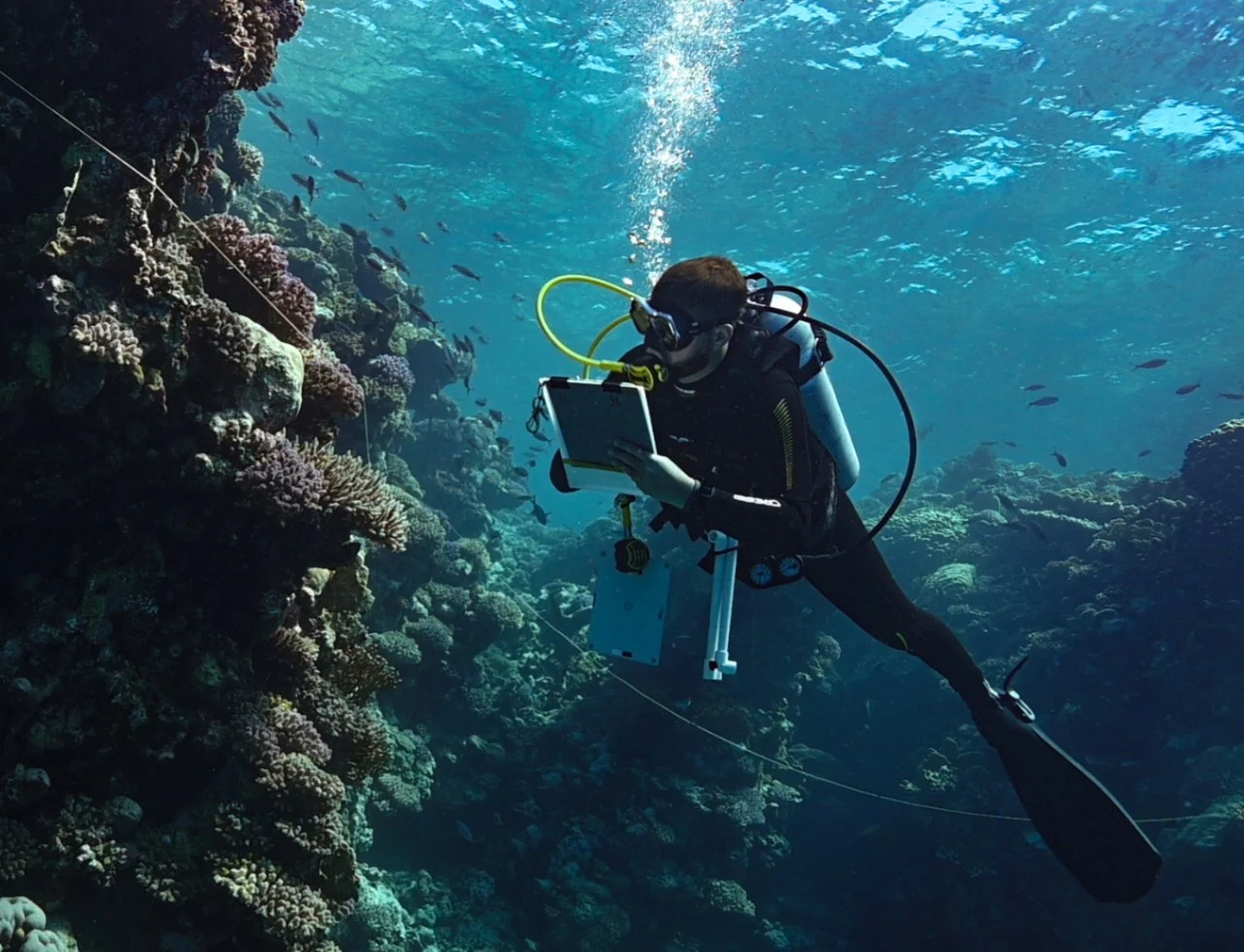
On reefs, coral cover and the survival of relocated corals tell only part of the story, he said. He would also look at whether young corals settle naturally, how the reef is built up, the variety of species, bleaching and disease, fish life and how well the reef works as a whole.
Mangroves are similar. 'The number of seedlings planted is not enough to demonstrate success,' he said.
What matters, he explained, is whether the young trees survive, whether new growth appears on its own, and whether working habitat rich in wildlife takes shape over the years. For seagrass, he would track how much ground the meadows cover, how dense and healthy they are, and how well they function.
Who keeps score
For Maghrabi, credible monitoring needs a clear starting point, the same surveys repeated over many years, comparison sites, open methods and access to the raw ecological data. Naturally dolphin-shaped Shura Island is the hub of Red Sea Global's The Red Sea destination and a showcase for regenerative tourism. (Instagram / @visitredsea)
'I would also like to see periodic review by scientists or institutions independent of the developer, with results made available for external scientific scrutiny,' he said.
Alansari said: 'The environmental protection and regeneration team monitors environmental performance through its internal environmental experts, supported by specialist technical partners and, where relevant, external research and academic institutions.'
Publishing peer-reviewed research, he added, opens RSG's methods and findings to outside checking.
Asked whether RSG would publish results every year until 2040, including years when they fall short, Alansari said evidence that a measure is failing feeds into later decisions and corrective steps.
'Rather than treating 2040 as a single end-point assessment, RSG is building the capability to track environmental change and adapt its approach throughout the journey toward the target,' he said. Coral cover and the survival of relocated corals tell only part of the story. (RSG)
On what would change if progress stalls, Alansari said: 'If monitoring indicates that ecological outcomes are not progressing as expected, the evidence can therefore inform changes to conservation measures and destination management.
'The specific response would depend on what science identifies as the cause of the pressure. Potential interventions could involve strengthening habitat protection or restoration, changing how particular areas are managed, adjusting operations, or introducing additional measures to reduce specific environmental pressures.'
He said it would be unscientific to decide now that steps such as limiting visitors or widening restricted zones would be needed in every case. 'The intervention should respond to the ecological evidence,' he added.
Alansari added that RSG has opened up its approach to others: 'We have made the framework publicly available so that its principles can be examined, challenged and potentially applied by others seeking to move beyond minimizing environmental harm toward delivering measurable gains for nature.'
For Maghrabi, the 2040 verdict should rest less on how many restoration projects were completed than on whether the evidence shows nature genuinely better off than at the start and than it would otherwise have been, once the full impact of development has been counted.
ملاحظة حول ملفات تعريف الارتباط
يستخدم نيوزهنت ملفات تعريف ارتباط ضرورية لإبقائك مسجلاً للدخول ولتذكر لغتك ودولتك، حتى يعمل الموقع كما تتوقع. بإذنك، نود أيضاً استخدام ملفات تعريف ارتباط تحليلية لفهم كيفية استخدام الأشخاص لنيوزهنت وتحسينه بمرور الوقت.
الموافقة تؤثر فقط على التحليلات. لمعرفة المزيد، اطّلع على سياسة الخصوصية or الشروط والأحكام.
(0)تعليقات