Download the Applications



NASA scientist Margaret Hamilton dies at 90 after helping Apollo astronauts reach the moon
فئة: تكنولوجيا العلوم
مشاركة
الأرشيف
إعجاب
In 1969, minutes before Neil Armstrong and Buzz Aldrin became the first people to touch down on the moon, warnings flashed on one of Apollo 11's onboard computers.
'Program alarm,' Armstrong radioed to Mission Control in Houston. 'It's a 1202. What is it?'
To thousands of engineers, scientists and technicians on Earth and to the two astronauts on board, that code meant nothing but stress and trouble. Margaret Hamilton had led the team that programmed that alarm code, one of 29 alarms that could be triggered as the lunar module Eagle landed on the moon.
'They were the never-supposed-to-happen alarms,' Ms. Hamilton told the Wall Street Journal in 2019. 'I was in a state of shock. How could this be happening now just before the landing? I'm thinking: Oh my God, this is not real.'
During those tense seconds, NASA's Mission Control considered whether it was time to abort the landing. Yet the alarm was signaling that Ms. Hamilton, then 32, had done her job perfectly: The error message indicated that the computer was overloaded and was dumping low-priority tasks to focus on flight safety. Trusting Ms. Hamilton's software, Mission Control gave the go-ahead to proceed. The Eagle was able to land - with only enough fuel for an estimated 30 seconds of flight.
'Our astronauts didn't have much time, but thankfully, they had Margaret Hamilton,' President Barack Obama said in 2016, awarding her the Presidential Medal of Freedom for overseeing the team that developed Apollo's onboard flight software.
Ms. Hamilton, he added, 'symbolises the generation of unsung women who helped send humankind into space. … Her example speaks of the American spirit of discovery that exists in every little girl and little boy who know that somehow, to look beyond the heavens is to look deep within ourselves and to figure out just what is possible.'
Ms. Hamilton, who was credited with coining the term 'software engineer' while working on the Apollo program, died Sept. 30 at age 90, at a hospital in Cambridge, Massachusetts. The cause was multiple organ failure, said her daughter, Lauren Hamilton.
A trailblazing computer scientist, Ms. Hamilton developed early computer software that helped pave the way for the digital world as we know it today.
'This is not somebody just dotting Is and crossing Ts,' Deborah G. Douglas, curator of science and technology at the MIT Museum, told the Boston Globe in 2016. 'Margaret Hamilton is at the vanguard of people really obsessed with making sure that computer programs work right - that they don't contain errors, that they do exactly what they're going to do, and when a crisis happens that they don't get overwhelmed.'
Ms. Hamilton started learning about computers in 1959, working at MIT under Edward Lorenz, a meteorologist who went on to lay the groundwork for chaos theory. Just a few years later, she was writing code for one of the largest computers ever made, a hulking 250-ton machine that served as the brains of a Cold War-era defense system known as the Semi-Automatic Ground Environment, or SAGE.
Through that job, in 1964, she became the first programmer hired for the Apollo project at MIT, and the first female programmer in the Apollo project altogether. Within a year, she was leading her own team at the MIT Instrumentation Laboratory.
'Because software was a mystery, a black box, upper management gave us total freedom and trust,' she later told MIT News. 'We had to find a way and we did.'
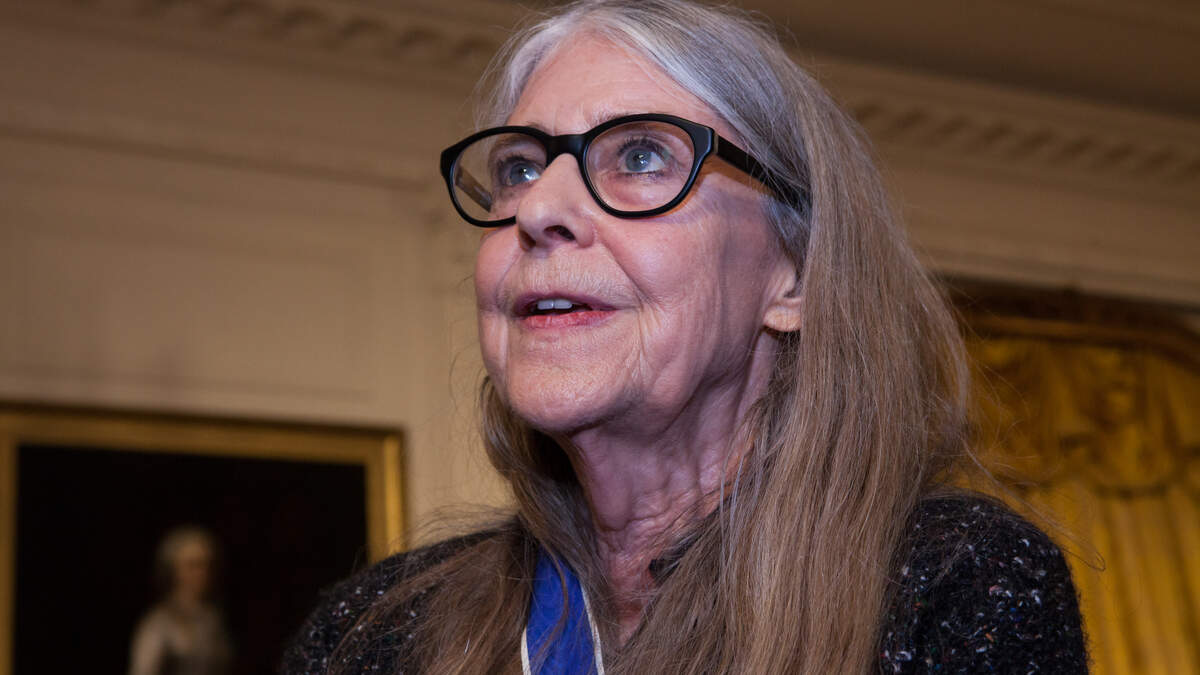
President Barack Obama awarded the Presidential Medal of Freedom to Margaret H. Hamilton, a pioneering computer scientist and former head of the Software Engineering Division of MIT's Instrumentation Laboratory who led the development of on-board flight software for NASA's Apollo moon missions. (Photo by Cheriss May/NurPhoto via Getty Images) © NurPhoto via Getty Images
Ms. Hamilton was the lead developer for the software that powered the Apollo guidance computer, which weighed 70 pounds but had only 72 kilobytes of memory, a fraction of today's smartphones. Her software played a key role in the success of six voyages to the moon between 1969 and 1972, and later contributed to the development of Skylab, America's first space station.
'Her work allowed a remarkably complex spacecraft to operate reliably in a truly unprecedented and unpredictable environment,' Brian C. Odom, NASA's chief historian, said of her contributions to Apollo.
As she worked on the Apollo computers, Ms. Hamilton began calling herself a software engineer, a new term intended to convey the complexity and value of her work.
'It was an ongoing joke for a long time,' she told the Guardian in 2019, referring to the way that her colleagues would dismiss the importance of software. 'Then one day in a meeting, one of the most respected hardware gurus explained to everyone that he agreed with me. The process of building software should also be considered an engineering discipline.'
Working many nights and weekends meant that Ms. Hamilton often brought her young daughter to the lab. One day, Lauren pressed a button that made a flight simulator crash while she was 'playing astronaut.' Ms. Hamilton realized that an astronaut might make the same mistake, and she programmed the software to have an alarm that would sound when the computer was overloaded.
'Astronauts' lives were at stake,' she told the Guardian. 'Our software needed to be ultrareliable, and it needed to be able to detect an error and recover from it at any time during the mission.'
Though she was part of a relatively small group of women working for NASA at that time, Ms. Hamilton said that she didn't realize the severity of her office's gender imbalance until she saw the office dynamic in 'Mad Men' many years later.
'When I first came to Apollo, there were no other women writing software. Then within a couple of years there would be a few - and I did have some working for me - but not many,' she told the Guardian. 'There were always many more men.'
The eldest of four children, Margaret Elaine Heafield was born in Paoli, Indiana, on Aug. 17, 1936, and grew up in Michigan's Upper Peninsula. Her mother was a high school teacher, and her father was a college professor of philosophy and English.
Ms. Hamilton studied maths at the University of Michigan before transferring to Earlham College in Indiana, where she received a bachelor's degree in 1958. She soon married James Cox Hamilton and moved to Massachusetts, where her husband enrolled in law school at Harvard while Ms. Hamilton took a job at MIT to pay the bills.
Though she planned to pursue a PhD in maths once her husband was working and making money, she changed her mind when he showed her a newspaper ad from the MIT Instrumentation Laboratory, which was looking for software developers to help 'send man to the moon.'
'I was attracted both by the sheer idea and the fact that it had never been done before,' she recalled.
At that time, computer code was written on thick paper cards with punched-out holes, which software engineers would check before sending them along to a Raytheon factory. There, a workforce of mostly women would weave copper wires and magnetic cores into long 'ropes' that would store the binary code. The wire went through the tiny magnetic core when it represented a one, and it went around the core when it represented a zero. Ms. Hamilton, who became known as the 'rope mother,' reviewed the software code before the core ropes were made, ensuring that they had no errors.
In 1972, she left MIT to start her own software and technology companies, which pioneered the development of a software architecture, Universal Systems Language, intended to help engineers design more dependable, error-free systems.
Ms. Hamilton's first marriage ended in divorce, as did her second, to fellow Apollo engineer Dan Lickly. In the late 1970s, she met Ron Hackler, a jazz musician who had a passion for math and became her partner in both life and business. He died in 2025.
In addition to her daughter, survivors include two brothers and a sister; two grandsons; and four great-grandchildren.
In 2017, Lego released a set of figurines honoring four pioneering women of NASA: Nancy Grace Roman, the agency's first chief of astronomy; Sally Ride, the first American woman in space; Mae Jemison, the first African American woman in space; and Ms. Hamilton, who often encouraged younger scientists to plunge into the unknown.
'Don't let fear get in the way, and don't be afraid to say 'I don't know' or 'I don't understand' - no question is a dumb question,' she advised in 2019. 'And don't always listen to the so-called experts!'
ملاحظة حول ملفات تعريف الارتباط
يستخدم نيوزهنت ملفات تعريف ارتباط ضرورية لإبقائك مسجلاً للدخول ولتذكر لغتك ودولتك، حتى يعمل الموقع كما تتوقع. بإذنك، نود أيضاً استخدام ملفات تعريف ارتباط تحليلية لفهم كيفية استخدام الأشخاص لنيوزهنت وتحسينه بمرور الوقت.
الموافقة تؤثر فقط على التحليلات. لمعرفة المزيد، اطّلع على سياسة الخصوصية or الشروط والأحكام.
(0)تعليقات