


Georgia scientists begin tracking elusive male sea turtles
Categoría: SciTech
Compartir
Archivo
Me gusta
This story also appeared in Georgia Public Broadcasting
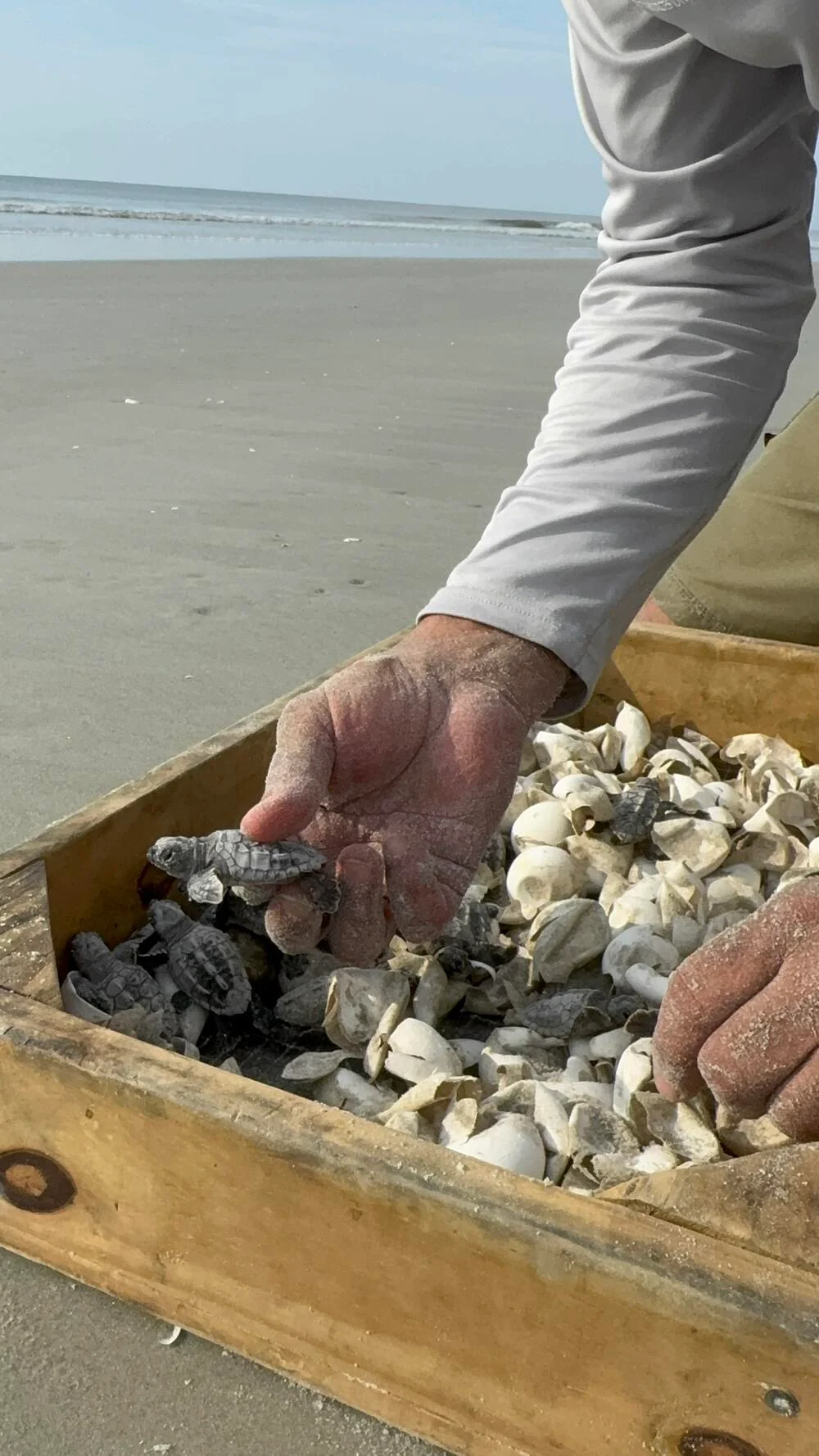
Hatching season is a marathon for state sea turtle coordinator Mark Dodd, who runs barefoot between Sapelo Island's 300 or so sea turtle nests on a hot July morning.
As Dodd does for many of Georgia's barrier islands, he performs the usual tasks: He records the number of eggs hatched, logs the number of dead hatchlings left behind, and collects an egg sample that would later yield the mother's DNA.
But this year, he takes something else.
Digging through damp sand smelling of salted rotten egg, he unearths a dead hatchling and snips a corner of one of its fins. Then, he puts the sample in a test tube, among others that will soon be sent to a lab.
It's Georgia's first attempt at tracking the long-elusive male sea turtle population.
'The big concern is are we producing enough males?' Dodd said.
The invisible man
Through persistent tracking, Dodd and the Georgia Department of Natural Resources (DNR) have witnessed the recovery of the formerly faltering loggerhead sea turtles.
Since comprehensive surveys across all of Georgia's barrier islands began nearly four decades ago in 1989 at 675 nests, sea turtle nest numbers have increased annually by 3% to 4%, reaching about 4,000 this year. That's good news, and a record-high for Georgia.
As for tracking the number of adults, the DNR has relied on female numbers.
The DNR has routinely plucked one egg from each nest to extract the female DNA who laid those eggs. In the last decade, between 500 and about 1,000 distinct females have come to nest on Georgia's coast every year, once they reach sexual maturity at around 30 years old, according to the DNR's data.
Males, however, have remained a mystery. After leaving the coast as hatchlings, scientists like Dodd don't know where they go.
'We don't know enough about the males to include them,' Dodd said.
Warming sands shift sex ratios
So far, DNR's female-only model has been enough for the state to confirm a healthy population.
But as summers grow hotter in Coastal Georgia, that model may no longer be sufficient. Dodd's daily summer runs on the beach seem unusually hot this year, he says. That matters, when the sex of turtle hatchlings depends on the surrounding temperatures.
As is for sea turtles' other cold-blooded relatives, like crocodiles and freshwater turtles, hotter ground surface temperatures where reptiles often lay their eggs will likely yield female hatchlings.
As demonstrated by one study on Australia's Raine Island, where most of the world's green sea turtles nest, 99% of hatchlings turned out female due to warming temperatures. That could be a problem for Georgia's recovering turtle population.
'Obviously, we have to have enough males around to mate with your females to sustain this recovery that we're seeing,' Dodd said. But despite the nesting success, a shifting sex ratio could change that trajectory.
The nuclear solution
After Dodd collects the eggs and snipped fins, he hands them over to University of Georgia senior research scientist Brian Shamblin.
Using a new nuclear DNA method of extraction — which was once more costly and inefficient — Shamblin can extract all the potential sperm DNA in that yolk from males who have attempted to fertilize the egg — or who Dodd calls 'the losers' of the race to propagate.
That sperm DNA provides a broad sense of how many males mated with that female. Then, using the flipper DNA, Shamblin can figure out which male ended up as the father.
'We're just excited because there's so many questions and now, we have hopefully an efficient way to get at some of them,' Shamblin said.
One of those questions he hopes to answer is where the males and females meet-ups occur — a mystery among many that has stumped scientists like him.
However, it will take years to paint a coherent picture of the male sea turtle.
This story comes to The Current GA through a reporting partnership with GPB News, a non-profit newsroom covering the state of Georgia.
Una nota sobre las cookies
Newshunt utiliza cookies esenciales para mantener tu sesión iniciada y recordar tu idioma y país, para que el sitio funcione como esperas. Con tu permiso, también nos gustaría utilizar cookies de análisis para comprender cómo las personas utilizan Newshunt y mejorarlo con el tiempo.
Aceptar solo afecta a las cookies de análisis. Para obtener más información, consulta nuestra Política de privacidad or Términos y condiciones.
(0)Comentarios