


US and German scientists win Nobel medicine prize for work on light and brain
Categoría: SciTech
Compartir
Archivo
Me gusta
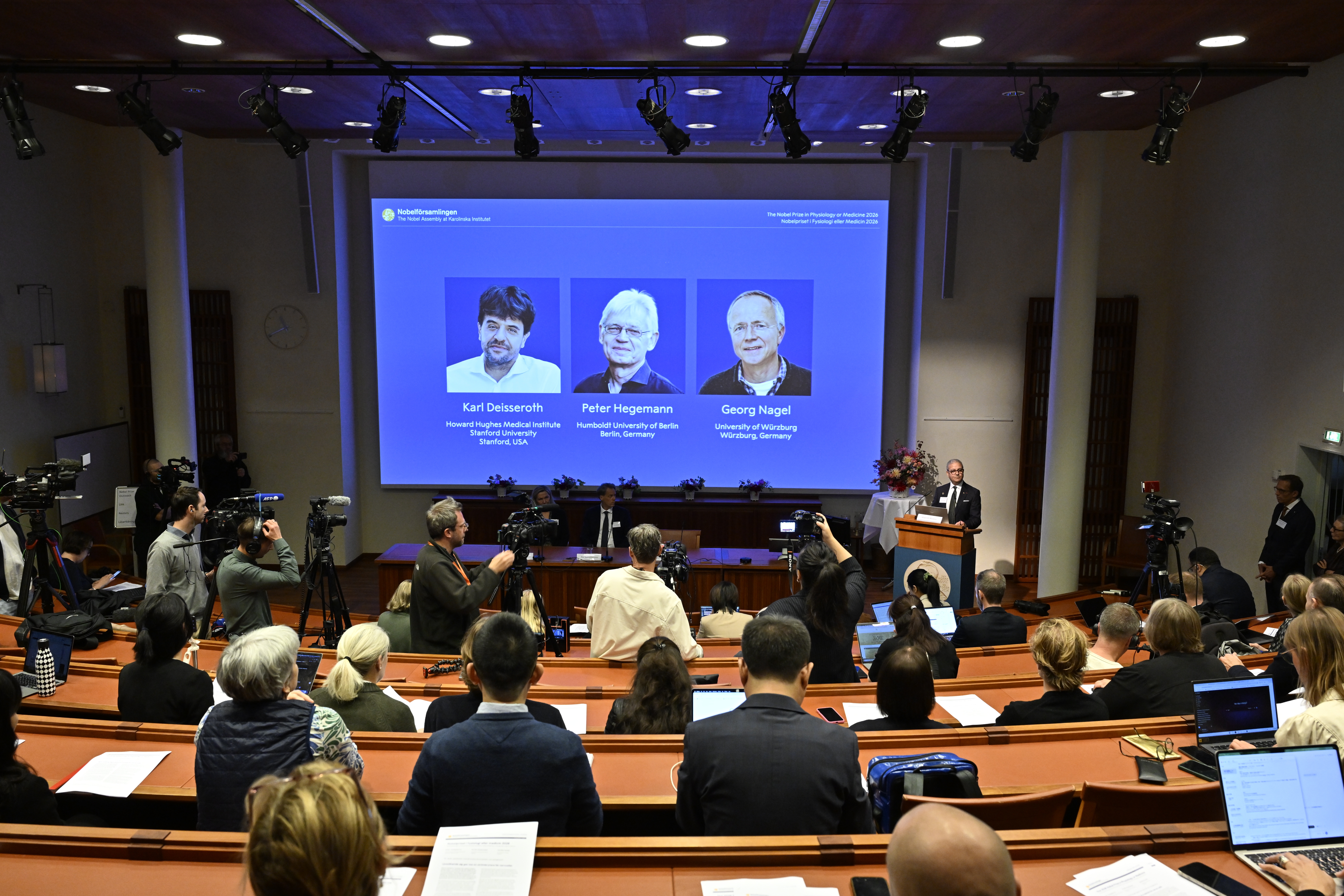
STOCKHOLM: American Karl Deisseroth and Germans Peter Hegemann and Georg Nagel won the 2026 Nobel Prize in Physiology or Medicine on Monday for developing optogenetics, a technique that uses light to control individual nerve cells in the brain.
The Nobel Assembly of Sweden's Karolinska Institutet said Deisseroth, 54; Hegemann, 71; and Nagel, 73, had been selected for their 'discoveries concerning light-gated ion channels and optogenetics.'
'This method makes it possible to switch on, or off, the activity of individual nerve cells in a living brain,' said Thomas Perlmann, Secretary-General of the Nobel Assembly at Karolinska Institutet.
Anna Wedell, a professor in genetics and a member of the Nobel Committee for Physiology or Medicine, said a new era in neuroscience had opened but it was only the beginning.
'For the first time we can actually start to understand how the brain processes information and how different neurons interact across the brain,' she said.
The trio will share a prize sum of 12 million Swedish crowns ($1.2 million). Announcements will follow in the coming days on this year's Nobel physics, chemistry, literature, peace and economics prizes, with the winner or winners of the 2026 Nobel Peace Prize to be announced on Friday.
Deisseroth said he was still awake in the early hours when he was called from Stockholm.
'I was not yet asleep, being a night owl, and now I don't think I'll be able to sleep for quite a while,' he said.
Hegemann said he was overwhelmed at getting a call from a number he recognized to be in Sweden: 'It's unbelievable when you get this message.'
Nagel said he was sitting on a terrace 'in a nice little village outside Naples' when the call came through.
'I actually thought it would not happen, but some other people always told me this will happen,' Nagel said.
Breakthrough from algae
Deisseroth was training to become a neurosurgeon when he encountered patients he could not help at a psychiatric clinic. That encounter – witnessing suffering he had no tools to treat – prompted a career-defining question: Why does the brain work so differently in different people?
The answer would come from an unexpected place: an alga, and two German scientists driven by equally simple curiosity.
Hegemann, fascinated by exploration and unknown territory, began investigating in the early 1990s how the alga Chlamydomonas reacts to light in half a millizecond.
He hypothesized that a single protein both captured light and acted as an ion channel, and contacted Nagel to ask him to test it.
'This was a good chance to do something new and exciting,' Nagel said of the original call from Hegemann, which resulted in him injecting Chlamydomonas genes into frog eggs and discovering channelrhodopsin-2, a light-sensitive ion channel.
In 2003, Nagel and Hegemann published findings showing the protein could be introduced into human cells to generate electrical impulses using light. Deisseroth showed the technique in rat nerve cells in 2005, and the method was named optogenetics in 2006.
One scientist at Hegemann's Max Planck Institute in Frankfurt in 2007 recalled researchers taping optical fibers salvaged from Christmas decorations to microscopes.
'We didn't really know how it worked, we didn't really have any tools,' said Dima Kuzmin, a neurochemist at the time. 'And it was massively exciting.'
Treatments under development
The three laureates' research is now providing insights about brain disorders. Animal models are being used to understand schizophrenia, Alzheimer's disease, Parkinson's disease, epilepsy and addiction – conditions that affect millions of people worldwide and have limited treatment options.
Deisseroth used optogenetics to control the movements of mouse whiskers by activating specific nerve cells in the motor cortex. He also used light to wake sleeping mice, confirming that specific nerve cells control wakefulness.
'There are mouse models of dementia, epilepsy, addiction,' Wedell said. 'By understanding which cells are active in these diseases in mice, we can understand where to look in humans.'
Researchers are also applying the technique to try to restore vision to people blinded by retinitis pigmentosa, a progressive eye disease, by inserting a light-sensitive protein into the retina. They also hope optogenetics could improve cochlear implants, potentially allowing more precise stimulation of the auditory nerve than current electrical devices.
'When you think about it in the retina, all patients need to do is open their eyes and you have the light,' said Paul Bresge, CEO of US biotechnology company Ray Therapeutics, which is developing a therapy to treat retinitis pigmentosa. 'So it makes a lot of sense as a potential therapy.'
The most advanced of the treatments are autism spectrum disorder therapy by a US-based biotech company MapLight, co-founded by Deisseroth, and a vision restoration medicine for retinitis pigmentosa by Nanoscope, also based in the United States, though both are still some way from reaching patients.
Manuel Valero, researcher at Barcelona-based Hospital del Mar, where he heads the Neural Computation Laboratory, said optogenetics had 'allowed us to push the boundaries between science and science fiction.'
'In laboratory animals, we have managed to control emotions, create false memories or even recover lost memories in models of Alzheimer's disease,' Valero said. 'Perhaps the great promise it has yet to fulfil is precisely one of its founding promises: its ability to treat diseases of the human brain.'
Each laureate's path reflected their distinct character. Hegemann developed an early fascination with exploration, viewing scientific research as charting unknown territory.
Nagel had worked as a teacher, opened a cafe and taken up hang gliding as a hobby. The suffering witnessed by Deisseroth at the psychiatric clinic drove him to seek deeper understanding of the brain through research rather than clinical practice alone.
Una nota sobre las cookies
Newshunt utiliza cookies esenciales para mantener tu sesión iniciada y recordar tu idioma y país, para que el sitio funcione como esperas. Con tu permiso, también nos gustaría utilizar cookies de análisis para comprender cómo las personas utilizan Newshunt y mejorarlo con el tiempo.
Aceptar solo afecta a las cookies de análisis. Para obtener más información, consulta nuestra Política de privacidad or Términos y condiciones.
(0)Comentarios