Download the Applications



Ecotourists drive long-running sea turtle research on Wassaw Island
Catégorie: Technologie scientifique
Partager
Archive
J’aime
For more than 50 years, researchers and volunteers have walked Wassaw Island's beaches at night, documenting the loggerhead sea turtles that come ashore to lay eggs.
The Caretta Research Project began monitoring sea turtles on Wassaw Island in 1973, when loggerhead populations were declining, and nests along Georgia's coast had little protection. More than five decades later, nesting numbers have risen substantially. In 2026, the Georgia Coast recorded a record number of loggerheads nesting: 4,292. Of those, 377 were found on Wassaw Island, a national wildlife refuge in Chatham County.
Kris Williams Carroll, director of the Caretta Research Project, removes a protective screen from a loggerhead sea turtle nest on Wassaw Island on July 18, 2026.
Credit: Justin Taylor/The Current GA/CatchLight/Report for America
The project's decades of tagging and nesting data help researchers track individual turtles, see how Georgia's loggerhead population is changing, and contribute to research across the Southeast.
Near the end of nesting season, The Current GA joined Caretta Research Project Director Kris Williams Carroll and eight others for an overnight trip to Wassaw to see how the work was done.
At left, one of two buildings used by the Caretta Research Project on Wassaw Island. The building serves as a meeting space, kitchen, laboratory and bunk room. Right, Kris Williams Carroll, director of the Caretta Research Project, collects a biopsy sample from a partially developed loggerhead hatchling during a nest excavation on Wassaw Island on July 18, 2026. The DNA sample helps researchers better understand the nesting and reproductive traits of loggerhead sea turtles.
Credit: Justin Taylor/The Current GA/CatchLight/Report for America
Around 6 p.m., staff and six volunteers gathered at the small cabin that served as the project's base of operations and received a briefing on the night ahead.
They dressed in long pants, long-sleeve shirts, and face coverings to protect against the island's mosquitoes.
Throughout nesting season, crews work through the night, heading to the beach around sunset and returning near sunrise. They sleep during the day before gathering again for dinner.
'If there's any nesting going on, then we're up all night long every night,' Carroll said.
Around 8 p.m., as the sun began to set, the group split into two teams. One headed north. The other headed south.
Together, they patrolled about 7 miles of undeveloped beach, looking for tracks in the sand and signs of female sea turtles emerging from the Atlantic to nest near the dunes.
Before darkness settled over the beach, Williams' team stopped to excavate nests that had hatched several days earlier.
BECOME A CARETTA VOLUNTEER Caretta Research Project offers volunteers a week of hands-on sea turtle research and conservation guided by professionals. The project welcomes everyone older than 15 years old to participate on their own. People 13 or 14 years old may participate under certain conditions. Cost: Fees for the 2027 season have not yet been set. Last year the fees ranged from $975 to $1,200, with early registration costing more. The fees cover rustic accommodation and all meals on the island, plus boat transportation to and from Wassaw. How to sign up: Registration dates for the 2027 season will be set in early December. See Caretta's website for more information. Each week of the sea turtle season (Sat-Sat; May-August) has 6 spaces for participants, reserved and filled on a first-call, first-pay basis.
Researchers excavate each nest three days after it hatches and inventory what remains beneath the sand, including empty shells, unhatched eggs, hatchlings that did not survive, and stragglers still trying to emerge.
The information helped determine the hatching success and could be linked to the female that laid it.
'That is the best way to get a reproductive history for each nesting turtle,' Carroll said.
Williams knelt in the sand, removed the protective screen covering the nest and began pulling its contents out by hand.
Kris Williams Carroll, director of the Caretta Research Project, excavates a loggerhead sea turtle nest as The Current's environment reporter Mary Landers helps record data on Wassaw Island on July 18, 2026. Researchers collect DNA samples and document hatched and unhatched eggs to better understand the turtles' reproductive traits.
Credit: Justin Taylor/The Current GA/CatchLight/Report for America
Researchers also collected samples for genetic studies that help identify individual females and determine whether turtles return to Wassaw or nested on other barrier islands.
DNA from dead embryos and hatchlings is also used to learn more about adult male turtles, which researchers don't encounter during nesting surveys.
'We only see females and hatchlings,' Carroll said. 'So anything that we can learn about the males, how many males there are out there, how many females they reproduce with every year, those kinds of questions, that's all new to us.'
A team of biologists and volunteers with the Caretta Research Project excavates a recently hatched loggerhead sea turtle nest on Wassaw Island on July 18, 2026. During nesting season, teams stay on the island for a week at a time, working from sundown to sunrise to survey nesting turtles and their hatchlings.
Credit: Justin Taylor/The Current GA/CatchLight/Report for America
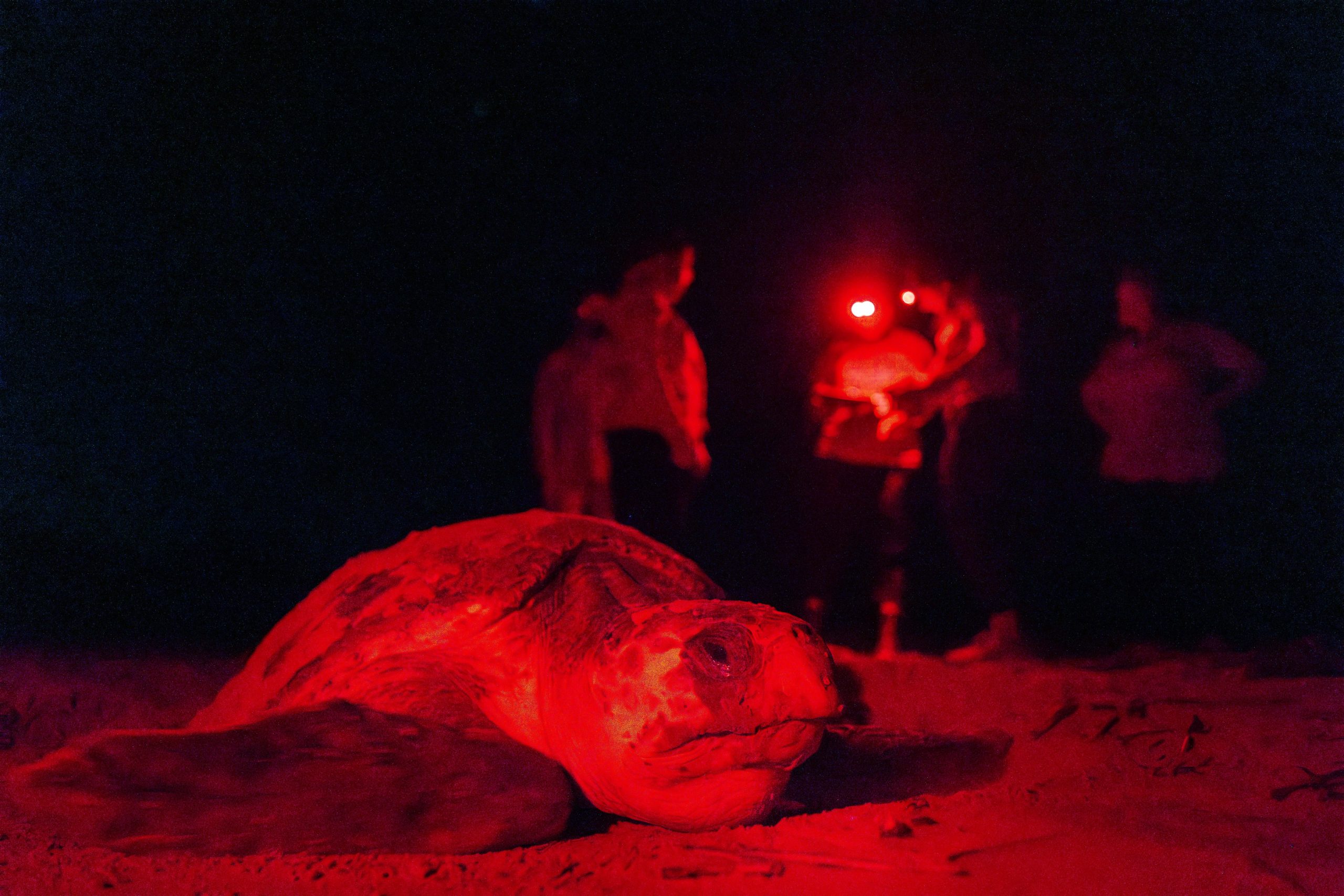
Once the last daylight disappeared, the crews switched to red lights to avoid disturbing the turtles and continued along the shoreline, watching for fresh tracks leading out of the surf.
A team of biologists and volunteers with the Caretta Research Project patrols Wassaw Island's 7 miles of beach in search of nesting loggerhead sea turtles on July 18, 2026. The team uses utility vehicles with modified headlights designed to avoid disturbing nesting turtles.
Credit: Justin Taylor/The Current GA/CatchLight/Report for America
Around 10:30 p.m., the southern team found the first nesting turtle of the night.
Researchers measured the loggerhead and checked for identifying tags. Some turtles carry a metal tag on their flippers and a PIT tag, a small microchip used to identify them when encountered again.
A team of biologists and volunteers with the Caretta Research Project measures a loggerhead sea turtle and documents its health as it lays eggs on Wassaw Island on July 18, 2026. Once egg-laying begins, the turtle enters a trance-like state and is undisturbed by the team's presence.
Credit: Justin Taylor/The Current GA/CatchLight/Report for America
The crew also documents injuries, including shark bites and propeller wounds, and collects small biopsy samples for nutrition and genetics studies.
Some nesting loggerheads in the project's records have been returning to Wassaw for decades. One, known as Old Faithful, was first tagged in 1986 and returned in 2025. Another turtle encountered this year was first tagged in 1995.
Carroll said researchers have documented females reproducing for at least 40 years, though much remains unknown about how long loggerheads stay reproductively active.
Around 11:45 p.m., a second turtle emerged from the ocean and headed toward a dune to nest.
Volunteer Marin Cox uses calipers to measure the head of a nesting loggerhead sea turtle on Wassaw Island on July 18, 2026. Researchers take measurements from each turtle to track its health from year to year.
Credit: Justin Taylor/The Current GA/CatchLight/Report for America
Researchers gathered around her under red light, recorded measurements, collected a DNA sample and tagged the turtle.
Carroll said the project encounters about 85% of the females that nest on Wassaw. They miss some because of high tides, storms, mechanical problems, or, on busy nights, simply too many turtles coming ashore at once. This year, Williams and her team evacuated the island for three days due to smoke from wildfires on the island.
Around 2 a.m., Carroll and her team returned to the Turtle House for coffee, food and a short break.
Kris Williams Carroll, director of the Caretta Research Project, logs DNA samples collected from loggerhead sea turtle nests on Wassaw Island on July 19, 2026. The samples are sent to a University of Georgia laboratory for testing.
Credit: Justin Taylor/The Current GA/CatchLight/Report for America
Volunteer Gina McCullough and biologist Jadyn Sethna document data collected from a nesting loggerhead sea turtle on Wassaw Island on July 18, 2026.
Credit: Justin Taylor/The Current GA/CatchLight/Report for America
They logged data collected during the first half of the night before continuing, while another group excavated nests.
Carroll said nesting on Wassaw began to increase significantly around 2010. Loggerheads can take 25 to 35 years to reach sexual maturity, so many of the turtles returning to Georgia's beaches in 2026 belonged to generations that benefited from conservation efforts begun decades earlier.
'All of the islands on the coast have been protecting nests since 1989,' Carroll said. 'Now we're really seeing all of these increases due to the conservation efforts of all of those early biologists, early conservationists.'
Carroll joined the project in 1996 and has watched generations of turtles and participants pass through Wassaw. Some have returned for decades.
Volunteer Gina McCullough of Maryland read about the Caretta Research Project in National Geographic decades ago and did her first stint on the island in 2014. She's been back every year since then. 'The first turtle I ever saw, I cried; I can remember that scene like it was yesterday. I remember sobbing,' she said. 'It was significantly moving to me. I knelt next to her and saw her pupils, and it was like you are in there.'
Biologist Jadyn Sethna measures the shell of a nesting loggerhead sea turtle as it lays eggs on Wassaw Island on July 18, 2026.
Credit: Justin Taylor/The Current GA/CatchLight/Report for America
Heather Baiman of New York first volunteered in the 1990s for three summers. That was before the project used UTVs.
'We walked the beaches all night then,' she said, a little wistfully.
She returned this year after her pet Chinese box turtle, Charette, died.
'It made me think of all the turtle things in my head,' Baiman said.
Others began as volunteers, became interns, and went on to careers in biology, conservation, and environmental education.
Biologist Spencer Haltom uses a headlamp to inspect nonviable loggerhead sea turtle eggs found during a nest excavation on Wassaw Island on July 19, 2026.
Credit: Justin Taylor/The Current GA/CatchLight/Report for America
That's the case with both staffers this night. Caretta's lead biologist Jadyn Sethna is in the doctoral program at the University of North Carolina studying how turtles use the earth's magnetic field to navigate. Research assistant Spencer Haltom, a graduate student at the University of Central Florida, studies the barnacles, algae, worms and crabs that attach themselves to sea turtles.
'It's like they're hitching a ride on the best taxi ever,' he said. 'They move around with the turtles as they're nesting.'
For Carroll, the people are as integral to the project's legacy as the turtles themselves.
'I think all conservation work is important,' Carroll said. 'We've got to preserve. We've got to preserve what we have, and to teach the next generation to be conservationists and to kind of foster that love of the outdoors and nature – that's really what's going to save it. That's what's important.'
The project runs for 17 weeks each year, from May through early September. Participants range from teenagers to retirees, hailing from all 50 states and seven countries.
'The only common thread is that they love turtles,' Carroll said. 'They care, and they want to help.'
By 4 a.m., both teams were together again on the beach. The search continued while another group excavated nests.
Volunteer Gina McCullough watches as two loggerhead hatchlings race toward the surf after emerging from their nest on Wassaw Island on July 18, 2026.
Credit: Justin Taylor/The Current GA/CatchLight/Report for America
Twenty live loggerhead hatchlings found during a nest excavation are placed in a bag for transport to the water before being released on Wassaw Island on July 18, 2026. Hatchlings can become trapped in the roots of sea oats growing in the island's dunes.
Credit: Justin Taylor/The Current GA/CatchLight/Report for America
A team of biologists and volunteers with the Caretta Research Project excavates a recently hatched loggerhead sea turtle nest on Wassaw Island on July 19, 2026.
Credit: Justin Taylor/The Current GA/CatchLight/Report for America
Two loggerhead hatchlings race toward the surf after emerging from their nest on Wassaw Island on July 18, 2026.
Credit: Justin Taylor/The Current GA/CatchLight/Report for America
Around 6 a.m., the first light appeared over the Atlantic. After about 10 hours on the beach, the crews called it a night and headed back toward the Turtle House.
Sunrise over the Atlantic Ocean.
Credit: Justin Taylor/The Current GA/CatchLight/Report for America
The Current GA's environment reporter Mary Landers contributed to this article.
À propos des cookies
Newshunt utilise des cookies essentiels pour vous garder connecté et mémoriser votre langue et votre pays, afin que le site fonctionne comme prévu. Avec votre permission, nous aimerions également utiliser des cookies analytiques pour comprendre comment les utilisateurs utilisent Newshunt et l'améliorer au fil du temps.
Accepter n'affecte que les analyses. Pour en savoir plus, consultez notre Politique de confidentialité or Conditions générales.
(0)Commentaires