Download the Applications



Teachers' Day: What my students taught me
Catégorie: Divertissement
Partager
Archive
J’aime
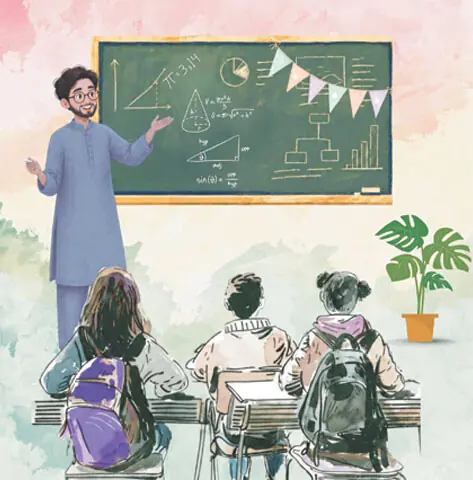
Illustration by Gazein Khan
Have you ever asked your parents about their teachers? Do they miss them? Or what is it that they cannot forget about them? Chances are they will pour their hearts out, sharing many good memories and moments they wish they could go back and relive.
This is a relationship that goes far beyond explanation, built on trust, love and respect. After our parents, teachers are the closest people to us, and they take on the responsibility of shaping our lives. That is why, even when we grow old, we still remember our teachers.
I always admired many of my teachers: the way they showed up and the way they made difficult concepts feel easy. No matter how many times my friends or I made faces or said we didn't understand, they found a way to teach us.
So, growing up, I dreamt of becoming a teacher. I often heard people say, 'Teaching is a hectic job; you will be frustrated.' But I still chose teaching because I remembered the smiling faces of my teachers. The strength and calmness in their personalities left a mark on my mind.
Teachers may enter a classroom thinking they heve knowledge to share, but they may leave with lessons of their own. Here, one teacher reflects on the unexpected things students taught her
But little did I know that my first two experiences of teaching would change the way I thought about the profession. What I believed teaching to be was not what it actually was. It deserved more respect and honour than I had given it.
My career as a teacher began with teaching adults at home and children at school. The two experiences could not have been more different. With the children, my biggest problem was getting them to sit down, pay attention and do the work. With the adults, I had expected them to understand things easily because they were adults, but it was the opposite. They had not had much schooling and did not know even the basics. So I had to slow down my teaching method to a point where I had to start almost from the beginning, without making them feel bad about it.
That was when I learnt something I had never really thought about before: teaching is not just knowing something and explaining it to someone — you have to first understand the person sitting in front of you.
It was a strange experience for me because I had started with a preconceived notion of what my students were, and then I found out that the reality was completely different. So I quickly learnt not to assume that an older student automatically understands things easily. An adult may know many things that a child does not in general terms, but that does not mean they have every basic skill needed for learning a particular lesson or subject.
Sometimes a person has managed to get through years of life while carrying a gap in their learning. They may have found ways around it, memorised things, or simply avoided situations where that gap became obvious. And when you finally have to teach that missing piece, you cannot rush through it just because the person is an adult. You have to teach and explain to them as you would to children in a class.
Illustration by Gazein Khan
Keeping the fun alive
Then there were the children. Childhood is all about fun and light stuff. And every teacher knows that kids always have much more interesting things to do than sit and study.
Kids can turn a simple instruction into a joke. They can start talking about something completely unrelated in the middle of a lesson. They can suddenly become very interested in a pencil, an eraser or something happening outside the window. Sounds familiar?
Most of the time, there was always that one thing more important to them than the lesson. This frustrates most teachers and it frustrated me too! But then, we have to work around it and make children understand that the work has to be done and they cannot spend the whole lesson fooling around.
And then the real job begins: to find a way to get our students interested in learning. We try hard to make them realise there are things they must prioritise at this age while still keeping their fun alive.
Sometimes that meant making the work feel like a game. Sometimes it meant giving them a small challenge. Sometimes it was enough to let them talk for a few minutes before bringing them back to the lesson. And sometimes, it meant having a lot more patience than I thought I had.
What I learnt from my students
My journey as a teacher was full of learning, and my students would have a lot to say about me. But today, as a teacher, I would like to speak on behalf of most teachers: it is not only that we teach and you learn. We also learn from you and you teach us too.
Yes, we learn that there is no simple formula for teaching. We learn different ways of teaching, not just from books, but by being with you, observing you and bonding with you. Some students understand something as soon as it is explained. Others may need five examples or may understand the example but not the rule behind it.
However, the most challenging ones to teach are those who don't ask questions and don't show whether they understood or not. This is where we, as teachers, have to keep changing too.
Noticing this sounds simple, but it can become a real challenge when you are sitting with a student who has been looking at the same question for five minutes. Then I had to look for the causes: why the child was not paying attention or why they couldn't do it.
As a teacher, I was equipped with knowledge of the subject, the lessons, the extra content and many other things I wanted my students to learn. But soon I realised that I was not only the one giving, I was also receiving from them. And the first thing I received was patience. They didn't ask me questions, but their expressions told me they hadn't understood, so I explained again and again. There was frustration, but I reminded myself that they were just kids looking up to me as a role model.
On the other hand, my adult students taught me that being an adult does not mean a person will understand things quickly. Sometimes they also needed to go back to the basics, and there is nothing wrong with that.
It was difficult for an adult to admit that they did not know something. A child can simply say, 'I don't understand.' But an adult may feel embarrassed saying the same thing, especially when they think they are supposed to know it already. And this time, as a teacher, I had to understand that their silence was not a lack of interest; it was fear of being judged.
So I learnt to make the space feel safe. I would explain gently, never show surprise at a basic question and let them know that it is perfectly fine to start from the beginning. After all, they were my students.
So my students changed the way I look at learning. They made me more patient, more observant and a little less quick to assume I know what each student needs. And one of the surprising things about teaching is that you walk into a class thinking you are there to give someone something, and you leave with something of your own.
A student-teacher relationship is not one person giving and the other receiving. It is two people slowly learning from each other, often without either of them noticing. Students learn from a teacher's lectures, knowledge and patience; and teachers learn from a student's questions and sometimes from their silence. We may forget the lessons with time, but we do not forget how a teacher made us feel, and a teacher never forgets the faces of the students who taught them something.
So this Teachers' Day, if you are a student, thank your teacher. And if you are a teacher, thank your students, because in the end, we were teaching each other all along.
Published in Dawn, Young World, October 3rd, 2026
À propos des cookies
Newshunt utilise des cookies essentiels pour vous garder connecté et mémoriser votre langue et votre pays, afin que le site fonctionne comme prévu. Avec votre permission, nous aimerions également utiliser des cookies analytiques pour comprendre comment les utilisateurs utilisent Newshunt et l'améliorer au fil du temps.
Accepter n'affecte que les analyses. Pour en savoir plus, consultez notre Politique de confidentialité or Conditions générales.
(0)Commentaires