


The future of Saudi architecture may lie in its past
श्रेणी: SciTech
साझा गर्नुहोस्
अभिलेख
मनपर्यो
JEDDAH: Across Saudi Arabia, skylines are rising, masterplans are taking shape and technology is becoming increasingly embedded in the way cities are designed. But amid the pace of change, architects are grappling with a question that is as cultural as it is technical: What should the future of Saudi architecture look like, and what parts of the past must travel with it?
That question ran through discussions at Effat University's Fifth International Architecture & Design Conference and Expo, where researchers, practitioners and students from around the world gathered under the theme 'From Desert Heritage to Global Legacy.'
While the event showcased emerging technologies and cutting-edge research, many conversations returned to a surprisingly simple idea: The future may have as much to learn from traditional desert settlements as it does from artificial intelligence.
Dimitra Kanellopoulou of ENSA Paris-Malaquais in France said the debate extends far beyond Saudi Arabia.
'It's a topic that multiple universities in Europe also have as a debate. I think this is a very important point for the conference, this bridge between heritage, the future and identity,' she said.
For Kanellopoulou, technology and tradition are not competing forces. Architects, she said, should embrace new tools while remaining attentive to the lessons embedded in vernacular architecture and generations of knowledge about living in challenging climates.
'As architects, we cannot close our eyes to technology because we have things today that we didn't have in the past that make life easier. But what we cannot import, and what we should not forget, is the intelligence of vernacular architecture, the way people have learned to live in desert conditions and how this knowledge has been passed from generation to generation.'
That balance between innovation and human experience also emerged in conversations about artificial intelligence, one of the conference's dominant themes. The beauty of 'rawashin' designs add a special character to traditional buildings in Al-Wajh and in coastal towns. (File/SPA)
Dr. Tarek Rakha, co-founder and CEO of Lamarr.AI and associate professor of architecture at the Georgia Institute of Technology, argued that AI's greatest value may lie behind the scenes, helping professionals process data, monitor construction and improve efficiency.
'My keynote specifically focused on when to embrace and resist AI in the built world. My argument was that there are a lot of severe benefits for the use of AI in specific parts of the industry in the built environment,' he said.
'That includes things like automating data ingestion or understanding and monitoring construction. But there is an opportunity for us to be critical about how to think about AI and design specifically.'
Rakha warned, however, that architecture risks losing something essential when creativity is outsourced to machines.
'We should be making an effort to resist AI when it comes to design practices and how we can be more in touch with our humanity rather than focusing on how to make things faster, cheaper and more accurate when indeed they are not really of that kind of quality,' he said.
Kanellopoulou echoed that concern, arguing that the most valuable contributions architects make cannot be generated by algorithms. Understanding communities requires observation, empathy and lived experience, she said.
'The plus value of human beings is being able to arrive in an unknown place, spend time with its inhabitants, gather knowledge from multiple countries and cities, and articulate that knowledge to propose something that does not already exist on the internet,' she said.
The discussion resonated strongly in a country where architecture is becoming one of the most visible expressions of transformation under Vision 2030. Across the Kingdom, planners are designing new districts, cultural destinations and urban environments while also seeking ways to preserve local identity.
For Dr. Asmaa Ibrahim, professor and dean of Effat College of Architecture and Design, the conference theme reflected a long-term view of heritage itself.
'The conference's theme is about 'From Desert Heritage to Global Legacy,' which means we want to build the legacy of what we are doing now to be heritage for tomorrow,' she said.
'And that is why we care about not only looking into the past and learning from the past, but also how to be innovative enough in order to build things currently for our next generations to consider it as heritage.'
Since the conference launched in 2017, it has grown into an international platform, attracting 122 research papers this year from about 25 countries and 198 authors.
But Ibrahim said its success is reflected not only in publication numbers. The event has also become a meeting point for researchers, universities and academic partners, helping create collaborations that extend well beyond the conference halls.
That emphasis on connection was visible throughout the program. Alongside research presentations and panel discussions, students exhibited almost 200 projects, placing emerging designers in direct conversation with academics and industry professionals.
Associate Prof. Dr. Tamer El-Serafi, head of the Architecture Department at Effat College of Architecture and Design, said the conference was designed to connect Saudi Arabia's architectural heritage with the ambitions driving the Kingdom's future development.
One example was the Musallah Hackathon 2026, which challenged students to rethink roadside prayer spaces. More than 220 students from 13 universities joined interdisciplinary teams that combined architecture, interior design and product design to reimagine a familiar feature of everyday life.
'The Musalla Hackathon is a very important event that engages undergraduate students from the three disciplines: architecture, interior design and product design, from all over Saudi Arabia in one design challenge,' El-Serafi said.
'The point of this hackathon is to engage them in a different experience than what they used to do in their studies.'
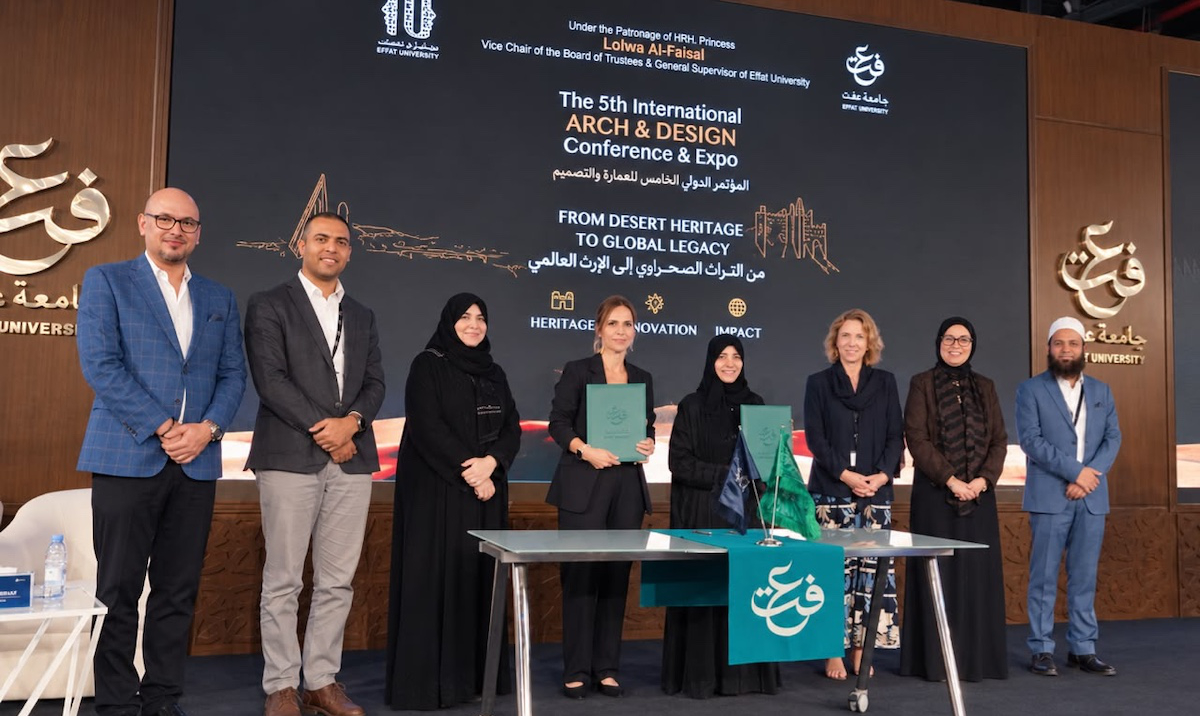
The conference also looked beyond architecture. On its opening day, Effat University signed a memorandum of understanding with Cours Florent, the French performing arts and cinema school represented in the Middle East by Galileo Global Education.
For Amandine Bebi, the partnership reflects another aspect of Saudi Arabia's transformation: The rapid growth of its creative industries.
'Our goal is to help Effat University develop skills in acting because they have a department in cinema, but it's mostly technical skills. So, we can bring our background and teaching skills in acting and performing arts through workshops and exchanges with students and faculty, and potentially develop joint degrees and projects,' she said.
As Saudi cities continue to evolve, the conversations at Effat suggested that the challenge facing architects is not simply how to build faster or taller; it is how to ensure that the buildings, spaces and communities taking shape today remain recognizably rooted in the culture, climate and human experiences that define the Kingdom, even as they point toward its future.
कुकीहरू बारे जानकारी
Newshunt ले तपाईंलाई साइन इन राख्न र तपाईंको भाषा र देश सम्झन आवश्यक कुकीहरू प्रयोग गर्दछ, ताकि साइट तपाईंले अपेक्षा गरेअनुसार काम गरोस्। तपाईंको अनुमतिमा, हामी Newshunt लाई मानिसहरूले कसरी प्रयोग गर्छन् भन्ने बुझ्न र समयसँगै सुधार्न एनालिटिक्स कुकीहरू पनि प्रयोग गर्न चाहन्छौं।
स्वीकार गर्नाले एनालिटिक्समा मात्र असर पार्छ। थप जान्नका लागि, हाम्रो हेर्नुहोस् गोपनीयता नीति or नियम र शर्तहरू.
(0)टिप्पणीहरू