


1,000-year-old skeleton found inside Roman coffin at Westminster Abbey finally identified
Категория: SciTech
Поделиться
Архив
Нравится
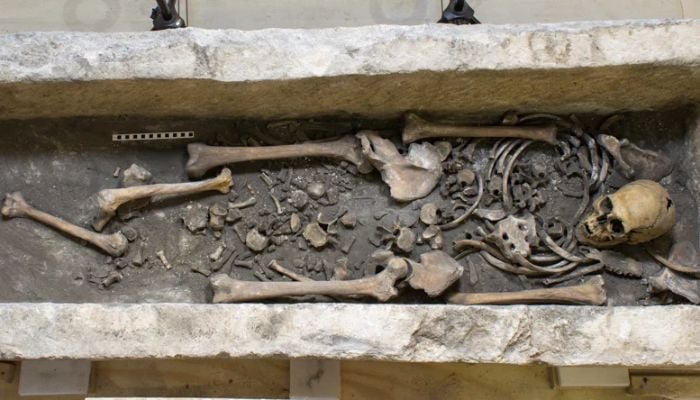
A mysterious skeleton discovered inside a Roman-era coffin at London's Westminster Abbey has finally been linked to a medieval religious leader, more than 150 years after its discovery.
Archaeologists believe the remains most likely belong to Ælfwig, an abbot who died around 1020, although another religious leader remains a possible candidate.
The stone coffin was discovered in 1869, but its unusual appearance left researchers puzzled for generations.
Interestingly, the sarcophagus carried a Roman inscription dating back to the fourth century, while its lid featured a Christian cross carved several centuries later.
But why was a medieval monk buried in a coffin originally made for a Roman?
According to a study published in the Journal of the British Archaeological Association, the coffin was reused during the Anglo-Saxon period, with its lid modified to accommodate a Christian burial.
The original inscription identified a wealthy Roman named Valerius Amandinus, whose sons had commissioned the tomb.
Researchers made a surprising discovery in 2016 when they opened the coffin for conservation and found an almost complete skeleton inside, despite earlier assumptions that the bones had been lost.
Radiocarbon testing dated the remains to between 987 and 1052.
Further examination revealed that the man was between 35 and 49 years old and approximately five feet nine inches tall.
Professor Warwick Rodwell, Westminster Abbey's consulting archaeologist, narrowed the possible identities to Ælfwig and his successor Wulfnoth, who died in 1049.
Ælfwig is considered the stronger candidate because he had already served as a monk at Westminster.
However, the identification is not definitive.
Примечание о файлах cookie
Newshunt использует необходимые файлы cookie, чтобы вы оставались авторизованными и чтобы запоминать ваш язык и страну, благодаря чему сайт работает так, как вы ожидаете. С вашего разрешения мы также хотели бы использовать аналитические файлы cookie, чтобы понимать, как люди используют Newshunt, и со временем улучшать его.
Принятие влияет только на аналитику. Подробнее см. в нашей Политике конфиденциальности or Условиях использования.
(0)Комментарии