


At UN, PM Shehbaz Sharif urges Middle East peace, warns India against weaponizing water
分类: Politics
分享
归档
点赞
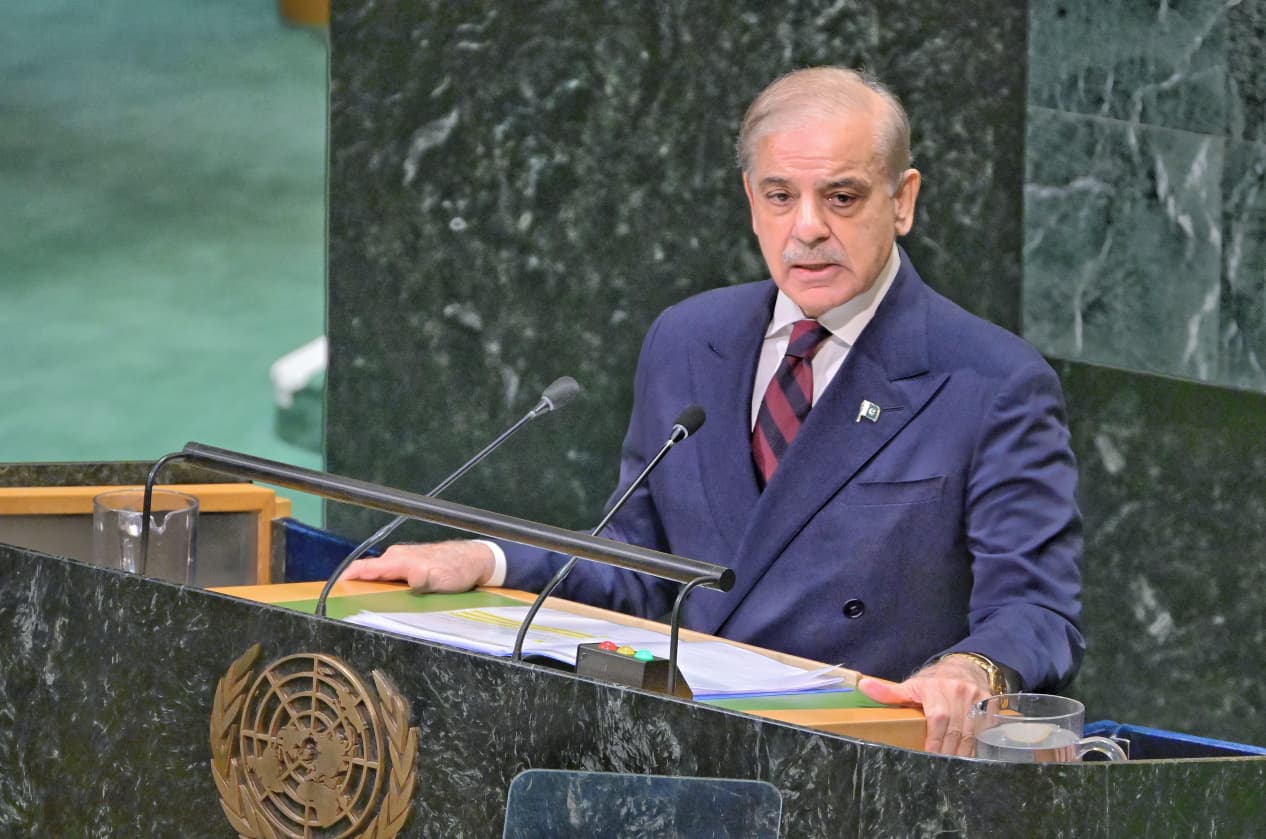
UNITED NATIONS, Sept 25 (APP):Prime Minister Muhammad Shehbaz Sharif on Friday called for renewed diplomacy to end escalating conflicts in the Middle East while warning India that any attempt to stop, impede or divert Pakistan's share of river waters would be treated as an act of war.
Addressing the General Debate of the 81st session of the United Nations General Assembly, the prime minister urged a world fractured by war, occupation and mistrust to rediscover the courage of diplomacy, declaring that Pakistan had chosen dialogue over confrontation, cooperation over coercion and peace over war.
'We live at a dangerous moment. But our future is certainly not predetermined,' he told leaders of the 193-member body.
'War is a choice. Peace is also a choice. And sometimes, the greater courage lies not in starting a war, but in preventing one,' he said. 'Pakistan has made its choice. We have chosen dialogue over confrontation. We have chosen cooperation over coercion. We have chosen peace over war.'
Speaking under the session's theme, 'Restoring Trust, Managing Transformation: A United Nations That Delivers for All,' Shehbaz Sharif presented Pakistan's position on conflicts in the Middle East, Palestine and Jammu and Kashmir, tensions with India, terrorism emanating from Afghanistan, climate change, economic inequality, debt distress and reform of the United Nations.
He opened his address with traditional salutations and a verse from the Holy Quran on peace, followed by Quaid-e-Azam Muhammad Ali Jinnah's declaration of Pakistan's steadfast support for the UN Charter.
Turning to the escalating conflicts in the Middle East, Shehbaz Sharif said diplomacy must not be drowned out by the sounds of war.
'Amid the roar of missiles, drones and guns, the voices for diplomacy must echo even louder,' he said.
The prime minister said Pakistan had moved swiftly after the outbreak of the regional conflict to help bring Washington and Tehran to the negotiating table in Islamabad, ultimately leading to the signing of the Islamabad Memorandum of Understanding.
He praised Deputy Prime Minister and Foreign Minister Ishaq Dar and Chief of Army Staff Field Marshal Syed Asim Munir for their efforts to create space for diplomacy under exceptionally difficult circumstances.
Calling the Strait of Hormuz and Bab el-Mandeb vital arteries of the global economy, he said they must remain open as passages connecting nations rather than becoming flashpoints of confrontation.
'These waters must carry the promise of prosperity, not the perils of war,' he said.
Shehbaz Sharif strongly condemned recent Houthi attacks against Saudi Arabia, particularly what he described as an attempted strike on the holy city of Makkah.
'Any threat to the safety and sanctity of the Haramain Sharifain is a red line that must never be crossed,' he said, reaffirming Pakistan's solidarity with Saudi Arabia.
Referring to the Makkah Joint Defence Agreement among Pakistan, Saudi Arabia and Türkiye, the prime minister said the alliance was not directed against any country but represented a collective commitment to regional defence, stability and peace.
On South Asia, Shehbaz Sharif recalled last year's conflict between Pakistan and India, saying Pakistan had exercised its inherent right to self-defense and that its armed forces, led by Field Marshal Syed Asim Munir, had responded with precision and professionalism.
'They silenced the enemy, repulsed its attacks and taught it a lesson it shall never, ever forget,' he said.
The prime minister praised US President Donald Trump, saying his 'resolute and visionary' intervention at a critical moment had helped prevent a potentially catastrophic confrontation between the two nuclear-armed neighbors and saved hundreds of millions of lives.
Shehbaz Sharif told the General Assembly that lasting peace in South Asia remained inseparable from a just settlement of the Jammu and Kashmir dispute.
He said the Kashmiri people had waited for decades for the United Nations to fulfil its commitment to a free and impartial plebiscite. He accused India of arbitrary detentions, extrajudicial killings, enforced disappearances, sexual violence, and collective punishment in Indian Illegally Occupied Jammu and Kashmir.
He also accused New Delhi of attempting to alter the disputed territory's legal status and demographic character through unilateral measures.
'Helpless Kashmiri mothers and fathers yearn for their sons and daughters who never return,' Shehbaz Sharif said. 'Their homes lie silent, under curfew and in deep grief. For many, there is no closure — only a lifetime spent searching for graves that bear no names.'
He reaffirmed Pakistan's diplomatic, political and moral support for the Kashmiri people until they attained their inalienable right to self-determination.
Turning to water security, the prime minister strongly opposed the weaponization of water and described the Indus River system as the 'lifeblood' of Pakistan and the wider region.
He said India's unilateral decision to hold the Indus Waters Treaty in abeyance had no legal basis, adding that the position taken by UN experts and the Court of Arbitration had vindicated Pakistan's stance on the treaty's continuing validity.
'Water must never be weaponized. Rivers should nourish nations, not divide them,' Shehbaz Sharif said.
He warned that Pakistan would regard any attempt by India to stop, impede or divert its rightful share of the waters as an act of war.
'India must make no mistake about it,' he declared.
The prime minister devoted a significant portion of his address to the suffering of Palestinians, invoking the deaths of children, including Hind Rajab and eight-year-old Wafaa Akila, as symbols of what he called the international community's silence and failure.
'Does not a child born in Gaza deserve the same life, the same future and the same dream as a child anywhere else in the world?' he asked.
'The tragedies of Hind Rajab, Wafaa Akila and countless others will echo through history as an indictment of our collective silence and inaction.'
Condemning the widening violence in the West Bank, Lebanon and Syria, Shehbaz Sharif reiterated Pakistan's position that an independent and viable Palestinian state based on the pre-1967 borders, with Al-Quds Al-Sharif as its capital, offered the only just and lasting solution.
On terrorism, the prime minister said Pakistan had lost nearly 100,000 civilians and members of its armed forces and suffered economic losses exceeding $150 billion in the fight against militancy.
He said the world was safer because of Pakistan's sacrifices and warned that Afghan territory continued to be used by the Tehrik-e-Taliban Pakistan and the Balochistan Liberation Army — groups Islamabad officially refers to as Fitna al-Khawarij and Fitna al-Hindustan — to destabilize the country.
'This must come to a grinding halt,' he said.
Shehbaz Sharif urged Afghanistan's Taliban authorities to meet their international obligations and take verifiable and decisive action to prevent Afghan territory from being used against Pakistan or any other country.
He also called on Kabul to respect the fundamental rights of the Afghan people, particularly women and girls, under all circumstances.
The prime minister highlighted Pakistan's long-standing contribution to UN peacekeeping missions and expressed concern over the global rise of Islamophobia, including hate speech, attacks on mosques and the desecration of the Holy Quran.
He warned of what he described as cross-border threats arising from RSS-driven Hindutva ideology and cited the recent demolition of a 150-year-old mosque in Saharanpur, India. Religious hatred, he said, must have no place in the world.
Turning to Pakistan's economy, Shehbaz Sharif said difficult structural reforms and stringent fiscal discipline had restored macroeconomic stability and laid the foundation for sustainable and inclusive growth.
He outlined efforts to modernize agriculture and industry, develop mineral resources, digitize the economy, equip young people with artificial intelligence and information technology skills, and strengthen regional connectivity.
He praised Chinese President Xi Jinping's leadership in advancing the Global Development, Global Security, Global Civilization and Global Governance initiatives.
Developing countries, Shehbaz Sharif said, urgently required timely debt relief, affordable long-term financing, and a stronger voice in international financial institutions.
He said Pakistan was opening new avenues of economic cooperation with China through the China-Pakistan Economic Corridor and expanding connectivity with the Gulf, Central Asia, and regions beyond.
On climate change, the prime minister said Pakistan contributed less than one per cent of global greenhouse gas emissions but continued to endure some of the crisis's most devastating consequences.
He called on developed countries to fulfil their climate finance commitments, accelerate funding for loss and damage, and provide adequate support for adaptation and resilience.
'The theme of this session calls upon us to restore trust. But trust cannot be restored by simple words alone. It must be earned through actions and behavior,' Shehbaz Sharif said.
'We will restore trust when rivers become lifelines of cooperation, not fault lines of conflict. We will restore trust when those who fueled the climate crisis protect those who suffer most from its devastating consequences. And, above all, trust will be restored when the guns are silenced and replaced by handshakes, embraces, and smiles.'
Calling for a stronger and more effective United Nations, Shehbaz Sharif said the Security Council must become more representative, democratic, and accountable. Reform, he stressed, should reflect the aspirations of the majority of nations rather than protect the privileges of a select few.
He reaffirmed Pakistan's guiding principle: 'Reform for All, Privilege for None.'
Concluding his address, the prime minister returned to the defining choice confronting the international community.
'Let this 81st General Assembly make the same choice — for us, for our children and for generations yet unborn,' he said.
'Let us restore trust. Let us preserve peace. And let us prove that, even in a divided world, humanity can still choose to stand together.'
(0)评论