


The cheapest megawatt Pakistan isn't producing
分类: Business
分享
归档
点赞
By
Pakistan's energy conversation has, for months, revolved around a single question: who should sell electricity to industry? NEPRA just approved uniform wheeling charges for bulk power consumers, clearing the way for the country's first competitive 400-megawatt electricity auction. The DISCO privatisation debate rages on in opinion columns and ministry corridors. Everyone is focused, reasonably, on the supply side — on how to make power cheaper, how to route it more efficiently, how to stop the grid from bleeding circular debt.
The issue is hiding in plain sight — in the air conditioners running through the night, the refrigerators that have not been serviced in years, the ceiling fans older than the teenagers sleeping beneath them, in the tube wells pulling water from the ground across millions of acres of farmland, and on the factory floor, in thousands of electric motors operating at efficiency levels their owners would not care to admit.
Electric motors are the workhorse of industrial production. They run everything — the loom and the lathe, the compressor and the conveyor, the pump pulling water and the grinder finishing steel.
According to NEECA's National Energy Efficiency Action Plan, electric motor-driven systems consume almost half of all industrial electricity in Pakistan — and in a typical SME factory, motors account for the majority of the electricity bill.
SAMA^Verte, a Lahore-based climate solutions firm working at the intersection of industrial decarbonisation and energy efficiency, conducted surveys across SMEs in Multan, Sialkot, and Lahore. Evidence from the ground suggests that between 60 and 80 percent of motors in the field had been rewound multiple times.
Rewinding — a repair practice in which burned-out motor copper winding is replaced — is ubiquitous in Pakistani industry, cheap, and almost entirely unregulated. Each rewind degrades a motor's efficiency. After three rewinds, a motor that once operated at 92% efficiency may be running at 75% or lower. Nobody measures this. Motors go in and out of service with zero diagnostic testing.
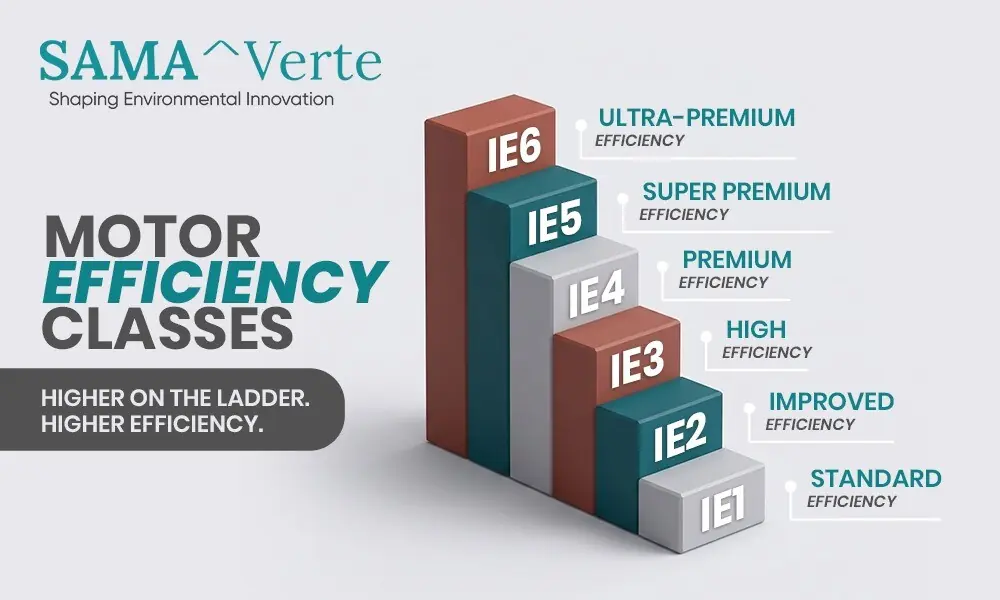
Motors are graded on an international efficiency ladder — IE1 being the least efficient, climbing through IE2, IE3, and beyond. The rest of the world is already at IE4 and IE5, chasing IE6. Bigger players in Pakistan are rightly pushing for IE3 and IE4. But for SMEs, the urgent fight is not at the top of the ladder — it is getting off the bottom rung.
Motor sizes in industry can range from 0.12 KW to 1000 KW but taking an example of a single 5.5 kW motor — a standard size common across Pakistani SME sector— that has been heavily rewound costs its owner approximately PKR 360,000 more per year in electricity than an IE2-class replacement would. A 30 kW motor running at the degraded efficiency typical of a rewound machine wastes roughly PKR 630,000 annually that a modern equivalent would not. For a factory running 30 such motors, upgrading to efficient equipment could deliver a profit uplift of over PKR 5 million per year from Year 2 onward — with the full replacement investment recovering itself in under a year.
The case study that stays with me is from Sialkot's surgical sector. A surgical instruments manufacturer replaced 40 motors — a mix of 1.5 KW and 2.2 KW units — with Chinese IE2-class machines. The before-and-after measurements were recorded: energy consumption in the sandpaper grinding application fell by 22%; in the buffing application, by 15%. The payback period on the investment was between 1.4 and 2.9 years and maintenance requirements dropped by 90%.
This is a company that made a commercially rational decision, measured its results, and came out ahead. But it is, by our survey evidence, an outlier. In the same city, in the same sector, factory owners were blaming expensive electricity and load-shedding for squeezed margins while their motors quietly consumed power at rates a modern machine would not.
The reason is awareness. Our surveys found that 90% of SMEs across three sectors had never heard of IE efficiency standards, had never heard of NEECA or PEECA, and had no idea that Pakistan notified minimum efficiency standards for motors as recently as 2024.
Motor purchase decisions at the floor level come down to one variable: upfront price. Heavier motors are perceived to be better motors. Unfortunately, rewound motor is a repaired motor, good as new, in the owner's mind.
The invisible cost of running an inefficient motor never appears on a line item. It is simply subsumed into the electricity bill, and the electricity bill is blamed on multiple factors but the motors.
Pakistan is simultaneously implementing a competitive electricity market — one that promises large industrial consumers access to cheaper power through wheeling and bilateral contracts — and allowing a demand-side technology lock-in that guarantees much of those savings will be lost the moment the power crosses the meter.
The barriers to closing this gap are three:
1. Upfront cost: since an IE2 motor is more expensive to buy than a rewound second-hand one and no targeted financing window exists for SMEs.
2. Testing infrastructure: experts believe realistically Pakistan has one certified motor testing lab at PCSIR in Karachi, while its manufacturers sit in Gujranwala, Gujrat, and Lahore.
3. Unregulated imports of end-of-life motors that, as one industry figure put it, have made Pakistan 'a junkyard of second-hand motors.'
Each is solvable. None is being actively addressed.
The cheapest megawatt Pakistan is not producing is not sitting in an untapped reservoir or an unbuilt solar farm. It is leaking, every hour of every operating day, through the coil windings of a motor that was rewound three times and never tested, running a motor that no one has bothered to size correctly, in a factory whose owner believes his high electricity bill is someone else's fault.
This article was written by Ramsha Noor, Energy and Sustainability Consultant at SAMA^Verte
(0)评论