


What Gaza's rubble reveals about the scale, dangers and politics of reconstruction
زمرہ: سیاست
شیئر کریں
آرکائیو
پسند کریں
Some 61 million tonnes of rubble conceal unexploded ordnance, human remains and evidence of possible war crimes
Clearing Gaza could take up to 14 years, with decisions over what is removed carrying profound political consequences
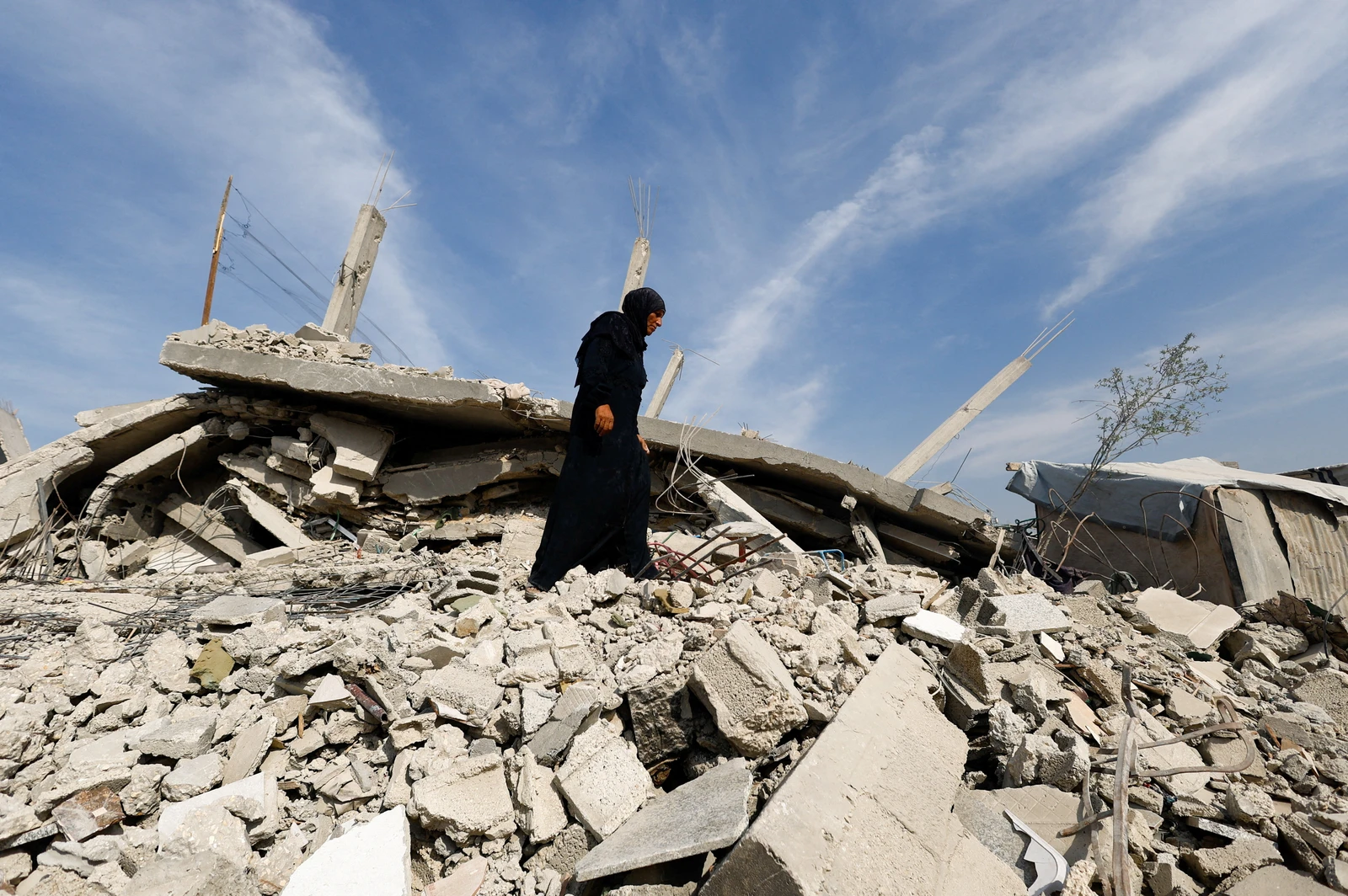
LONDON: Recent satellite imagery has revealed the sheer scale of destruction in Gaza. But beneath the rubble covering large swathes of the enclave, what remains hidden is harder to quantify — and far more consequential. The latest UN estimates put the amount of rubble at about 61 million tonnes — roughly 33 times the volume removed from Ground Zero in Lower Manhattan after the Sept. 11, 2001, attacks. It was at Fresh Kills, once the world's largest landfill in the borough of Staten Island, that thousands of workers and investigators sifted through the debris of the World Trade Center for evidence, personal effects and human remains. Gaza faces a far larger and more complex task. Beneath mountains of pulverized concrete lie unexploded ordnance, hazardous materials, personal belongings and the remains of thousands of people yet to be recovered. Clearing the rubble is therefore not only a logistical challenge; it is also a humanitarian, environmental, forensic and political one — and a necessary first step toward recovery. Three years of war have left Gaza almost uninhabitable. The UN estimates that 82 percent of buildings have been damaged, with at least two-thirds of those completely destroyed. There are an estimated 169 kg of debris per square meter across the strip. The scale of the destruction has continued to grow despite the ceasefire, with estimates rising from around 40 million tonnes in summer 2024 to more than 60 million today. Precise figures are difficult to establish because much of Gaza remains inaccessible and clearance is taking place in an active conflict zone. So far, about 580 km of road has been cleared to allow for aid deliveries and the resumption of essential services, with some routes cleared more than once after further strikes. 'The estimate of the total amount of rubble in Gaza is 61 million tonnes,' Jaco Cilliers, the UN Development Programme's special representative in Palestine, told The Guardian. 'It is approximately 20 times the amount of rubble generated in all wars across the world over the last 18 years.' The figure could not be independently verified by Arab News, but the scale of destruction is undisputed. A UN Environment Programme report published in July 2025 estimated that 8 million tonnes of Gaza's debris could be hazardous, including almost 5 million tonnes potentially contaminated with asbestos, a carcinogenic material. Unexploded ordnance presents another major danger. An Arab News estimate, based on the amount of explosives dropped on Gaza and typical failure rates, puts the possible quantity of unexploded munitions at about 7,000 tonnes. Since clearance operations expanded, the UN Mine Action Service and partner teams have identified and marked hundreds of surface and buried explosive items, including aerial bombs, mortars, rockets and improvised devices. Progress remains sluggish, however, given their limited capacity. The threat is not limited to explosions. Much like the 9/11 rescuers, Gazans face the danger of respiratory illnesses caused by concrete dust and other materials. Gaza has recorded hundreds of thousands of acute respiratory infections since Oct. 7, 2023, when the war began, although the extent to which they are directly linked to rubble remains difficult to establish. Sensitivity is also required in the recovery of human remains buried in the debris. UNDP estimates that between 8,000 and 10,000 bodies could still be trapped beneath the rubble, some in advanced stages of decomposition and requiring specialized equipment and procedures. Partially standing buildings pose another danger. Described by some officials as 'deathtraps,' they can collapse without warning as residents return to homes they believe are safe. Assessing and stabilizing damaged structures before people return is therefore a central part of the recovery effort. Progress, however, remains slow. So far, about 907,000 tonnes of debris have been removed, about 1.5 percent of the total, and about one-third of that has been recycled. At this rate, the UN estimates the work could take between seven and 14 years. Access is a major obstacle. Israeli forces occupy large parts of Gaza, leaving barely 30 percent of the territory open to civilians and aid workers, making even the question of where to put the rubble more acute. International agencies have also repeatedly pointed to Israeli limits on bringing in equipment and services. Israel bars 'dual-use' items that it says could benefit Hamas, so heavy and specialized equipment has largely stayed out. The teams rely on seven crushers to process the rubble, all of which were in Gaza before the war. Local engineers rebuilt two of them over the past year. Most of the equipment is badly worn and often breaks down, partly because spare parts and engine oil are scarce. In this vacuum, people try to fill the gap however they can. Civil defense workers, volunteers and families have often dug through concrete, sand and debris with their bare hands or with shovels, hammers and metal bars. Despite these limits, UNDP is trying to turn the debris into a resource. It manages five crushing sites — two in Gaza City, two in Deir Al-Balah and one in Khan Younis. Debris from roads and damaged infrastructure is stripped of metal and steel rods, then crushed to roughly the size of a marble for reuse. In this context, UNDP said recycling becomes a 'practical necessity.' The agency estimates that recycling 50 percent of the debris, though immensely difficult, would cut the overall cost by about 20 percent. The operation as a whole is estimated at $1.2 billion. The challenge is not only technical, with rubble clearance also carrying legal and governance implications. Under international humanitarian law, parties that carry out attacks must facilitate the recovery of the wounded and dead, and occupying powers must ensure public order and civic life, including safe living conditions and infrastructure. The US has pressed Israel to oversee and pay for the initial large-scale removal. Many experts, however, say Israel effectively controls the operation at arm's length. They argue that it benefits from poor coordination between the UNDP and UNEP, which carry out the physical work, and the National Committee for the Administration of Gaza. The NCAG is a body of Palestinian technocrats, supervised by the US-led Board of Peace, and it is meant to handle governance and planning. 'Israel's control over crossings, territory and the entry of equipment gives it enormous power over both the pace and character of rubble removal,' Ahmed Najar, a Palestinian political analyst, told Arab News. 'That turns a supposedly technical process into a political instrument: Israel can destroy Gaza at extraordinary speed while retaining effective control over how slowly Palestinians are permitted to clear and rebuild it.' For Najar, the absence of a legitimate and independent governing authority creates a further risk. 'Decisions about which neighborhoods are cleared first, where rubble is taken and whether residents can return are not politically neutral,' Najar said. 'If these decisions are controlled by Israel, foreign contractors or an externally imposed body that is not accountable to Palestinians, rubble removal could facilitate permanent displacement and reshape Gaza without the consent of its people.' The process also raises the question of evidence. If clearance is rushed, undocumented or controlled by parties to the conflict, critical evidence of indiscriminate or disproportionate strikes and potential genocidal acts could be lost. 'Gaza's rubble is not simply construction waste; in many places, it is also a crime scene,' Najar said. 'The location and relationship of this evidence are often as important as the objects themselves. If rubble is moved, crushed, mixed or discarded without first being mapped, photographed and examined, that context can be permanently lost. 'Human remains may become impossible to identify, munition fragments can disappear and the chain of custody needed for future legal proceedings may be broken.' He warned that unregulated removal, particularly in areas under Israeli military control, 'could erase evidence of war crimes and other atrocity crimes under the guise of reconstruction.' Experts have raised such concerns about large-scale clearance in Israeli-controlled areas. Even so, the Israeli military uses heavy machinery to clear, level and transport rubble in areas under its immediate control, mainly around its tactical military installations. Francesca Albanese, the UN special rapporteur on the Occupied Palestinian Territories, has said such operations could breach the Genocide Convention and contravene the International Court of Justice's 2024 order requiring Israel to preserve evidence, adding that they could become another means of entrenching Israel's illegal occupation. Najar said Israel, as a party accused in the case, should not be allowed to control the crime scene or decide what is preserved and what disappears. 'This does not mean Gaza's people should be forced to live among dangerous ruins while investigations proceed,' he said. 'It means clearance must be organized carefully.' Healing, he added, begins with this process, but it must be handled carefully. 'Rubble removal will be presented as the beginning of Gaza's recovery,' he said. 'But unless it is Palestinian-led, independently monitored and tied to accountability, it could instead become the final stage of destroying the evidence, dispossessing survivors and deciding Gaza's future without them.'
کوکیز کے بارے میں ایک نوٹ
نیوزہنٹ آپ کو سائن ان رکھنے اور آپ کی زبان اور ملک یاد رکھنے کے لیے ضروری کوکیز استعمال کرتا ہے، تاکہ سائٹ آپ کی توقع کے مطابق کام کرے۔ آپ کی اجازت سے، ہم یہ سمجھنے کے لیے تجزیاتی کوکیز بھی استعمال کرنا چاہتے ہیں کہ لوگ نیوزہنٹ کو کیسے استعمال کرتے ہیں اور وقت کے ساتھ اسے بہتر بنانا چاہتے ہیں۔
قبول کرنا صرف تجزیات کو متاثر کرتا ہے۔ مزید جاننے کے لیے دیکھیں پرائیویسی پالیسی or شرائط و ضوابط.
(0)تبصرے