


Bhojo's forgotten battlefield: Assam's Ahom military heritage under threat
Category: Blend
Share
Archive
Like
Assam's historical landscape is losing a remarkable reminder of the military ingenuity of the Ahom kingdom. At Bhojo in Charaideo district, an archaeological site associated with the training of Ahom warriors in guerrilla warfare is reportedly facing encroachment.
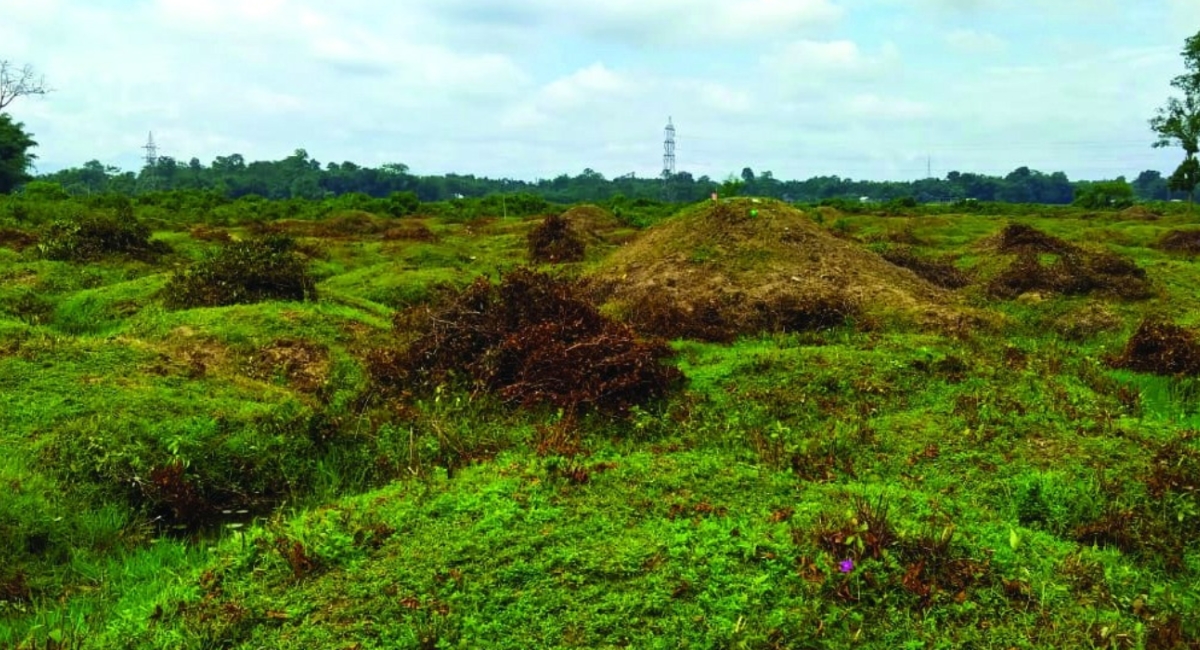
Spread across about 129 bighas, the site is distinguished by man-made earthen formations that show how soldiers may have practised movement, concealment and battlefield tactics.
The Assam Tourism Department identifies Bhojo as an Ahom-period guerrilla warfare training centre, underlining its importance as a military heritage site. The crisis concerns the disappearance of a material record of Assam's medieval military history and archaeological heritage.
The Ahom kingdom, which emerged in the Brahmaputra Valley in the thirteenth century and survived until 1826, developed military practices suited to Assam's difficult terrain. Rather than depending solely on conventional battlefield formations, Ahom forces made effective use of rivers, forests, wetlands, fortified positions and surprise tactics.
Their resistance to Mughal expansion was shaped by this ability to adapt warfare to local geography and knowledge of the Brahmaputra Valley. Historical studies indicate that military personnel underwent training, including practice with weapons and guerrilla techniques.
The physical landscape at Bhojo is significant because the earthen structures may offer clues to how such skills were rehearsed. The site adds an archaeological dimension to the study of Ahom military organisation.
The Bhojo site came to wider official attention in the 2000s and was subsequently recognised as a protected archaeological monument. Reports of its present condition reveal the familiar gap between legal protection and conservation. The absence of fencing and supervision has reportedly enabled portions of the protected area to be occupied and cultivated.
Vegetable farming has extended into sections of the landscape, while some earthen formations have allegedly been levelled. Once such structures are flattened, their arrangement and relationship with the surrounding terrain become extremely difficult to reconstruct.
Unlike movable artefacts kept inside museums, archaeological landscapes cannot simply be collected and relocated. Their value lies in their location, spatial pattern and relationship with the environment.
The issue also highlights a larger challenge for Assam's heritage administration. The state possesses an extraordinary range of historical remains, from the burial mounds of Charaideo to palaces, tanks, temples, battle sites and earthworks. Yet monuments located outside major tourist circuits often receive less public attention. Legal protection alone is insufficient.
Clearly marked boundaries, fencing, periodic inspection, documentation, community participation and strict action against unauthorised occupation are essential. At Bhojo, urgent measures should include a detailed archaeological survey, mapping of surviving mounds and trenches, photographic and digital documentation, restoration wherever scientifically feasible and historically justified, and creation of a buffer around the protected zone for long-term preservation.
The controversy has prompted concern among cultural organisations, including the Tai Ahom Yuba Parishad, which has called for government intervention and stronger safeguards. Such demands should be viewed not merely as a dispute over encroachment but as a call to preserve a historical inheritance.
Local communities can become partners in conservation when they are made stakeholders rather than treated as potential violators. Awareness programmes, heritage signage and controlled visitor access could transform Bhojo from a neglected archaeological tract into a valuable educational and heritage destination for future generations.
Bhojo reminds us that history is not preserved only in books and monuments with impressive architecture. It can survive as an uneven mound of earth, a trench or an unusual pattern in the landscape. The significance of these remains becomes visible when their context is understood.
If the Bhojo formations disappear under cultivation and development, Assam will lose more than ancient structures; it will lose evidence of the culture that helped the Ahoms defend their kingdom for centuries. Protecting the site is an investment in memory, archaeological scholarship and Assam's cultural identity.
A note on cookies
Newshunt uses essential cookies to keep you signed in and to remember your language and country, so the site works the way you expect. With your permission, we'd also like to use analytics cookies to understand how people use Newshunt and improve it over time.
Accepting only affects analytics. To learn more, view our Privacy Policy or Terms & Conditions.
(0)Comments