


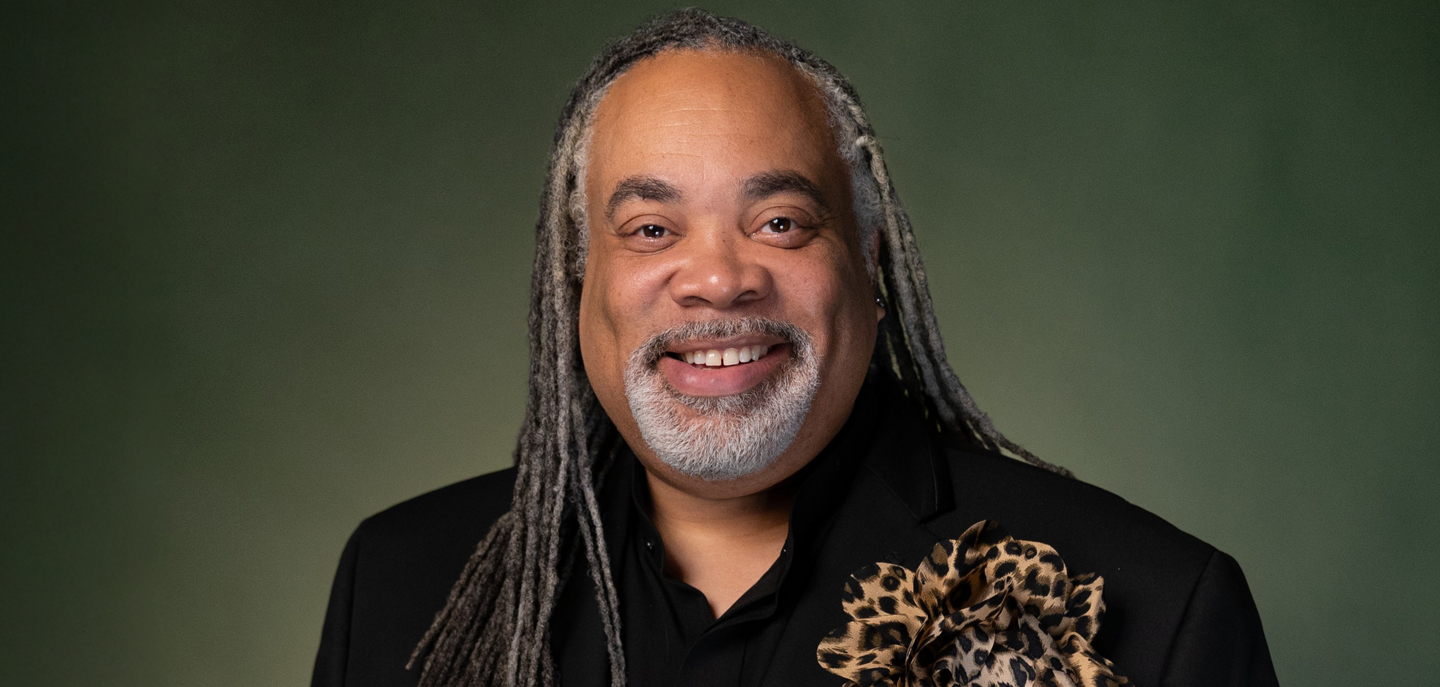
Kevin Anderson Named Montrose Center's 2026 LGBTQ+ Innovator
Category: Health
Share
Archive
Like
This is the second of two profiles of the honorees at the Montrose Center's 2026 Out for Good gala. Read about LGBTQ+ Health Advocate Award recipient Amanda McMillian.
When Kevin Anderson learned the Montrose Center would honor him with its 2026 LGBTQ+ Innovator Award, the word 'innovator' connected the recognition to something much larger than himself. 'I'm really grounded and centered when it comes to the lineage of my ancestors,' says Anderson, founder and CEO of The T.R.U.T.H. Project. 'I have ancestors that were enslaved, that were truly innovators by all extreme usage of the word.'
For Anderson, their ability to create, adapt, and survive informs his understanding of innovation today. 'I lean in on the fact that I come from folk that had to innovate to survive,' he states. 'Utilizing resources, utilizing relationships, and bringing folks to the forefront to really be a part of your vision, and working together and collaborating with community. That's what innovation means.'
From Open Mic to Healing Space
That philosophy has guided The T.R.U.T.H. Project, whose roots stretch to 2009, when Anderson created Heart and Soul, which he describes as one of the country's longest-running queer-centered open mics. 'That's what I knew was missing at the time,' Anderson recalls. 'It was the heart-and-soul space, an honest space where folk could storytell, where they could move and dance, sing, and all of these things.'
There, Anderson heard mothers talk about battling former husbands for custody after beginning to live openly as lesbians, while others publicly disclosed their HIV status for the first time. 'It was through hearing those stories that it became important to me to create an organization and a space, a healing space specifically for queer and trans communities of color,' he maintains.
The T.R.U.T.H. Project was founded in 2011 and became a nonprofit in 2013, with art central to its approach. 'Art just serves as really a universal language,' Anderson explains. 'Where someone may have a hard time really connecting with the subject matter, art makes it a little easier. … It allows you to interpret and create meaning for yourself and for you to have these beautiful reflective moments with how you move forward with your own life.'
The organization has evolved alongside its community. Its early work heavily centered on HIV awareness, while cultural arts, wellness, and sexual wellness have become increasingly interconnected. 'In listening to community, it's helped shape the narrative of who the organization is,' says Anderson.
Anderson is particularly interested in creating more opportunities to recognize and include transgender and nonbinary people, especially trans people of color. 'Anytime we're able to ensure that our communities are in the same space, we are providing opportunities for people to learn, to ask questions, and to just be joyful together,' he says.
Meleah Jones, the Montrose Center's Director of Development, has watched Anderson do that work for nearly two decades. 'I cannot remember a time when Kevin wasn't there as a leader doing this great work,' Jones explains. 'Sometimes he's done the work behind the scenes, so as much attention and glory as we can give to him, he's so very deserving.'
Finding His Own Courage
In helping others tell their truths, Anderson also found the courage to tell more of his own. A person of lived HIV experience, he spent years working professionally in public health without publicly disclosing that part of himself. Watching artists share deeply personal stories helped change that. 'I'm sitting off on the side thinking, 'Man, I wish I had that courage,'' Anderson remembers. Eventually, his courage came. 'It became easier for me to self-disclose,' he adds, 'and then know that it's going to reach a lot of folk and to still be honest in that space.'
'But it's because of the artists, it's because of the community that I've worked with and have created kinship with that I'm able to move forward,' he says. 'They've taught me, so they've helped me in more ways than you can imagine.'
That journey also changed Anderson's understanding of coming out. 'I think coming out happens in so many layers,' he explains. 'I'm 51 years old, and over the last 25 years, I've come out multiple times.'
Ultimately, Anderson measures The T.R.U.T.H. Project's impact by what it makes possible for others. 'The impact that I hope that the organization over the years has had is that people are positioned where they could live freer,' he says, 'and really be in a space of collective connectedness, one where they understand that as we connect there's more that we can achieve together.'
What: Out For Good
When: Saturday, October 3, 2026
Where: Marriott Marquis Houston, 1777 Walker Street
Info: tinyurl.com/outforgood2026
A note on cookies
Newshunt uses essential cookies to keep you signed in and to remember your language and country, so the site works the way you expect. With your permission, we'd also like to use analytics cookies to understand how people use Newshunt and improve it over time.
Accepting only affects analytics. To learn more, view our Privacy Policy or Terms & Conditions.
(0)Comments