


What Drove a Chef-Restaurateur to Knock on Her Neighbors' Doors
Category: Politics
Share
Archive
Like
In the thirteen years since I moved to Providence, I've poured a lot of myself into the city. I have opened two businesses and collected hundreds of thousands of sales tax for the government. I bought a house and made my home in it. I transformed my career from corporate to hospitality in a bout of quarter-life crisis. I basically built my entire adult life here.
And yet, despite having invested and intruded in Providence in just about every way I know how, I had never gotten involved in its politics. I had never once knocked on a stranger's door for a political candidate. This summer, I did it five times for David Morales, a twenty-seven-year-old state representative challenging the incumbent mayor.
Owning two small businesses here taught me something I didn't fully understand before: local government probably has more impact on my actual day-to-day life than any other level of government. It determines whether the streets get plowed, whether the sidewalks are passable, how permitting works, what happens with housing, what your property taxes look like, and whether the systems you interact with every day function with anything resembling common sense. It is also the level of government that we have the greatest chance of influencing with our voice and our vote.
Running Rebelle, we gained a strange amount of visibility among the local bagel-eating politicians. Candidates for office would reach out to meet me and curry my vote in ways that went far beyond regular door knocking. I was just a person who made bagels and brunch, and suddenly people running for office wanted to sit down with me and ask what I cared about. It didn't really change the way I decided on my votes, but the conversations added color.
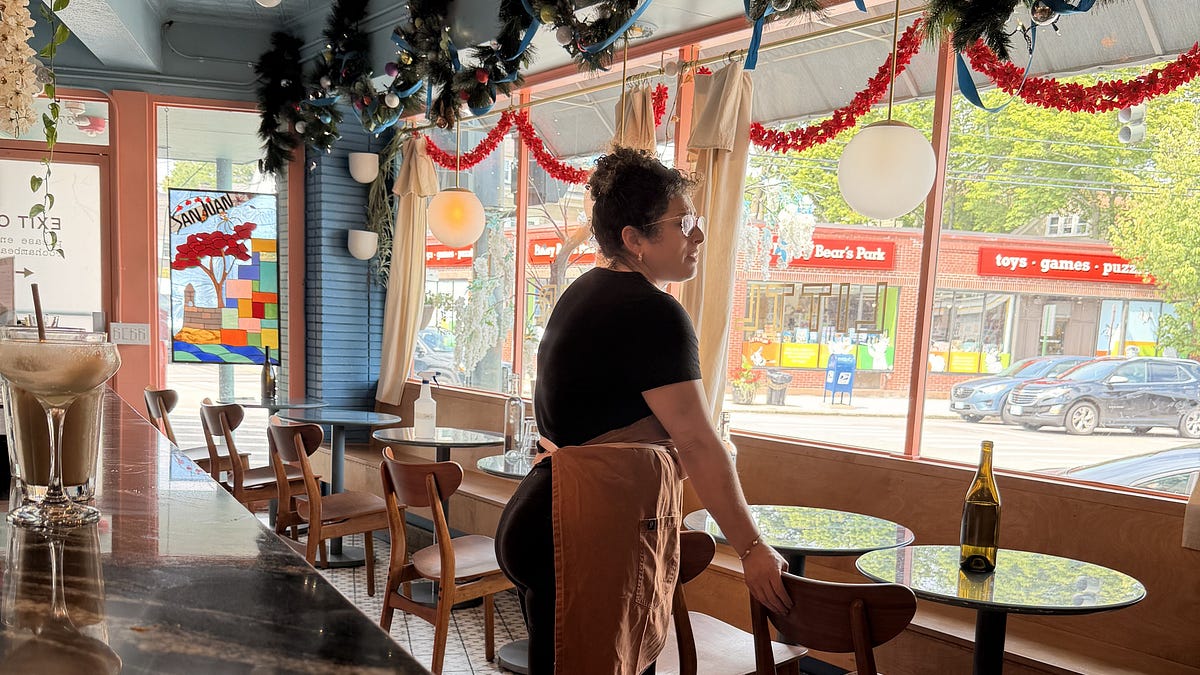
A few months ago, David Morales's campaign reached out about hosting an event at Little Sister to reach neighbors on the East Side. I was fascinated by his energy when I met him. Does he sound rehearsed? Absolutely. David has a way of talking that makes him sound like a long-running political ad or an NPR segment that somehow became sentient. But I also got the feeling that he was very genuine.
More importantly, he came through for me on a big ask.
I had been dealing with an issue involving Rhode Island's power utility monopoly and asked for help pursuing legislation that would create stricter billing requirements. My own state representative and state senator had done what felt like the bare minimum. David, who was not even my representative, reintroduced the bill himself and found colleagues to co-sign it. The bill didn't pass, but because he'd recruited cosponsors, I now have a coalition to go back to next year. That kind of support from our elected officials matters greatly to me.
So I opened my dining room to his campaign for a meet-and-greet. We donated someempanadasandcroquetas, hosted a cash bar, and he rolled in with his microphone and little amplifier to address the room. His answers weren't perfect. There is a lot of recent East Side history — bike lanes, development fights, neighborhood grievances — that he simply wasn't privy to. But his answers were thoughtful. I got the sense that if he were elected, he would genuinely consider everyone in the city a constituent, including the people who didn't vote for him.
Somehow that inspired me to go door to door in my neighborhood, on my own time, trying to convince my neighbors to give him a chance. I'd never gone canvassing and I ended up getting quite into it! The campaign would assign me a list of homes, I'd download it to my phone, grab a pack of flyers, and walk around for two hours in the evenings with my rehearsed talking points.
I took canvassing seriously. Before I went out, I scoured online forums and Facebook pages trying to understand the grievances on my side of town so I could know what people were likely to bring up. I armed myself with facts and rebuttals. A part of me is hellbent on doing an excellent job at whatever the 'job' is, but a bigger part wanted to know how my neighbors really think about what our city can be.
Canvassing for a political candidate is a wildly optimistic task. If I'm being honest, it wasn't optimism that made me do it — it was the nagging disillusionment that I feel living and doing business in post-pandemic Providence. After thirteen years, two businesses and a home, I didn't feel like I was building my life in a place that was on the rise. Yet when I first moved here, there had been a sense of momentum. In the mid-2010s, Providence felt like it was on the verge of becoming something more than a satellite town to Boston. That's what encouraged me to build and make long-term commitments that would keep me rooted here. Now I sometimes wonder if that feeling of rootedness was real or if it was a mirage. Is it the same potential every newcomer sees when they arrive? Does it fade away once they crack the city open and see its guts?
Providence has always felt like there is so much potential because all the elements are here. We have an Ivy League university. We have hospitals and a highly educated population. We have one of the best art schools in the country. We have a community of makers and doers. We have a culinary school. We have a restaurant scene that outshines Boston's when awards season rolls around.
It is all here. So why isn't it coming together?
That has been my nagging thought for years.
The door-to-door conversations with my neighbors didn't really give me hope as much as they bummed me out. A surprising number of the houses I knocked on belonged to former customers of mine, mostly from Rebelle's days in Providence. I know so many of these folks by first and last name, even if we've only ever exchanged a few words.
A guest I knew from Little Sister asked me, bewildered as we stood in the aggressively air-conditioned foyer of hermulti-million dollar domicile, why I was out passing flyers for a mayoral candidate —wasn't I busy enough with two restaurants?
'This is how much I care, this is how big a difference it would make for my business if the city could run better,' I explained.
She gave me a tight-lipped smile and responded she was supporting Smiley, the candidate better aligned with her values and priorities. I accepted her response, noted it on my canvassing app, and left a bit unsettled.
Some folks I spoke with answered their doors and complained about therent stabilization ordinancethat current Mayor Smiley vetoed and David Morales pledged to support. I armed myself with patience for these conversations. It was jarring to encounter such opposition about a program designed to help our neighbors live in the city, from folks who didn't stand to gain or lose from it. (Unless they're all secretly slumlords, in which case, heard!)
Other times, I'd try to persuade them by soliciting their thoughts on city services. I would bring up thesnowstorms this winterand how poorly the city had handled them — streets blocked for days, people effectively trapped in their neighborhoods, people missing work or school, the risk of an ambulance not being able to reach someone who needed help.
'Well, I don't really leave the house,' I'd often hear.
'It was a historic snowfall,' others hedged.
I found it sad to make excuses for the city keeping folks homebound for the better part of the week. I caught more heat back in the Rebelle Providence days for running out of everything bagels too early in the day than our mayor did for not getting the roads cleared of snow.
As the September 9 primaries drew closer, the campaigning got nastier. The negative flyers from our current mayor's campaign, tacky as they are, seem to be working. Many neighbors dismissed David Morales as inexperienced, even though he's served in office for the last six years. Some of them mocked David's hobby ofLucha Librewrestling, and many neighbors brought it up to me as a mark of his unseriousness; I don't think they understood how culturally specificLucha Libreis, which made the criticism feel pettyandtone-deaf. We're all allowed to have quirky, harmless hobbies! I think it would be fucking cool if the mayor were a guy who cared deeply about fixing governmentandalso had a personal life with hobbies outside his job.
For ten years, I've had a relationship with many of my affluent East Side neighbors where they know me, come to my restaurants, spend their money at my businesses, enjoy my food and hospitality, and perhaps even feel a sense of connection to me. But what happens when I step outside the frame and show up as Milena the citizen, not Milena the chef-restaurateur? Does the familiarity and respect transfer from one setting to the other? I thought years of serving this community had made me part of it but canvassing made me wonder whether some people had experienced that relationship differently. Perhaps I was a beloved provider of things they enjoyed rather than someone whose ideas about the city carried weight.
This sense of insulation, a recurring frustration in my time living here, flared up during my canvassing.It didn't affect me, therefore I don't careis a cushy way to go through life but it doesn't make for a thriving town.A vibrant economy demands room for everyone — what are we going to do whenhourly workers can't afford to live here, move away and we're left with a city full of people who are all above taking a $20-per-hour barista gig?Stay home?
I am insulated from some of these problems too. I own my house. I know people in government. Years in business have taught me how to navigate around broken systems. Maybe that is exactly why I find it so depressing when insulation becomes an excuse not to fix them.
My neighbors have rainbow flags outside and progressive lawn signs that sayin this house we believe, blah blah. They understand, at least symbolically, the idea of being an ally to people whose lives are different from theirs.
Are we obligated to show each other solidarity simply because we live in the same city?
Shouldn't we be able to demand better for our neighbors even when what is broken doesn't affect us personally?
I am not naïve about David Morales, but I am optimistic. Heisyoung — he is the age I was when I had all the energy in the world to work seven days a week bootstrapping a bagel shop. I recognize that energy in him. I recognize that hunger to build something, and maybe that's part of what gives me hope. I think the city needs that vibe shift desperately.
Some people who read my work interpret my criticism of Providence as evidence that I hate the city. If I truly hated Providence, I would have packed my shit and left a long time ago. Instead, I allowed myself to fall in love with my house and my garden. I opened two businesses here that kept me fed and realized my teenage dream of becoming a chef. I've struggled, endured ridicule, and ultimately grown from it. I'vegone to the statehouse and fought for issues that affect otherslong after I stood to gain anything. I'm not sure if this place claims me as its own, but after thirteen years, it's as much of a hometown as the town where I grew up in Puerto Rico. That is why I want it to be better. That is why I demand more from it.
That hope, that things can and should be better for us, is what drove me to knock on a stranger's door and trust that a conversation could make a change. I was grateful for the folks who genuinely engaged me in conversation and seemed open to another perspective. Weirdly, knocking on those doors was the most optimistic thing I've done in Providence in a long time. It reminded me that underneath all my frustration, I must still believe this place can become something more.
Apparently, I'm not done pouring myself into it yet.
If you're new here:Hi, I'm Milena — the chef and restaurateur behindLittle SisterandRebelle. InLatent Heat, I write from inside the restaurant business about money, labor, power, taste, and what it really costs to feed people. I also publish original recipes from my restaurants and home kitchen.
If you're already subscribed,thanks for being here. If not, you know what to do…
get my weekly essays
Thanks for reading Latent Heat! This post is public so feel free to share it.
Share
A note on cookies
Newshunt uses essential cookies to keep you signed in and to remember your language and country, so the site works the way you expect. With your permission, we'd also like to use analytics cookies to understand how people use Newshunt and improve it over time.
Accepting only affects analytics. To learn more, view our Privacy Policy or Terms & Conditions.
(0)Comments