


Nobody is Average
Category: Sports
Share
Archive
Like
InTheory v Practice, I wrote:
The data is presented, as it mostly is in these sorts of studies, as a mean effect size. But the participants are individuals. A teaching method that improves 9 kids by 0% and 1 kid by 10% is very different than a teaching method that improves 10 kids by 1%. More on this later, but let me hit #4.
This is the more on that.
In6 Months Of Speed Results, I summarized the results of the speed work (sprint, jump, spike velocity) that I did with athletes that year.1When discussing improvement in spike velocity, I noted that the median improvement for this U17 team was 2mph. That's nice, but what's noteworthy is that most of the players didn't improve 2mph. Some were quite a bit more, and some hardly improved their spike velocity at all.
Is this good or bad? I don't know. It just is, and this sort of result is also very common.
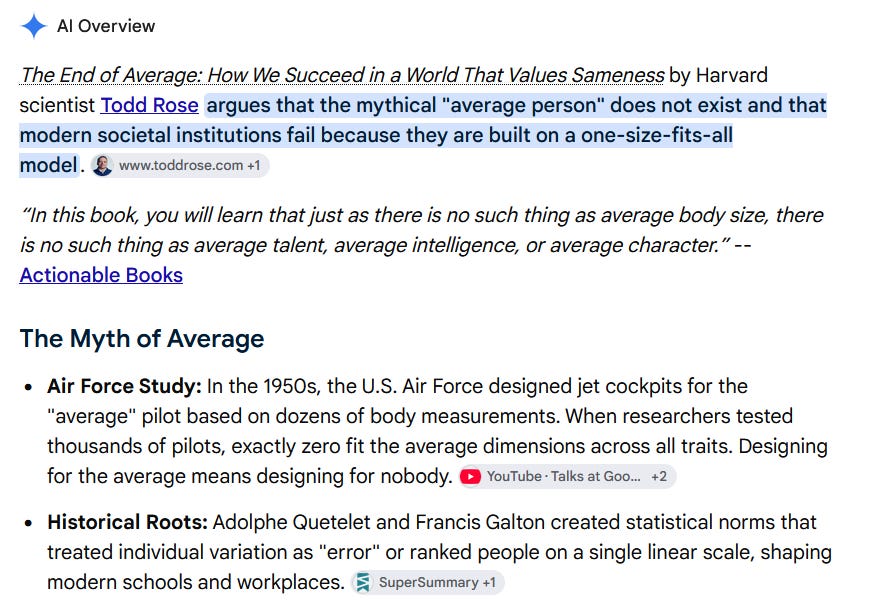
Somebody wrote a book calledThe End of Average. I haven't read it and probably won't. At a certain point, all these books written by a guy associated with Harvard who does a Ted Talk with a cleanly summarized, focus-group workshopped thesis start to blur together. No offense to that guy, he seems great. Anyways, the summary of the book kind of tells you what you need to know:
Makes sense. And the thesis of the book seems pretty valuable. As a radical homeschooling extremist, I certainly condone not putting everybody in one-size-fits-all-boxes.
But what does it mean for coaching?
In the Theory v Practice article, I was talking about how to interpret scientific studies. As Rose notes, a strong scientific culture has resulted around the idea of presenting the result of a scientific study as an effect size with a certain confidence interval. That's probably valuable in some situations, but not so helpful in others.
This is ignoring the fact that 'Average can kill your grandma' as Taleb says2. Ex: Bogota and Beijing have near-identical average yearly temperatures. But Bogota accomplishes this with a coldest monthly low of 433and a warmest monthly high of 68. On the flip side, Beijing has a January average low of 19 and a July average high of 89. So distributions matter.
But what we're talking about here is a training effect. Is one better than the other? Again, I don't know, but I know that this effect seems to be pretty common.
We know thatMost Practice Doesn't Do Anything. But sometimes most practice just seems like it doesn't do anything, because it doesn't do anything for most players, but it helps a few. It's also possible that it messes some players up but helps others. At GMS, we sometimes talk about the value of doing more game-based warmups and we present a meta-analysis of stretching that concludes it has no significant benefit. But I think it's almost impossible that a systematic stretching routine would have zero effect. I think it's overwhelmingly likely that some athletes benefit while some athletes are harmed.4And that's very different.
Coaching is probably like this too. Most studies show that, in professional sports,most coaches don't have much of an impact. There's various ways to test this statistically that I don't want to get too far into the weeds with. But one way that a coach can have no positive impact is by having no impact on anybody. Another way is to have a positive impact on half of the team and an equal-but-negative impact on the other half of the team. Net zero, but very different process.
There's also clearly evidence that sometimes coaches help teams and sometimes they harm teams. And sometimes it's the same coach! Bill Belichick was famously fired from his first NFL head coaching job before becoming arguably the most successful NFL coach of all time. And then… not so much at UNC.
My opinion is that, the higher up you go in level, the more coaches become particular to certain situations, players, programs, etc. I can think of a long-time, highly-successful volleyball coach with let's just say a… distinctive coaching style and demeanor. Part of that coach's success was recruiting players that worked with the style of the coach. Other coaches who have emulated that coach have not necessarily been as successful.
There's also the fact that you are a different person at different points in your coaching career. I was a different sort of coach when I was 24. I think I'm a better coach now, but also importantly a different coach. There's probably a few players out there or types of team I would have been better with 15 years ago, and then there's more players/teams that I'm better with now. It's not just a pure leveling up in all fashions.
Okay, let me get back on point.
The point of knowing that Most Practice Doesn't Do Anything is three-fold:
(1) Don't break your team. A 'first, do no harm' approach isn't bad. I can think of 3 separate matches my club team won this year against comparable opponents because the other coach just imploded and freaked their team out. I don't think we gave any away in that fashion and I think I'd be honest enough to tell you if I did. Considering we went 35-27, that's most of our difference above 0.500 right there. While that's competition and not practice, I think the point still holds. The negative impact of coach comes quickly and with a high magnitude (imploding in a match, running an unsafe practice that gets a player hurt, destroying a relationship with a key player, selecting the wrong player to start or to be on the team in the first place) while the positive impacts of a coach tend to be lower in magnitude and happen over time.
(2) Don't be afraid to try some stuff every now and then. There's probably some things you're doing at practice that aren't materially any different than what another coach is doing. You know I love my preciouspractice templates, but I mostly love them because players benefit from consistency and it makes my life easier as a coach.
(3) If you can get an idea of stuff that falls in the 'doesn't do much from some, but does a lot for a few,' and you can employ it in the right way, you can potentially get some concentrated benefits without losing much in the process.
I will focus on #3 for now, as we come to the crux of the article.
A note on cookies
Newshunt uses essential cookies to keep you signed in and to remember your language and country, so the site works the way you expect. With your permission, we'd also like to use analytics cookies to understand how people use Newshunt and improve it over time.
Accepting only affects analytics. To learn more, view our Privacy Policy or Terms & Conditions.
(0)Comments