


Missouri Was Built by Workers. Washington Is Working for Wall Street.
Category: Politics
Share
Archive
Like
Labor Day is often treated as the unofficial end of summer. In Missouri, that sells the holiday a little short.
This state has one of therichest labor histories in America.
In 1877,railroad workers in St. Louis walked off the jobas part of a nationwide strike over wage cuts. Other workers joined them. Factories shut down. Thousands marched through the streets. For several days, workers brought much of the city to a halt in what became one of the first general strikes in American history.
The industries changed over the next century, but the basic fight did not.
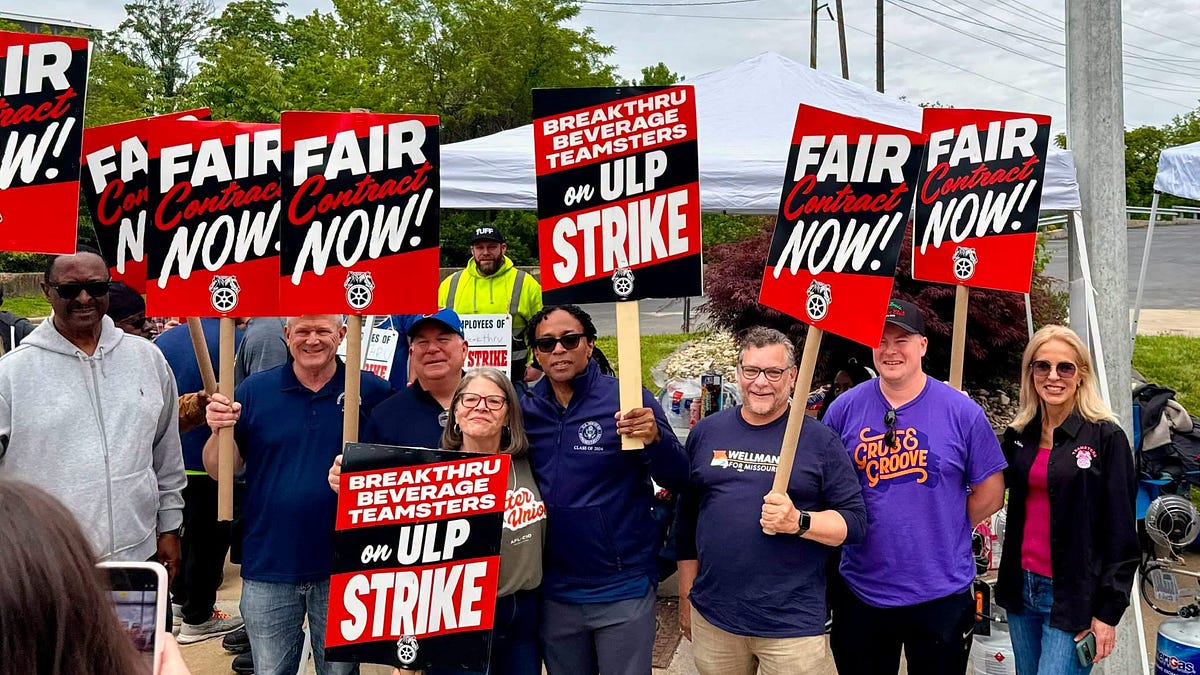
Railroad workers organized. Miners organized. Brewery workers organized. Machinists, electricians, autoworkers, Teamsters, teachers, firefighters and building trades organized.
They did it because they understood something fundamental: an individual worker negotiating with a giant corporation does not have much leverage. Workers standing together do.
That principle helped build the Missouri middle class. And Missourians have defended it even when our politics moved in a different direction.
In 2017, Republicans in Jefferson City passed so-called right-to-work legislation designed to weaken unions. Working people organized, collected signatures and forced the issue onto the ballot.
Then Missouri voters crushed it.
InAugust 2018, nearly68 percent of Missouri voters rejected right-to-work. InFranklin County, a large part of the Second Congressional District, voters rejected it by nearly three to one. That was not a liberal electorate voting. That was Missouri.
There is an important lesson in that vote, especially on Labor Day: Missourians understand the difference between an economy in which working people have some power and one in which all of the power flows upward.
Which brings me to Congresswoman Ann Wagner.
Wagnerchairs the House Financial Services Subcommittee on Capital Markets. It is one of the congressional bodies responsible for overseeing the Securities and Exchange Commission and writing the rules governing our capital markets.
That is an enormously important job. And Wagner's own financial disclosures raise some obvious questions about whose economy Washington is building.
On June 22, while serving as chair of that subcommittee, Wagner and her husband reported purchasing between$250,001 and $500,000in a KKR private-equity investment vehicle.
This was not their family's only significant investment in private markets. Wagner's disclosures also list between$100,001 and $250,000 in a Carlyle private-credit fundand between$250,001 and $500,000 in another private-capital fund.
At the same time, Wagner has been one ofCongress's leading advocates for changing the rules governing those markets.
She helped lead legislation expanding access to private investment funds. She hassponsored legislation restructuring the SEC. Her subcommittee has spent considerable time examining financial regulations that Wall Street wants changed.
And while theSEC is at a 16-year low in enforcement actions against bad actors, the financial industry has been very good to her politically.
Over the course of Wagner's career,millions of dollars in political contributionshave come from corporate PACs and the financial sector. Her donor network includes executives from investment banking, brokerage, insurance and private equity.
Then there is KKR. A chairman and co-founder of KKRcontributed another $7,000 to Wagner's campaign on April 1of this year. About ten weeks later, Wagner and her husband reported investing between a quarter-million and a half-million dollars in a KKR private-equity vehicle.
That does not prove that a law was broken. I am not claiming it does. It does, however, illustrate a problem that Americans have every right to be angry about.
The people writing and overseeing the rules of our economy increasingly live in a completely different economy than the people they represent.
For a family trying to buy groceries, private credit is not an asset class.
For a carpenter wondering whether his pension will be there when he retires, private equity is not a diversification strategy.
For a parent trying to cover child care, a quarter-million-dollar investment is not a line on a disclosure form.
And while Ann Wagner has been in Congress, her own disclosed assets have grown dramatically. Her financial disclosures showed roughly$4 million to $8 million in assets when she entered Congress. Her latest filing shows roughly$13 million to $37 million.
Again, wealth itself is not wrongdoing. Getting rich is not a crime. But public service should force us to ask a basic question:Who are you there to serve?
Because Congress has spent years debating how to make capital move more freely, how to make private markets bigger and how to reduce regulatory burdens on financial firms.
Working people have a different set of questions:
Why has the cost of housing raced ahead of wages?
Why can a worker spend decades at a company and still worry about retirement?
Why does a CEO have infinitely more power at the bargaining table than the people who actually make the company run?
Why does Wall Street get sophisticated new investment opportunities while families are trying to figure out whether they can afford daycare, health insurance and groceries in the same month?
And why do the people responsible for writing the rules so often seem to prosper under the rules they write?
Missouri workers have been asking versions of those questions for almost 150 years.
The railroad workers who shut down St. Louis in 1877 understood that economic power does not surrender itself voluntarily.
The union men and women who built our factories, wired our buildings, moved our freight, taught our kids and kept our communities running understood it too. And the Missourians who rejected right-to-work by more than two to one understood it in 2018.
Labor Day is not about pretending every union is perfect or every business is the enemy. It is about recognizing that a healthy economy requires balance.
Workers need power. Consumers need protection. Markets need rules.
And elected officials need to remember that their job is not to create a better economy for the people sitting around a private-equity conference table.
Their job is to build an economy in which somebody putting in a hard day's work in Franklin County can build a decent life.
Missouri was built by people who worked. Washington ought to start working for them again.
A note on cookies
Newshunt uses essential cookies to keep you signed in and to remember your language and country, so the site works the way you expect. With your permission, we'd also like to use analytics cookies to understand how people use Newshunt and improve it over time.
Accepting only affects analytics. To learn more, view our Privacy Policy or Terms & Conditions.
(0)Comments