


The dangers of adding and subtracting percentages
Category: Financial
Share
Archive
Like
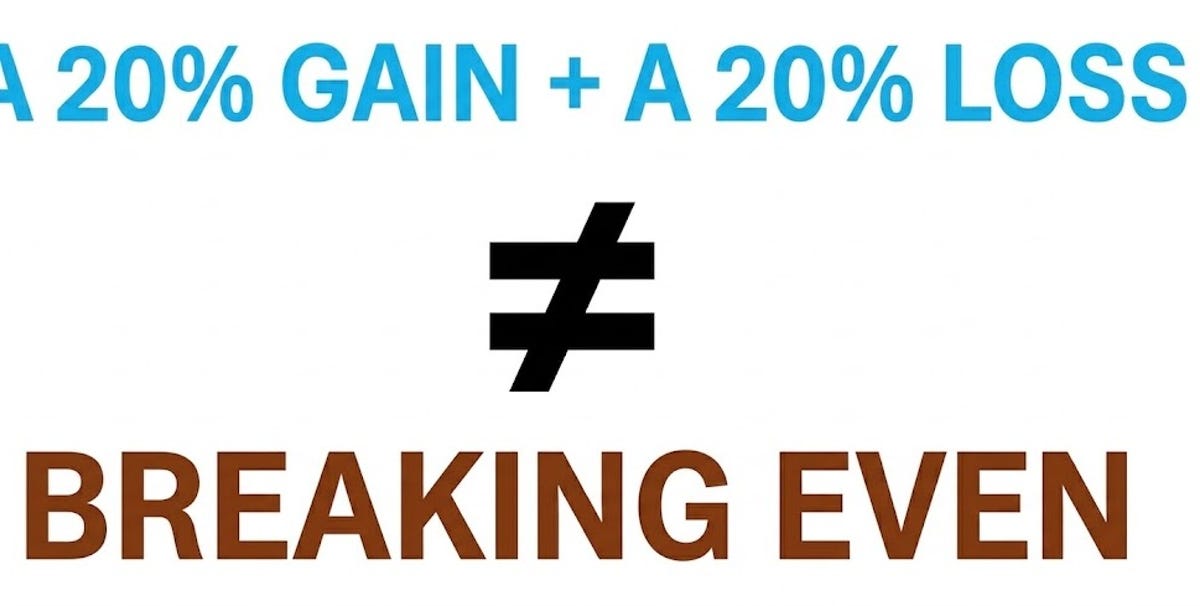
If a stock gains 20% today and loses 20% tomorrow, are you back to where you started?
Most people instantly answer yes, assuming that equal percentages cancel each other out.They don't.The real answer is that you aredown 4%.
This mistake comes from treating sequential percentage changes as additive instead of multiplicative. Percentages are not fixed, absolute amounts - they arerelative multiplierstied directly to the number they modify.
When a value increases by 20%, youmultiply it by 1.20. The subsequent 20% loss applies to thatnew, larger figure, taking away a bigger dollar amount than you gained in the first place.
Here is the exact math:
Start with $100.
Add 20%: $100 × 1.20 = $120.
Subtract 20%: $120 × 0.80 = $96.
You can apply the same sequence of calculations to a general variableY.
Start withY.
Add 20%:Y× 1.20 = 1.20Y.
Subtract 20%: 1.20Y× 0.80 = 0.96Y.
Multiplying the two stages together gives an overall factor of1.20 × 0.80 = 0.96. This leads to a loss of 4% -regardless of the initial starting value.
In finance, ignoring this property leads to serious miscalculations. It hides the asymmetry of losses:
A 20% drop requires a 25% gain just to break even.
A 50% drop requires a 100% gain just to break even.
When working with percentages, it is good to start with the baseline value explicitly and perform the calculations one step at a time - just like I did above. This will make it easier to obtain the final answer correctly.
Last week, I wrote about another common mistake involving percentages:interpreting an increase of 200%. I encourage you to read that article, too!
A note on cookies
Newshunt uses essential cookies to keep you signed in and to remember your language and country, so the site works the way you expect. With your permission, we'd also like to use analytics cookies to understand how people use Newshunt and improve it over time.
Accepting only affects analytics. To learn more, view our Privacy Policy or Terms & Conditions.
(0)Comments