


‘It Ends,' Gen Z Anxiety and the New Generation of Independent Filmmakers
Category: Entertainment
Share
Archive
Like
The Gen Z filmmaker moment is here. This summer, a new generation of storytellers is flexing their creativity through original, independent films that speak to their peers. Obsession and Backrooms captivated audiences of all ages, and now another new Gen Z filmmaker is bringing their unique vision to theaters: Alex Ullom's It Ends .
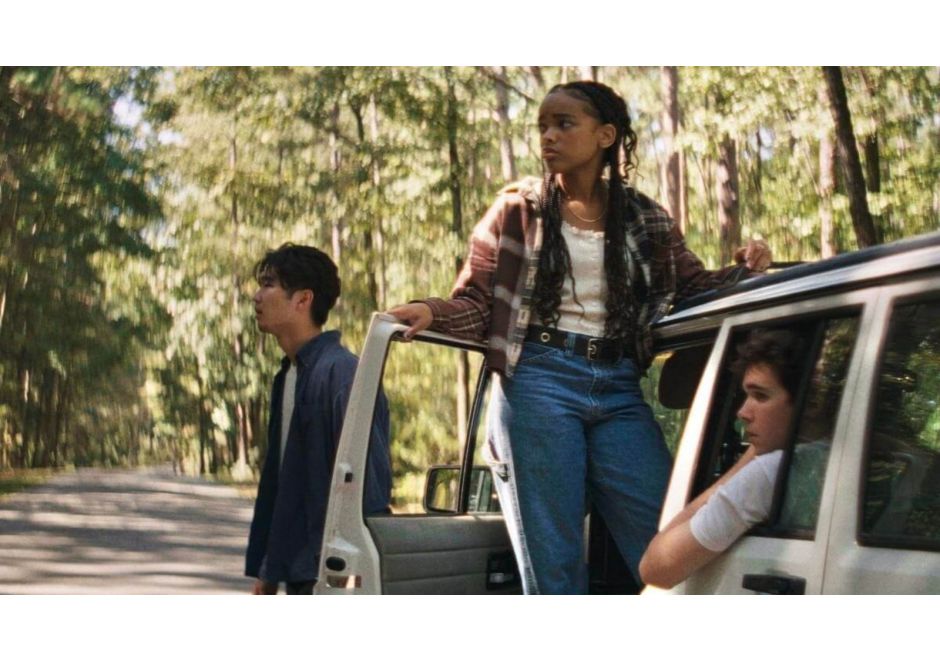
It Ends follows four recent college grads who help someone move into their new place. The initial conversation in the car isn't very hopeful, though. None of them seem excited about life, as if their futures are bleak, unknown, or expected to be unfulfilling at best.
Soon into their trip, they turn down a road that cuts through a forest, and it doesn't quite seem to end — ever . After a few miles, they turn back only to hit a dead end. Without spoiling, let's just say something spooks them, and they realize their only choice is to drive and keep driving.
It Ends has only four main cast members: James (Phinehas Yoon), Tyler (Mitchell Cole), Fisher (Noah Toth), and Day (Akira Jackson), and most of the movie takes place inside their Jeep. Welcome to liminal storytelling.
Liminal space can represent a physical location or psychological state of transition. It's an "in-between" area between where you came from and where you're going. Think of movies like Backrooms , The Shining , The Last House, or the pillow fort scene in Insidious: Out of the Further with seemingly endless space, time, or hallways that feel transitional and unsettling.
"I think for people my age, our relationship with infiniteness and liminality — call it 'Backrooms,' if you will — all stems less from a religious place and more from the fact that we don't really have a destination to 'arrive at' anymore," Ullom said in a RogerEbert.com interview.
He adds, "If liminal spaces are transitionary states, it just feels like we're in a long one right now...We're losing a connection to something bigger than ourselves."
There's a reason that liminal space is apt to drive someone mad: progress is measured in moving forward, even though characters can never seem to find an endpoint. It Ends' long, never-ending journey tests the characters' perception of reality and questions literally everything, a feeling they had psychologically before turning down that road. Writing a Hangout Horror
Netflix recently released The Last House , a movie about a family of four trapped inside their home. They don't know what's causing their inability to exit the house, or how long they're going to be there.
It Ends is similar. Four characters, one location, and no idea how long they'll be trapped in their Jeep on a road they can't turn off. In both movies, these characters are forced to 'hang out' with each other for an unknown amount of time.
One of Ullom's inspirations, other than the psychological well-being of Gen Z, is Richard Linklater's Before trilogy. Instead of a romantic hangout story, It Ends is 'hangout horror' where the foursome are stuck together and forced to discuss life deeper than they ever would before. In this way, It Ends spends more time on life's biggest (and smallest) questions than it does on the dreadful aspects of their journey.
Most horror movies don't give their characters much time to hang out. There are small conversations here and there, but it all gets interrupted by trying to escape a killer, a mystery to solve, or some supernatural threat.
Hanging out doesn't mean nothing is happening during this time; rather, the characters' conversations add to the tension as they get on each other's nerves, debate what's happening to them, and wrestle with uncertainty on the road they're traveling and the lives they lead. Start with a Simple "What If?"
All movies tend to start with a "What if?" question. For It Ends , the simple question is, "What if you turned down a road that never ends and there was no escape?"
It's an understandable premise for a story and one that's immediately intriguing. The concept is frightening and raises a whole bunch of other questions about reality, friendship, mortality, and uncertainty.
"What if?" questions provide an enormous amount of screenwriting potential. What if a teenager was kidnapped and they didn't realize her father was a former CIA agent? ( Taken )
) What if a Barbie doll became self-aware? ( Barbie )
) What if we lived in a world that was actually a computer simulation? ( The Matrix )
The important thing isn't simply asking a "what if?" question. It's asking one that creates enough unanswered questions to sustain an entire movie. The Horrors of Uncertainty
Uncertainty can be scary. It Ends stares uncertainty head-on and brings the audience along for the ride.
For the four characters in the Jeep, the road is uncertainty. How long must they drive on it? And what happens if they stop? They are asking questions that don't seem to have answers. But that's the point.
"There's no such thing as objective truth anymore," Ullom said in the RogerEbert.com interview. "So now these questions are a truth in a way. The actual limit of the human experience is questions with no answers. The confines of existence are questions without an answer, but also know that since there's no truth, everyone's subjective opinion is the most important thing now."
Ullom's partial inspiration for It Ends comes from the uncertainty his generation faces.
"If it's not clear in the movie, I had a pretty rough transition into adulthood, at least mentally and emotionally," Ullom said in an interview with The Wrap. "When I first wrote the movie when I was 21, I was coming from a lot more of an emotional, physical place, feeling like, Damn, is this the rest of adulthood? Is that what my life is going to be like? "
That's the uncertainty the four characters debate before turning onto the endless road, and, just like Ullom, they were uncertain if becoming an adult is a destination in itself.
A note on cookies
Newshunt uses essential cookies to keep you signed in and to remember your language and country, so the site works the way you expect. With your permission, we'd also like to use analytics cookies to understand how people use Newshunt and improve it over time.
Accepting only affects analytics. To learn more, view our Privacy Policy or Terms & Conditions.
(0)Comments