


Trump's Venezuelan Oil Deal Criticized by The Economist as a Barrier to Democracy
Category: Politics
Share
Archive
Like
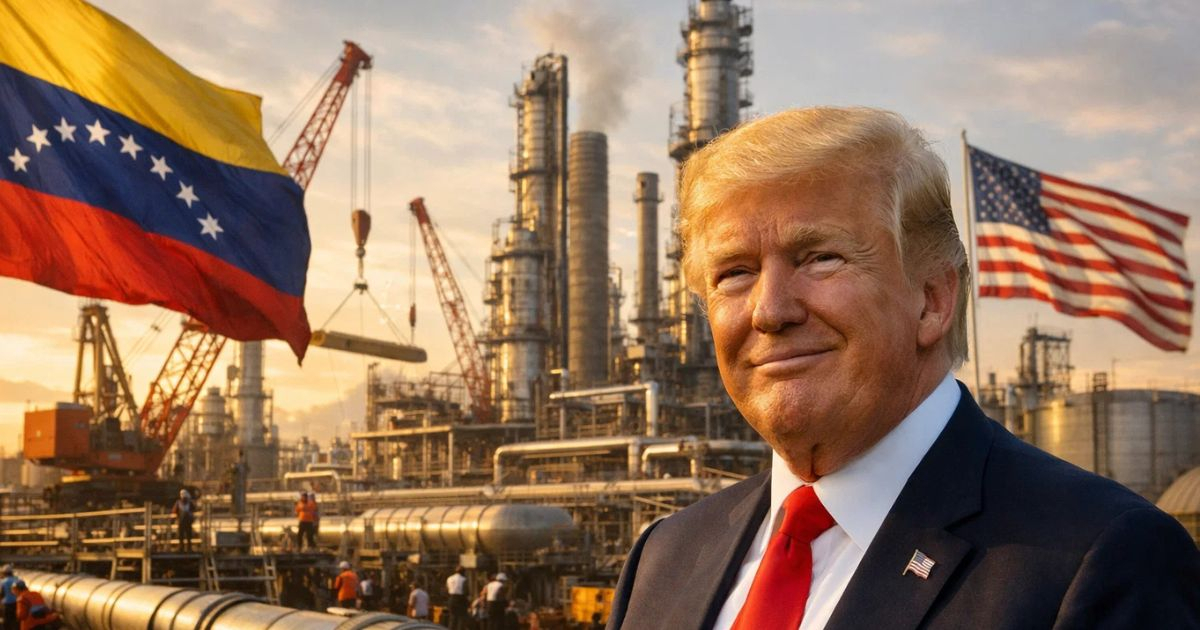
The renowned publication, The Economist, recently released a scathing editorial criticizing the oil agreement between Donald Trump and the Venezuelan government led by Delcy Rodríguez. Described as "bold yet murky," the editorial warns that the deal creates dangerous incentives to halt any democratic transition in Venezuela.
Trump announced this pact at the end of August, calling it "the largest oil deal in the world's history." It grants the private company North American Blue Energy Partners (NABEP) access to 17 Venezuelan oil fields with proven reserves of around 65 billion barrels.
In exchange for Washington's backing, the Pentagon secures a 35% stake in NABEP and rights over its production, ensuring the U.S. first choice on purchasing options for fields that account for one-fifth of Venezuela's reserves over the next century, with some acquisitions at a discounted rate. Red Flags Raised by The Economist
The Economist highlights three major concerns that render the deal "regrettable." First, it was negotiated with an "illegitimate regime" accused of election rigging. Second, Trump's chosen private partner, Alejandro Betancourt, head of NABEP, is controversial in Venezuela due to his business ties with the Chavismo regime and investigations by U.S. and European authorities, though never formally charged.
The third concern directly involves Trump: the day following the deal's announcement, he declared intent to "take all" the Venezuelan oil, which the publication labels as "imperialist bluster" likely to provoke Venezuelan opposition.
The editorial further cautions that any future democratically elected Venezuelan government might contest a deal granting Washington so much control over the nation's resources, thereby deterring major investors. Economic and Political Implications
Despite the apprehension, major international oil companies remain cautious, although Chevron has separately committed $7 billion to its current Venezuelan operations.
The editorial's most severe argument targets the political core of the agreement: the financial influx and tax revenues generated could motivate powerful players to obstruct democratic progress. Betancourt, "well-connected in both Caracas and Mar-a-Lago," has every reason to advise Trump against hastening towards free elections, potentially jeopardizing his oil profits, according to the magazine. Rodríguez, it adds, will undoubtedly reinforce this message.
Delcy Rodríguez herself claimed that the project might eventually yield over 1.5 million barrels per day, boosting Venezuela's total production to 2.5 million barrels, about three-fourths of pre-Chávez levels. However, she failed to provide a clear timeline or specify the source of the over $100 billion needed for such expansion.
The Economist acknowledges that some Trump administration officials, notably Secretary of State Marco Rubio, "clearly understand that a democratic Venezuela is desirable and in America's interest."
In theory, Washington could leverage its influence over NABEP to demand transparent competition in Venezuela's oil sector and make room for opposition forces.
Opposition leader María Corina Machado has already warned that an agreement of this scale can only be signed by a legitimately elected government, with rule of law and transparency, conditions that Rodríguez's regime does not fulfill.
The Economist criticizes the deal for being negotiated with an illegitimate regime, involving a controversial partner, and risking Venezuelan resources while potentially deterring democratic transitions and major investments.
The deal could generate substantial financial and tax revenues that may incentivize powerful actors to block democratic change, while also deterring major international oil companies due to its controversial nature.
A note on cookies
Newshunt uses essential cookies to keep you signed in and to remember your language and country, so the site works the way you expect. With your permission, we'd also like to use analytics cookies to understand how people use Newshunt and improve it over time.
Accepting only affects analytics. To learn more, view our Privacy Policy or Terms & Conditions.
(0)Comments