


6 Tick Infested Areas In The Rockies
Category: Health
Share
Archive
Like
In the Rockies, the worst tick danger comes with the snowmelt rather than the summer heat. Once the sun clears the snow off the sagebrush slopes in late March and April, the Rocky Mountain wood tick (Dermacentor andersoni) climbs to the tips of the grass stems and waits for a passing deer, elk, or person. It favors open, semi-arid country between roughly 4,000 and 10,500 feet, and a second tick, the American dog tick (Dermacentor variabilis), is now expanding into the region. The realistic risk here is not the Lyme disease that dominates headlines back East, because the blacklegged tick that spreads Lyme is not established across most of the interior West. The real concerns are Colorado tick fever, Rocky Mountain spotted fever, and tularemia, all carried by that same wood tick. Based on the surveillance records and case counts, the areas below appear to be the most infested.
The Bite Is Only Half The DangerThe 13 Deadliest Animals In Montana
Bitterroot Valley, Montana
The Bitterroot Valley of Montana.
This valley in Ravalli County, along the Bitterroot River south of Missoula and centered on the town of Hamilton, is where Rocky Mountain spotted fever was first identified, and the wood tick has been established here ever since. The habitat suits it well: brushy, grassy edges on the logged-over west-side slopes, alive with the deer and small rodents the ticks feed on, and adults out on sunny exposures as early as mid-February. A 2025 survey of wood ticks in the Bitterroot Mountains still detected the bacterium behind Rocky Mountain spotted fever, along with several related Rickettsia species, while earlier sampling found Colorado tick fever virus in about 6.7 percent of local ticks.
A wood tick on a blade of grass.
Montana health officials name spotted fever, Colorado tick fever, and tularemia as the infections residents are most likely to catch from a bite, and they warn that spotted fever can turn deadly within a week of the first symptoms. The federal Rocky Mountain Laboratories in Hamilton continues to identify ticks, and the state now asks residents to submit any ticks they find.
Sublette County, Wyoming
Bull moose grazing in sagebrush. It is an ideal habitat for the wood tick.
If one place defines the region's tick-fever risk, it is Sublette County, the sagebrush basin around Pinedale where the Green River runs between the Wind River and Wyoming ranges. The open big-sagebrush flats above 7,000 feet are exactly where the wood tick waits, and heavy populations of deer, pronghorn, and small rodents keep it well fed. A national review of Colorado tick fever put Sublette's incidence at about 142 cases per million residents, far higher than any other county across the western states in the study.
A person removing a tick with a pair of tweezers.
Heading into the 2025 season, Wyoming health officials again named Colorado tick fever, Rocky Mountain spotted fever, and tularemia as the state's main tick-borne risks. The American dog tick, a second Rocky Mountain spotted fever vector, has now become established in Wyoming, though so far in the state's eastern counties rather than this basin.
Grand Teton And Bridger-Teton, Wyoming
People hiking toward the Teton Mountain range in the Grand Teton National Park.
In Teton County, around Grand Teton National Park and the Bridger-Teton National Forest near Jackson Hole, the Rocky Mountain wood tick is the dominant species. Teton County Weed and Pest run Wyoming's first tick surveillance program, launched in 2024 after preliminary collection the summer before, and its results show how uneven the risk is. Countywide the tick infection rate averages about 0.5 percent, but on certain trails it climbs to 10 to 15 percent.
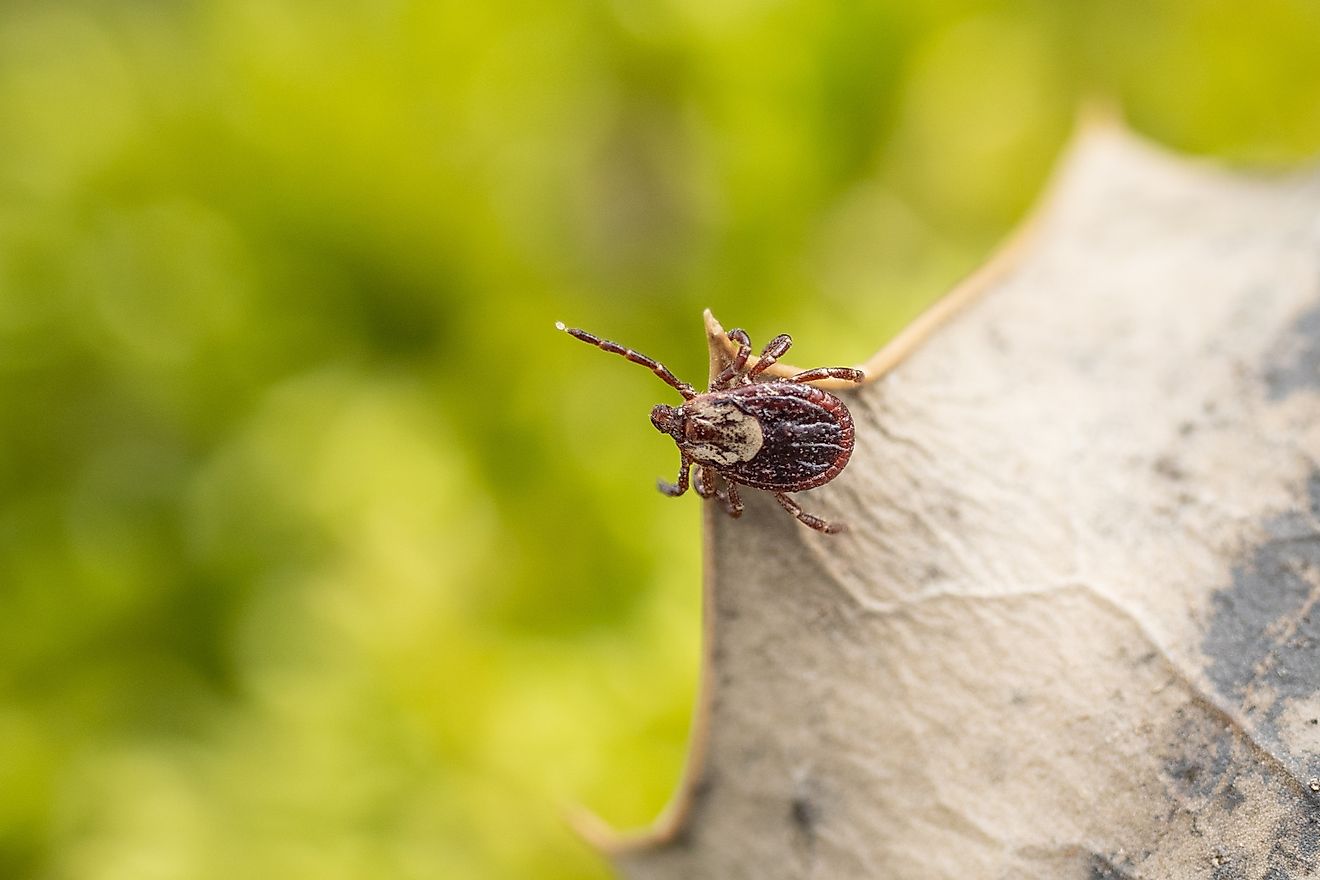
A Rocky Mountain wood tick. Image credit: James Gathany, Public domain, via Wikimedia Commons.
In recent surveys, Henry's Road produced the highest tick density at about 96 ticks per hour surveyed, followed by Dog Creek, East Gros Ventre Butte, Coyote Canyon, and Game Creek. An earlier CDC study in the same area found 21 percent of sampled ticks carrying Colorado tick fever virus, all of them in sagebrush above 7,000 feet. The annual "tick blitz" now tracks these patterns each May.
Poudre Canyon, Colorado
A hiker hikes a trail in Poudre Canyon, Colorado.
The Cache la Poudre River canyon west of Fort Collins, inside Roosevelt National Forest, is a good example of why case maps can understate the danger. Sampling in Larimer County has found wood ticks on the open, grassy canyon slopes in far greater numbers than inside nearby Rocky Mountain National Park, and one multi-year study measured Colorado tick fever virus in about 61 percent of the county's ticks, among the highest rates recorded anywhere. After a mild winter left tick numbers higher than usual, Colorado expanded active surveillance to more than 25 counties for the 2026 season, with Colorado tick fever and Rocky Mountain spotted fever the illnesses officials are watching for. Hikers, fishers, and rafters head up the canyon each spring to the Cache la Poudre, Colorado's only federally designated Wild and Scenic River, during the season when adult wood ticks are questing and most bites happen unnoticed.
Boulder County Foothills, Colorado
Grasslands in Boulder County, Colorado.
In the Front Range foothills immediately west of Boulder, some of the busiest hiking trails in Colorado overlap with strikingly high tick infection rates. Sampling here has found about 59 percent of wood ticks positive for Colorado tick fever virus, nearly matching neighboring Larimer County. The habitat is the classic wood-tick transition zone: grassland and shrub giving way to ponderosa pine at the base of the mountains, grazed by mule deer that carry the adult ticks.
A wood tick on animal fur.
Thousands of walkers head out on trails such as Mount Sanitas and through the Chautauqua meadows each spring, right when the ticks are most active. Rocky Mountain spotted fever stays rare statewide, with six cases reported across Colorado in 2025, but the same wood tick is its vector along these slopes.
Wasatch And Cache Valley Foothills, Utah
Dry mountain trail, Cache Valley, Utah.
The Rocky Mountain wood tick is the most common tick in Utah and turns up in nearly every county, but state surveillance finds the risk concentrated in the northern foothills above Logan, Ogden, and Salt Lake City. Crews there collect adults in sagebrush and mixed grasses, with larvae in tall, dry grass that has been flattened by passing deer and elk, at elevations between about 5,600 and 7,800 feet. Davis, Box Elder, and Weber counties account for some of the highest tick counts in the state. Colorado tick fever is Utah's most commonly reported tick-borne disease, with one to two human cases most years, followed by the occasional case of Rocky Mountain spotted fever. State health officials ask residents to submit any ticks they find for identification and testing.
Snake-Filled Waters In The RockiesDespite colder weather at higher elevations, snakes have found a home in and around major bodies of water in the Rockies.
Staying Ahead Of Tick Season
Across the Rockies, the risk runs from snowmelt through mid-July, so treat any spring outing in sagebrush or grassy foothills as tick country and reach for permethrin-treated clothing and repellent before you go. Health departments across the region want your specimens: Utah and Colorado accept ticks for identification, Teton County runs its annual tick blitz, and Wyoming and Montana require Colorado tick fever to be reported to the state. If fever, headache, and deep fatigue follow a bite, tell your provider you were in wood-tick country, because these are not the illnesses most clinicians outside the region think to test for first.
A note on cookies
Newshunt uses essential cookies to keep you signed in and to remember your language and country, so the site works the way you expect. With your permission, we'd also like to use analytics cookies to understand how people use Newshunt and improve it over time.
Accepting only affects analytics. To learn more, view our Privacy Policy or Terms & Conditions.
(0)Comments