


1961 North Carolina B-52 Crash Nearly Detonated Hydrogen Bomb
Category: Blend
Share
Archive
Like
In January 1961, a U.S. Air Force B-52 bomber broke apart in mid-air over North Carolina, releasing two thermonuclear weapons. While one parachuted safely into a tree, the other slammed into a tobacco field at 700 mph. Sandia Corporation reports later revealed that safety systems nearly triggered a catastrophic detonation.
Cold War strategic policy relied on constant vigilance, keeping nuclear-armed bombers airborne around the clock. Under a program originally named Head Start and later designated Chrome Dome, the U.S. military flew up to 12 B-52 Stratofortress aircraft daily over the Northern Hemisphere. These missions were designed to ensure that a retaliatory strike could survive a hypothetical Soviet first attack.
By January 1961, the bomber fleet had accumulated massive flight hours under demanding conditions that included aerial refueling. On January 23, 1961, a B-52G on a Strategic Air Command airborne alert mission departed from Seymour Johnson Air Force Base in Goldsboro, North Carolina. Carrying two Mk 39 Mod 2 thermonuclear weapons, the aircraft encountered trouble when the tanker crew reported a fuel leak in the bomber's right wing during refueling over the Atlantic.
Mid-Air Breakup and the Descent Over Faro
Instructed to stay over the ocean to burn off excess fuel, the pilot maintained control until the wing leak worsened significantly. According to accident reports, the aircraft lost 37,000 pounds of fuel in a two-minute period. Brought back over land for a stabilization run at approximately 10,000 feet, the aircraft lost structural integrity. The entire right wing separated, sending the bomber into an uncontrollable spin.
North Carolina Teen Charged with Murder in Deadly Mosque Shooting Livestream Case
On the ground below in Faro, North Carolina, 18-year-old Billy Reeves witnessed the disaster. Reeves watched the bomber roll over the tree line from his bedroom window just after midnight on January 24, 1961.
Flames climbed higher than nearby 100-foot pine trees as the aircraft broke apart along a path spanning roughly a mile and a half. Five of the eight crew members successfully bailed out and survived, while three others died.
Two Bombs, Two Very Different Fates
As the B-52 disintegrated between 2,000 and 10,000 feet, two thermonuclear bombs broke free from the payload bay. Each weapon packed a destructive yield roughly 250 times greater than the atomic bomb dropped on Hiroshima.
Photo: popularmechanics.com
Buncombe County School Bus Crash Leaves No Students Injured
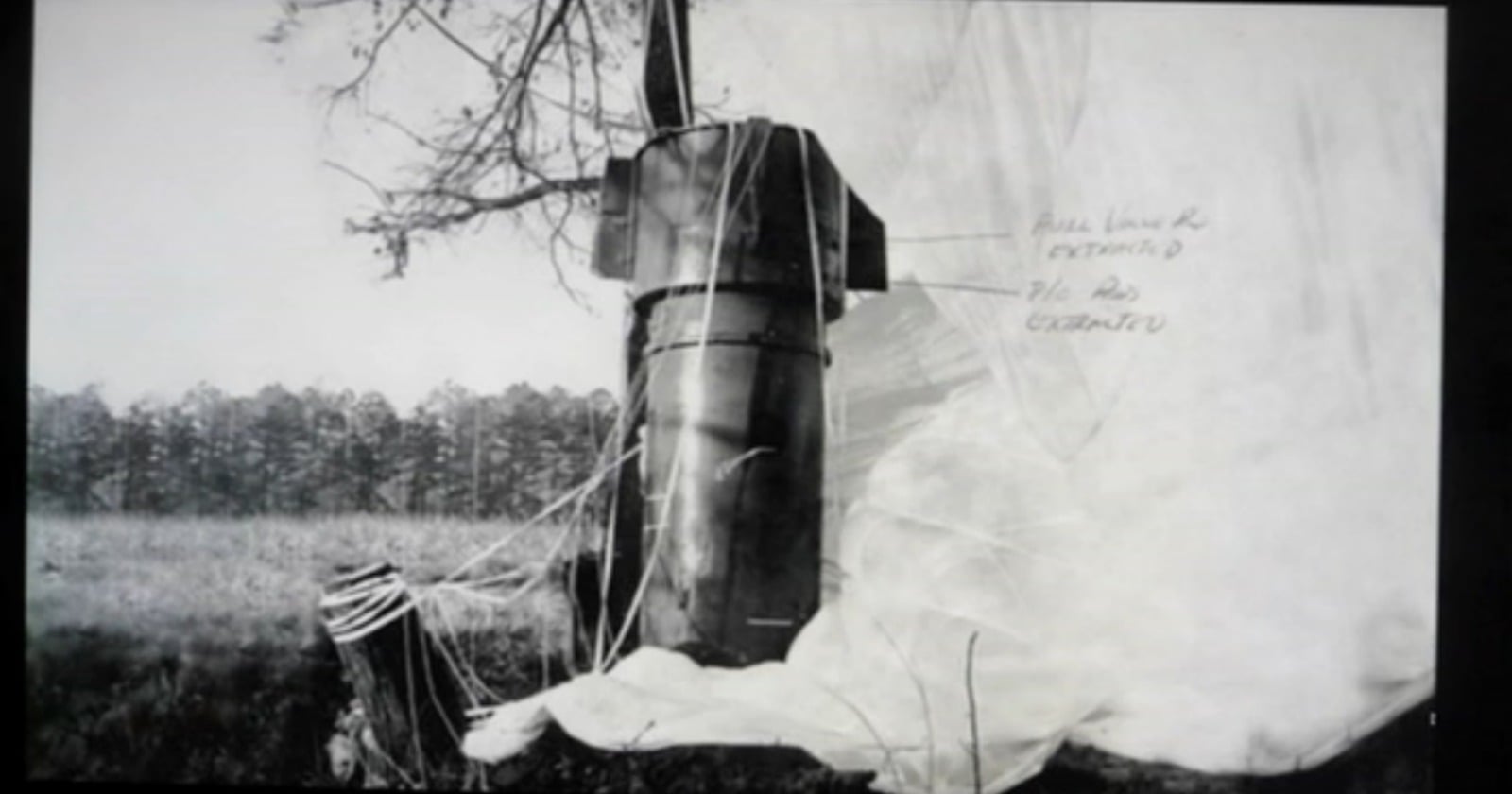
The first weapon descended under a normal parachute deployment, landing in a thicket of gum trees near Reeves's home. It hung suspended in the branches with its nose buried 18 inches into the sandy clay. Investigators examining this weapon discovered a terrifying sequence of events. Documents released through a Freedom of Information Act request revealed that the low-voltage thermal battery fired, the timer completed its cycle, and the trajectory-arming barometric switch registered all contacts closed. The high-voltage thermal battery also fired, and the crush switch in the nose supplied a fire signal on impact.
Photo: arstechnica.com
Catastrophe was averted solely because two internal safety switches remained untouched. As engineering reports concluded, the MC-772 arm-safe switch stayed in the safe position, blocking current from reaching the high-voltage safing switch behind it and preventing the firing capacitor from charging.
The second bomb suffered a different mechanical fate. Its parachutes failed to deploy, and it slammed into a tobacco field at approximately 700 miles per hour, carving a crater six feet deep and 15 feet wide. While recovery teams retrieved the primary pit containing conventional explosives and plutonium, the secondary component containing highly enriched uranium remained buried deep underground.
Federal Judge Extends Block on New USPS Mail-In Ballot Rules
Legacy of the Cold War Deterrence Strategy
Stephen Schwartz of the Bulletin of the Atomic Scientists noted that civilian and military policymakers operated under intense anxiety regarding potential Soviet sneak attacks. The Strategic Air Command relied on continuous airborne patrols to maintain a credible second-strike capability.
The B-52 Crash That Almost Detonated a Nuke Over North Carolina
The B-52 Stratofortress itself proved exceptionally durable, remaining operational decades later as the Air Force looks toward modern additions like the B-21 Raider. Yet the Goldsboro incident remains one of the most severe close calls in military history, exposing the hazardous reality of maintaining a continuous global nuclear watch.
Related
A note on cookies
Newshunt uses essential cookies to keep you signed in and to remember your language and country, so the site works the way you expect. With your permission, we'd also like to use analytics cookies to understand how people use Newshunt and improve it over time.
Accepting only affects analytics. To learn more, view our Privacy Policy or Terms & Conditions.
(0)Comments