


'God bless our troops, God bless America, and gentlemen, start your engines' 🏎️💨
Category: Entertainment
Share
Archive
Like
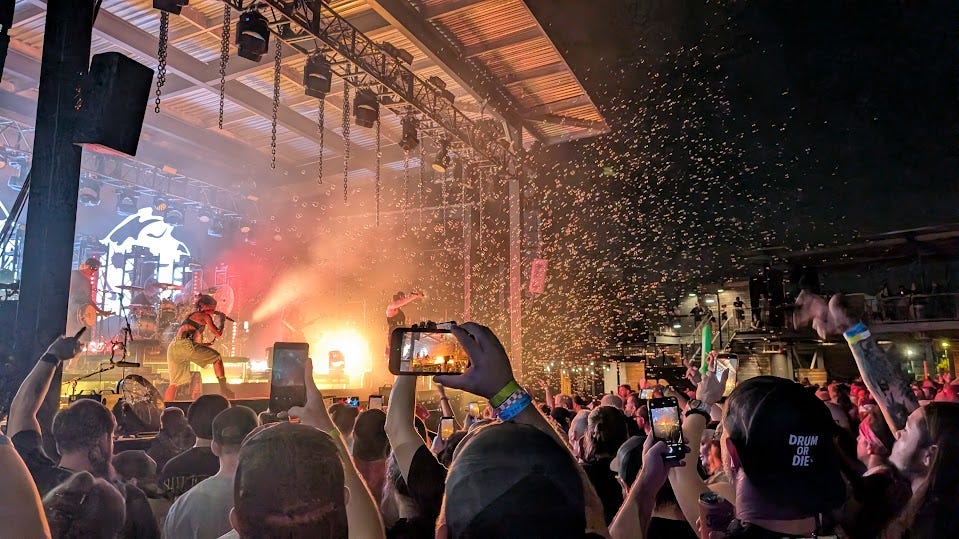
Minutes before the headliner, Bilmuri, took the stage on Sunday night in Birmingham, the guy in front of us turned around and introduced himself.
Flanked by my college roommate and his wife, we reciprocated. He proceeded to share that he had lost 50 pounds in the last six months due to severe illness, and asked if we would help him protect his girlfriend from the crowd. She stood about 5-feet-tall, a hundred-and-something pounds. Honoring the understood rules of the most pit, we enthusiastically responded yes.
Grateful, he proceeded to share that preceding his illness, he had been medically decommissioned after multiple deployments in the navy, and finished his brief explanation with a sincere, 'Thank you, guys. I really need this.'
This was my first Bilmuri concert, and honestly, I had been struggling to grasp the makeup of the audience. Alongside Austin 3:16 shirts and camo-style tour merch were women with inch-wide ear gages and hair died every color. There was no shortage of American flags in the audience either, but that part made sense to me, since the band's songs had samples of screeching eagles and revving engines in them.
I gestured to the guy and asked him how many people here he thought were veterans in the audience, he took a second to consider the question, and he confidently responded, '40%.'
Soon after the headliner took the stage, wave after wave of bone-rattling bass drums, soulful saxophone, and heavy metal guitar rifts combined nasally emo hooks visceral screams began to wash over me, and I understood.
There is internet lore debating whether or not the band is just some massive parody orchestrated by the middle-aged lead singer from his mom's basement in Ohio. The band and it's lead singer, Johnny Franck, doesn't shy away from the controversy either. Pulling froma profile compiled by Revolver Magazine early this year, 'In 2016, [Franck] launched the Bilmuri project and began releasing album after album of all-caps energy referencing lifting weights, doing Ohio shit and, of course, 'cranking hog' — a phrase that has morphed from jack-off slang into something closer to a quasi-religious philosophy about living life to the fucking fullest. All of it spills into his videos, which ride the line between purposefully half-assed — riding lawnmowers, stomping through the woods in a daze — and full-assed works of psychotic outsider art.'
But what I witnessed and experienced was a band that transcended the typical emo, pop punk and hardcore genres to get to the heart of the matter for so many typically drawn to the scene, trauma. More specifically, I felt that the music, performance and lyrics massaged the wounds and scars of PTSD that haunt specific groups of people, like those veterans in the audience that night. The slap-and-tickle balance struck between saxophone and electric guitar, intermingling male and female vocalists, the strobe lights, bubble machines and friendly moshing, made room for psychological safety, vulnerability and camaraderie in a high-intensity environment that likely mapped over the harmful experiences for so many in the audience.
To sample a few lyrics from their most played songs:'I, I don't want to be the bad guy no more… 'cause I'll always let you down.''I'm not saying that I'm perfect, so why am I the one that's hurting?''So, when they ask who hurt you, point the figure at myself, but I think of you. It's in the past, but I still do.''Maybe I'm crazy for risking my life, 'cause you'll be the one to kill me twice.''I'm still gettin' these concussions, throw my head against the wall, turning nothing into something, making everything my fault.''When the silence is suffocating me, feels like I can't breathe, so I isolate.'And finally, from the song where the lyrics for the title for this blog lives:'Why is it always up to you when I'm collateral damage?'
I don't have much experience working with veteran populations, but living in a society where we still agree (at least in principle) that they way we treat those who have served is a direct reflection of our moral and spiritual compass, I am at least aware of and sensitive to their reality. What those lyrics impressed upon me, especially in real time at that performance, was the internal turmoil of searching for meaning and purpose, experiencing neglect and harm, and reckoning with the depths of suffering, disregard and dismay as a result. This band, their concert, and the environment and community it cultivated was a safe space in that regard.
During the band's encore, the hundred degree heat index finally caught up to us as someone in the audience passed out. In a moment, everything came to a complete halt. The band stopped playing. The stage lights flooded the crowd. And a thousand people united in a moment to make sure that person was okay. For the uninitiated reading this account, the golden rule of any mosh pit is that when someone falls, you pick them up. I've spent more than decade trying every which way to encourage that mentality and practice in our broader society, and still nothing compares to the moment when someone reaches their hand out amidst bodies flying, surfing and colliding to pick a complete stranger up and bring them back into inclusion and [relative] safety in the mass of the crowd.
As that person was brought to their feet, the band asked for the crowd to make a walkway and commanded their stage crew to start passing out water. Once they were evacuated, the band momentarily found themselves at a loss for how to proceed. But then they thanked everyone for their responsiveness, for their attendance and for the opportunity to perform music for a living before enthusiastically shouting, 'let's run that back!'I think I'm done going back-and-forth about the male loneliness crisis. The solutions are out there, the work is already being done. It just needs more attention, resources and support.
'Gentlemen, start your engines.'Eagle screeches. Crowd roars.
Thanks for reading communitales! Subscribe for free to receive new posts and support my work.
A note on cookies
Newshunt uses essential cookies to keep you signed in and to remember your language and country, so the site works the way you expect. With your permission, we'd also like to use analytics cookies to understand how people use Newshunt and improve it over time.
Accepting only affects analytics. To learn more, view our Privacy Policy or Terms & Conditions.
(0)Comments