


Yale University Press Decides 100 ‘Jewish Lives' Are Enough
Category: Entertainment
Share
Archive
Like
'What do we expect of a Jewish life?' asks distinguished film historian David Thomson in his introduction to Warner Bros: The Making of an American Movie Studio, his splendid biography in the Yale Jewish Lives series of the four brothers, most prominently Jack Warner, who helped turn Hollywood into Hollywood. 'Surely the publishing test isn't based on the mere existence of anyone who happened to be Jewish?' Thomson continues. 'I doubt the editors of this series would proceed to print a full account of what might be plain or empty lives—say, Isaac of Prague (1171-1262), or Hirsch Wonsal (1781-1858), the one a tailor, the other a shoemaker…'
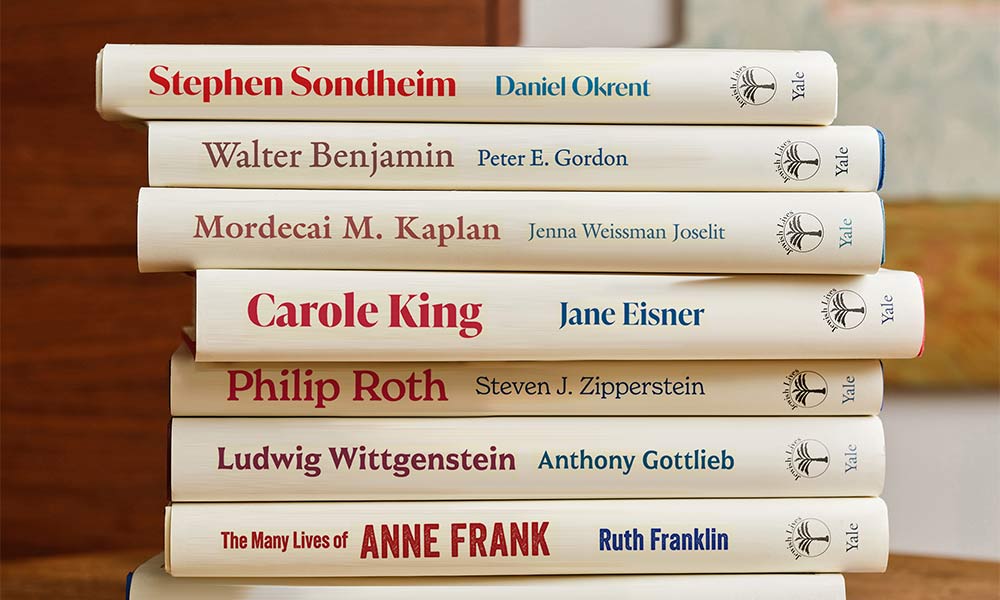
Well, no 'empty-lived' tailors or shoemakers yet (though Yale does include a lens grinder named Spinoza), but in the 81 volumes published since the series began in 2010, the range of Jewish lives brought to life by top-notch contemporary Jewish writers sprawls far and wide. The series is so varied, the publisher needs to break it down into categories: 'Antiquity' (e.g., Abraham, Rabbi Akiva); 'Arts/Culture' (Irving Berlin, Carole King); 'Business' (Julius Rosenwald); 'Entertainment' (Barbra Streisand, Stephen Sondheim); 'Law/Politics' (David Ben-Gurion, Louis Brandeis); 'Literary Arts' (Franz Kafka, Arthur Miller); 'Philosophy/Religion' (Maimonides, Gershom Scholem); 'Science' (Franz Boas, Albert Einstein); and even 'Rogues' (Bugsy Siegel, Sidney Reilly).
The volumes are a partnership of Yale University Press (YUP) and the Leon D. Black Foundation. When Yale launched the series, it credited Black, the billionaire former CEO of Apollo Global Management and well-known Jewish philanthropist, with the idea. Black commented that he saw 'a hunger for books that zero in on the fascinating questions at the core of the Jewish experience, whether secular or religious.' In a note on the website of JewishLives.org, the Foundation's site for promoting the series that is separate from YUP's, Black states that he was 'inspired to found Jewish Lives in response to a question one of my sons asked relating to Jewish identity and continuity.'
Black got in touch with Steven J. Zipperstein, the Daniel E. Koshland Professor in Jewish Culture and History at Stanford University. Zipperstein then connected with Ileene Smith, a former editor-at-large for Farrar, Straus and Giroux who had joined Yale University Press in 2006 with the mandate to develop 'a distinguished trade list' for the university press. She became the editorial director of Jewish Lives. Zipperstein also brought in Anita Shapira, the now-retired distinguished Israeli scholar of Jewish history, as a second series editor, and all three worked on the scores of titles. The essential idea of Jewish Lives, according to Zipperstein, 'is to display the astonishing diversity of Jews and their preoccupations over the course of the centuries.' Accordingly, the editors haven't wanted to impose what both Zipperstein and Smith call 'cookie-cutter' rules for the volumes, and have left it to individual authors to determine the Jewish dimension of their texts.
Each subject in the series is paired with a known writer, something that was part of the series from the beginning. Says Smith, 'I was excited to draw on my editorial relationships with leading biographers, and to pair them with just the right subjects. What interested me was the publication of books written in a distinctive style, each one with a very individual voice.' John Donatich, Yale University Press's director at the time, also stressed the importance of the synergy between biographer and subject: 'The degree of thought that has gone into each pairing of subject and author will produce a corpus of biography of unusual distinction.'
The biggest reason for the series to continue is that it has, over and over, by its inspired sweep across a formidable array of Jewish subjects, answered David Thomson's question, 'What is a Jewish life?'
Among the inspired pairings are Jack Miles, who won a Pulitzer Prize for God: A Biography, on Jesus; former IDF chief education officer Mordechai Bar-On's take on 'controversial hero' Moshe Dayan; the great Holocaust historian Saul Friedlander on Franz Kafka; acclaimed Hollywood chronicler Neal Gabler on Barbra Streisand; and Hebrew scholar and Bible translator Robert Alter on his longtime friend Amos Oz.
The series doesn't aim at fresh Jewish scholarship, though some authors have delivered it. Rather, the series seeks to bring the fruits of Jewish scholarship to general readers in compact, stylish and accessible form, in the manner of Nextbook/Schocken's former 'Jewish Encounters' series or the 'Jewish Thinkers' series for Halban Publishers in the UK, for which Zipperstein himself wrote a volume on the essayist Ahad Ha'am. The Nextbook series focused on themes and ideas rather than people, with volumes such as David Mamet's The Wicked Son: Anti-Semitism, Self-Hatred, and the Jews and Melvin Konner's The Jewish Body. The Halban series passed on rogues and entertainers to target major Jewish thinkers, politicians and writers such as Rashi, Martin Buber and Haim Arlosoroff.
Jewish Lives differs from the standard academic book series in its targeting of mainstream Jewish readers and, effectively, everyone interested in Jewish life. Rebecca Keys, managing director of Jewish books for the Black Foundation, says, 'We believe Jewish Lives biographies should be objects of pride in every home. The books are meant to be read, shared and displayed. Indeed, every Jewish home should have a Jewish library, and the cornerstone of that library should be Jewish Lives.'
Thanks to Black's largesse, Jewish Lives implemented that goal by paying trade-book advances—rather than the pittance most academics get for scholarly monographs—to professional journalists, writers and academics who know how to write for a non-scholarly readership. 'We never would have gotten the authors we've published, otherwise,' notes Smith.
In 2014, the series won the Jewish Book Council's Jewish Book of the Year Award, the first time the Council had awarded that honor to an entire series. More recently, the 2022 volume on the prophet Elijah by eminent Kabbalah scholar Daniel Matt won the $50,000 Rabbi Sacks Book Prize. A list at the end of each volume alerts the reader to forthcoming titles, among them Robert Oppenheimer by David Rieff, best known as the author of books about international conflict and humanitarian aid, and—surprise!—Fiorello La Guardia by much-honored biographer Brenda Wineapple in 2027. (The famous New York City mayor's mother was Jewish.)
But there's the rub. Add the 19 or so 'forthcoming' volumes to the 81 already published and that's it. YUP's new director, Niko Pfund, the former longtime president of Oxford University Press, USA, confirms 'Jewish Lives' is ending there. 'Yale University Press,' Pfund said in an email, 'is no longer commissioning new books in the series, in keeping with YUP's vision of aiming for publishing up to 100 books in the series. With regard to its contractual obligations for books commissioned, many contracted years ago, we will of course fulfill our commitment to our authors and see these books through to publication.'
For those who love the series, it's a dart in the heart. No forthcoming Jeffrey Epstein in 'Rogues' (or is that 'Business'?) or Woody Allen in 'Entertainment' (or would it be 'Rogues')? No Benjamin Netanyahu or Jerry Seinfeld or Jared Kushner? Come to think of it, there are more than 100 Jewish lives!
Is the decision to kill Jewish Lives just a shift in taste and agenda on the part of the new director? Pfund replaced Donatich, the longtime Yale director, on July 1, 2025. Asked about the decision, Smith, who will continue to shepherd the remaining volumes into print, replies with admirable delicacy, 'I think Niko wants to forge his own path at the Yale Press, which makes perfect sense.'
Pfund appeared to confirm that judgment in a wide-ranging interview with YaleNews last October. Asked, 'What is the role of a series in a publisher's list?' he replied, 'I'm a big fan of series—but I'm a big fan of series that have a beginning and middle and an end. It's really important when you launch a series to think about what the intellectual contours of the series are up front, what purpose it is serving, and then to build in stage gates, ideally once a year, where you assess how it's going, on academic grounds, intellectual grounds, commercial grounds. And then to be willing to change course or even back away from it if it has outlived its usefulness.'
All of that sounds reasonable enough. However, when asked for this article whether he decided to end Jewish Lives, he responded that 'this decision preceded my arrival at the Press and was in keeping with the Press's decision to cap its publishing in the series at no more than 100 books.'
Money doesn't seem to explain the shutdown. Smith notes that YUP has made a 'not insignificant' amount from Jewish Lives. 'On the bestseller side,' Pfund says, three volumes are among the top performers: British psychotherapist Adam Phillips's Becoming Sigmund Freud: The Making of a Psychoanalyst; legal scholar Jeffrey Rosen's Louis D. Brandeis: American Prophet; and prolific novelist Francine Prose's Peggy Guggenheim: The Shock of the Modern.
Regarding the future, while Leon Black did not respond to a request for comment, the foundation's Rebecca Keys suggests that Jewish Lives is looking for a new home, and Smith adds that 'Leon cares deeply about Jewish Lives.'
Why wouldn't he? A survey of scores of book reviews of Jewish Lives volumes over the years reveals near-unanimous praise, and the books receive frequent attention in prestigious media outlets. The New York Times, for instance, praised Paul Mendes-Flohr's Martin Buber as 'scrupulously researched, perceptive,' demonstrating 'authoritative command.' And The Australian, extolling Martin Goodman's Herod the Great, called it 'typical of the Yale Jewish Lives series: short, clear, illuminating.'
Thanks to Black's generosity, Jewish Lives boasts authors who write lively, accessible prose rather than indigestible academic gruel. The few critical naysayers on the series seem to misunderstand its stated goals. A Los Angeles Review of Books critic complained that the Freud volume 'even with index cannot reach 200 pages.' A Jewish Chronicle reviewer huffed that while author Benjamin Taylor set Proust in his Jewish context, he failed to explain 'why Proust still matters to readers.' The reviewer ignored the book's explicit premise that while everyone knows Proust still matters, most understand next to nothing about his life's Jewish dimension.
Let's then celebrate the series itself—a magnificent array of books that demonstrates in kaleidoscopic detail the rich variety of Jewish life. Consider the challenging divergences among the series's subjects. Some are inextricable from their Jewishness: former New York Times reporter Joseph Berger's Elie Wiesel ('The most admired ambassador of the Jewish faith in the world') and Yiddish Book Center senior writer Ezra Glinter's Menachem Mendel Schneerson ('His theology transformed the face of modern Judaism').
Others during their lifetimes viewed their Jewishness as tangential, requiring their biographers to frame them differently. Thomson, the film historian, writes that the four Warner brothers 'longed to transcend Jewishness.' Adina Hoffman tells of how Ben Hecht 'only became a Jew in 1939' upon learning about the slaughter of Jews in Europe, then, after embracing his identity, devoted much of his fabled energy to anti-Nazi causes. Adam Begley's Houdini doesn't even mention Jewishness in its prologue, but it's there in the index. Neither does Allen Shawn's Leonard Bernstein, but Shawn gets around to a nuanced discussion of Bernstein's 'Kaddish' symphony. John Lahr's Arthur Miller doesn't include Jewishness in his introduction or index, but Lahr quickly locates Miller's moral instincts in 'the intellectual fervor and moral intensity of the Jewish community.' Stephen Sondheim 'barely considered himself Jewish,' writes Daniel Okrent, ending up 'a Jew to the goyim' but 'not to himself.'
Some of the biographers promise that while their subjects downplayed their Jewishness, they will extract it. Ayn Rand 'claimed that being Jewish did not matter to her,' but her biographer Alexandra Popoff wryly titles her first chapter 'Born Jewish.' 'While it was previously assumed that she did not pursue Jewish themes,' Popoff explains, 'this book will argue otherwise by revealing connections between Rand's formative years in a traditional Jewish milieu and the stories she told in her books.'
Similarly, Shlomo Avineri, the late Israeli political theorist, observes that many previous biographers, including Avineri himself, 'consciously avoided' the Jewish roots of his man, Karl Marx, partly because Marx never publicly referred to his Jewish origins. Writes Avineri, 'Marx cannot be seen as a 'Jewish thinker,' and his knowledge of matters Jewish was minimal. Nor did his biography follow any pattern of Jewish life. Yet his Jewish origins and background did leave significant fingerprints in his work, some of them obvious and others less so. One of the aims of this book is to put this background in its proper and balanced perspective.' He provocatively argues that Marx's embrace of the proletariat evolved from Jewish values.
A further eye-opening contrast as one reads through the series is the different challenges presented by grappling with a still-living subject, or one the author knew before the subject died, and the quite dissimilar task of recounting the life of an ancient figure. John Lahr, for instance, enjoyed a long friendship with Arthur Miller. Steven Zipperstein knew Philip Roth. Their explanations of how that affects a biography enlighten. Jane Eisner, however, couldn't get the still-living Carole King to agree to an interview, yet soldiered through with admirable journalistic tenacity and produced a fine result.
Jewish Lives boasts authors who write lively, accessible prose rather than indigestible academic gruel.
Equally compelling is how biographers such as Anthony Julius (on Abraham) and Barry Holtz (on Rabbi Akiva) manage to do their job despite, shall we say, some uncertainties. Consider this paragraph from Holtz's introduction to Rabbi Akiva: Sage of the Talmud, a man for whom the term 'circa' might have been invented:
'We don't know where Akiva was born and even where he lived in later life. He is sometimes associated with the town of Bene-Berak, but the association derives from fewer than a handful of passing references in the literature. And finally, we do not know where he died or where he is buried. Most sources will state with assurance that he was executed and buried in the northern coastal city of Caesarea, but in fact the actual rabbinic stories about his execution, as we will see in chapter 7, do not mention the place where he died.'
Still, by the end of 248 pages, Holtz accomplishes the magisterial job of capturing Rabbi Akiva's life—and his hugely influential thought—as they matter to us today.
Not every joy of this series rests on the philosophical and profound. One guilty pleasure of the books is slowly compiling the real names of many of its subjects: Jerome Rabinowitz (Jerome Robbins), Stanley Martin Lieber (Stan Lee), Izzy Baline (Irving Berlin), Alisa Rosenbaum (Ayn Rand), Amos Klausner (Amos Oz), Melvin Kaminsky (Mel Brooks).
Another enjoyable game is counting up the Yiddish droppings, some clearly included to display the bona fides of the biographers. You can't get through Jeremy Dauber's Mel Brooks without a lot of shpritz and shtup, or Neal Gabler's Barbra Streisand without learning that her grandmother considered her farbrent (fiery).
So why, oh why, is Yale canceling this wonderful series? It clearly hasn't (to use Pfund's formulation in YaleNews) 'outlived its usefulness.'
Asked directly if he thinks it has, Pfund replies, 'It's less a question of whether Jewish Lives 'outlived its usefulness'— obviously there are more than 100 Jewish people who merit biographies—and more a subjective assessment on YUP's part on the best use of its resources given the breadth of its mission.'
Why, though, lose the support of a billionaire like Leon Black? 'It's not appropriate for me to get into the finances of our publishing,' says Pfund, 'but, as you know, advances are only one component of any publishing arrangement.' He likewise dismisses any suggestion that YUP's ending of Jewish Lives might involve a distancing of YUP from Black, who has recently been battling a congressional committee over testimony about his ties to Jeffrey Epstein.
Pfund also says he's not concerned that, given the widely reported resistance growing in book publishing among professionals on the left to Jewish or Israeli projects—in some cases when staffers lower down in a publishing house lobby decision-makers higher up—outsiders may see YUP's decision as part of that syndrome. Pfund replies, 'Absolutely not. I can assure you that no such objections have been raised.'
Smith, asked if she thinks resistance to Jewish and Israeli projects in publishing played any part in the shutting down of the series, replies, 'Not that I'm aware of.' Donatich, Pfund's predecessor, does not wish to comment on current YUP business, says publicity director Jennifer Doerr.
Smith, however, adds: 'I don't think John 'ended' the series. There was a consensus from early on that it would encompass roughly one hundred acquisitions. We got there over the course of many years—well more than a decade, and John's recent departure made it a logical place to stop. That said, we will be publishing for two more years. We'll see what the future brings.'
One hopes Yale reconsiders the decision on Jewish Lives, or that another prestigious publisher picks it up. Multiple reasons seem obvious. Jewish Lives is the most extensive series of Jewish biographies ever published in English. Its authors are the most accomplished and distinguished writers to contribute to such a series. It's the most critically acclaimed series of its kind. It's the most commercially successful. A billionaire is paying a lot of the bills.
But the biggest reason for the series to continue is that it has, over and over, by its inspired sweep across a formidable array of Jewish subjects, answered David Thomson's question, 'What is a Jewish life?'
The answer that emerges: It's ultimately what a Jew chooses to make it. Many Jewish leaders resist the idea of à la carte Judaism, which permits Jews to decide exactly how Jewish their lives are going to be. Yet if Jewish Lives demonstrates anything, it's that the very multitude of opinions and choices that marks the Talmud and the history of secular Jewish thought—that old joke about three Jews and five opinions—plays out colorfully in Jewish biography. Bugsy Siegel, say hello to Menachem Schneerson.
Finally, there's one last reason for Jewish Lives to continue, whether in the lap of Princeton University Press, or University of Chicago Press, or some equally illustrious publishing house. A slew of other sublimely named members of the tribe—among them Benjamin Kubelsky (Jack Benny) and Hollywood's first Odysseus, Issur Danielovitch (Kirk Douglas)—remain to be revealed.
A note on cookies
Newshunt uses essential cookies to keep you signed in and to remember your language and country, so the site works the way you expect. With your permission, we'd also like to use analytics cookies to understand how people use Newshunt and improve it over time.
Accepting only affects analytics. To learn more, view our Privacy Policy or Terms & Conditions.
(0)Comments