


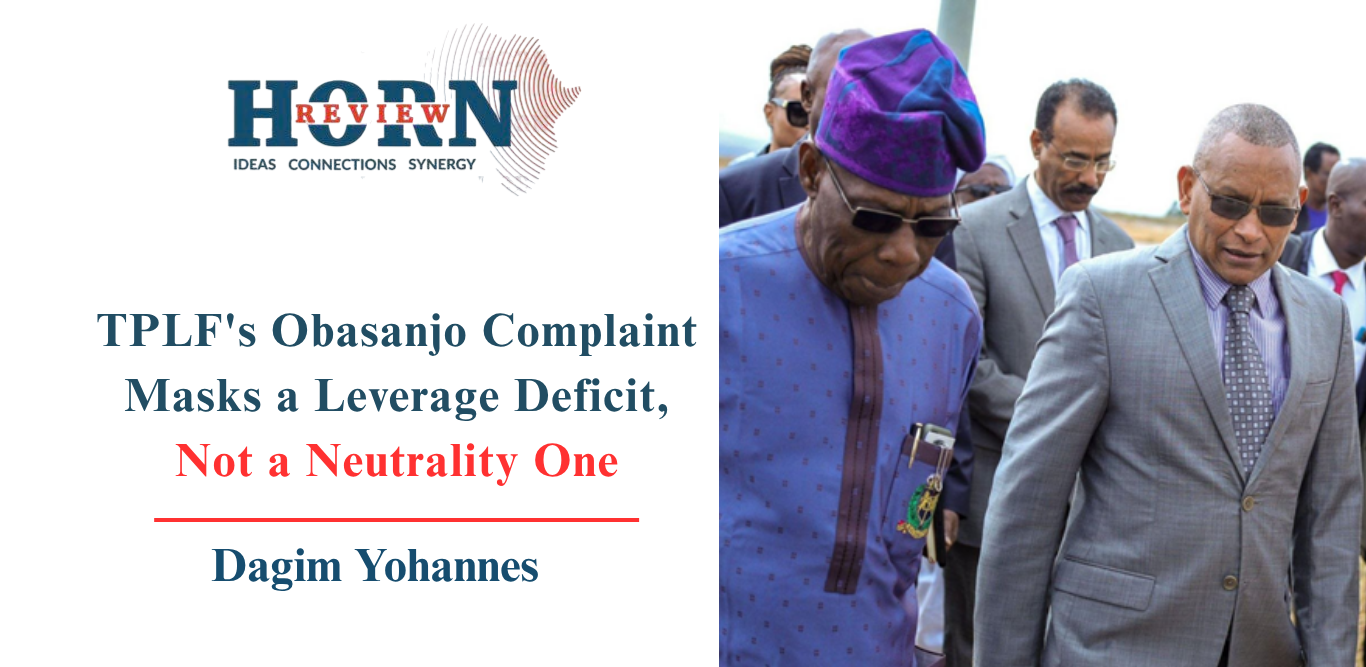
TPLF's Obasanjo Complaint Masks a Leverage Deficit, Not a Neutrality One
Category: Politics
Share
Archive
Like
The Tigray People's Liberation Front's September 6 statement accusing Olusegun Obasanjo of lacking neutrality is a tactical retreat dressed up as a principled objection. Four years after the Cessation of Hostilities Agreement, Tigray's leadership still has no answer to the problem that actually determines outcomes in this conflict: it holds no leverage capable of forcing federal compliance. Recasting that impotence as a mediator's failure is therefore a narrative substitute for a strategy the TPLF does not have. The sequencing TPLF itself supplies undercuts its own case. Obasanjo visits Mekelle in June, five entry points for dialogue are identified, nothing follows. He returns in August, again nothing follows. TPLF's response is to demand a different envoy rather than to account for what it did in the intervening two months to generate pressure of its own. An organization that has outsourced its entire peace strategy to the travel schedule of an African Union appointee is not well positioned to complain that the schedule has not produced results. Impartiality complaints are not a substitute for leverage; they are what an actor issues once it has run out of the latter.
TPLF's account of why Obasanjo delayed his return that federal officials asked him to wait for the National Dialogue Conference to conclude comes from TPLF's own statement and is unverified from any independent source. Even taken at face value, a two-month gap in a mediator's shuttle schedule is not proof of federal capture of the process; it is, at most, a scheduling decision TPLF has chosen to read in the least generous light available. What the statement does not do is more telling than what it alleges: it names no alternative broker, proposes no verification mechanism, and does not explain why the AU High-Level Panel it also blames for CoHA's ( Cessation of Hostilities Agreement) weak monitoring would perform any better under different stewardship. A complaint about the mediator's timeline, unaccompanied by any concrete alternative, functions less as a process objection than as a way of registering grievance for an international audience without committing TPLF to a course of action that could be tested against results. The two months TPLF spent waiting on Obasanjo were not idle for all parties. Ethiopian officials have long alleged that TPLF used this period to deepen coordination with what they call Tsimdo, an informal alignment they describe as linking Eritrea, TPLF hardliners, and other federal opponents. TPLF and the actors named dispute the characterization as a fabrication designed to discredit them. Independent of that dispute, ACLED's conflict monitoring documents that, a Tsimdo-linked gathering in this window drew Eritrean-aligned actors, Sudanese Armed Forces leadership, dissident Ogaden National Liberation Front factions, and Amhara nationalist figures, and that the alliance's operationalization is already visible on the ground corroborated by observed federal armor movements into Welkait in response. Whatever the truth of TPLF's own role, the documented activity of actors in its orbit sits uneasily with the statement's self-portrait of an organization waiting patiently on a stalled mediator.
The statement's readiness for dialogue is also worth testing against what it never specifies. TPLF says it will engage in a 'credible, reality-based and time-bound process,' but the five entry points identified in June were never disclosed publicly, and the 6 September statement itself names no negotiable issue more concrete than 'impartial mediation.' A party that has spent four years cataloguing grievances, blockade, siege, drone strikes, Sheraro deployments but has not stated what outcome on any single one of them would constitute progress is not yet negotiating; it is stating preconditions for beginning to negotiate. That distinction matters because it is symmetrical: if TPLF can condition talks on mediator selection, the Federal Government is equally entitled to condition talks on TPLF halting its coordination with Tsimdo-linked actors and accepting a jointly selected mediator in Obasanjo's place. The statement gives no indication of how TPLF would respond to that reciprocal demand, whether it would suspend the cooperation in exchange for talks, or attempt to run both tracks simultaneously, treating negotiation and alliance-building as parallel rather than competing strategies. Until TPLF states which of its stated grievances it would trade for a seat at the table, and under what mediator it would actually show up, its claimed commitment to dialogue is unfalsifiable, it costs TPLF nothing to declare readiness for a process it has not yet had to actually enter.
The claim that inadequate AU monitoring allowed CoHA's implementation to 'fall under federal control' deserves more scrutiny than TPLF gives it. Implementation did not drift into federal hands by accident; the agreement TPLF signed in 2022 contained no independent verification architecture to begin with. Four years of retroactive outrage over a defect visible at signing is either an admission that TPLF understood the gap and accepted it anyway, in which case the present complaint is post hoc, or an admission that it did not understand the terms it was accepting, which is a harder concession about the quality of its own negotiating position and one the statement is careful not to make.
The statement's most rhetorically effective claim is also its least substantiated: that federal officials have cited Nigeria's civil war and the defeat of Biafra as a template for resolving the Tigray conflict. If accurate, this is a serious signal that Addis Abeba's actual objective is military defeat rather than negotiated settlement, and the comparison to a war that ended in blockade, starvation, and the collapse of a secessionist army is a legitimate flag for the international community to press on. But TPLF supplies no name, no forum, and no date for the remark, despite dating every other event in the statement with precision, the June visit, the August visit, the four-year CoHA anniversary. A claim this inflammatory, made this vaguely, in a document otherwise attentive to specifics, reads as a rhetorical device selected for its emotional weight rather than a documented fact offered for verification. The same pattern holds for TPLF's characterization of Prime Minister Abiy Ahmed's parliamentary remarks, which it interprets as evidence that the Federal Government no longer considers CoHA binding without quoting the remarks themselves. An organization that practiced in public messaging knows the difference between reporting what was said and reporting what it concluded from what was said. It chose the latter.
Read together, the undated Biafra citation and the uncited parliamentary remarks are not isolated lapses but the load-bearing elements of a single argument: that Addis Ababa has already abandoned CoHA in substance, so TPLF's own eventual withdrawal from the process would be a response to federal bad faith rather than a choice. Pairing a declared readiness for 'peaceful dialogue' with a catalogue of blockade, siege, drone strikes, and an unaccountable mediator is not a serious offer to negotiate. It is groundwork laid so that if talks collapse, the collapse is legible internationally as the Federal Government's doing rather than the product of an impasse both sides have a hand in.
The United States' response exposes the gap between TPLF's rhetorical position and its actual standing with the external actors it depends on. Washington did not engage the neutrality question at all. It reaffirmed Obasanjo's continued involvement and pivoted immediately to drought response and the safe, dignified return of displaced people, a framing that treats the mediator question as settled and moves past it. TPLF is contesting who should broker the peace process at the exact moment its most important international interlocutor has signaled it does not intend to relitigate that question. A demand for a different mediator, issued into that vacuum, is not a negotiating position so much as a statement for the historical record.
The statement's claims of federal bad faith continued drone activity, troop deployments, attacks near Sheraro rest on the same evidentiary standard as its complaint against Obasanjo: TPLF's own characterization, offered without external corroboration, at a moment when TPLF has a clear interest in shaping how any future breakdown in talks is perceived. Set against TPLF's own unresolved position on Tsimdo-linked coordination and its refusal to specify a single negotiable issue, the statement reads less as a call for a fairer process than as the opening argument in a case TPLF is building for why the process was never going to work, a case authored well before the process has actually failed, and structured so that its failure, when it comes, will look like it was done to TPLF rather than by TPLF or with it.
By Dagim Yohannes, Researcher, Horn Review
A note on cookies
Newshunt uses essential cookies to keep you signed in and to remember your language and country, so the site works the way you expect. With your permission, we'd also like to use analytics cookies to understand how people use Newshunt and improve it over time.
Accepting only affects analytics. To learn more, view our Privacy Policy or Terms & Conditions.
(0)Comments