


Bank employee is not ‘public servant' under IPC, rules HC
Category: Politics
Share
Archive
Like
Nagpur:
An employee of State Bank of India (SBI) cannot be treated as a 'public servant' under IPC's Section 21 merely because he's a bank employee, the Nagpur bench of Bombay High Court has held, quashing a criminal charge against a 65-year-old educationist, who was accused of assaulting a public servant.
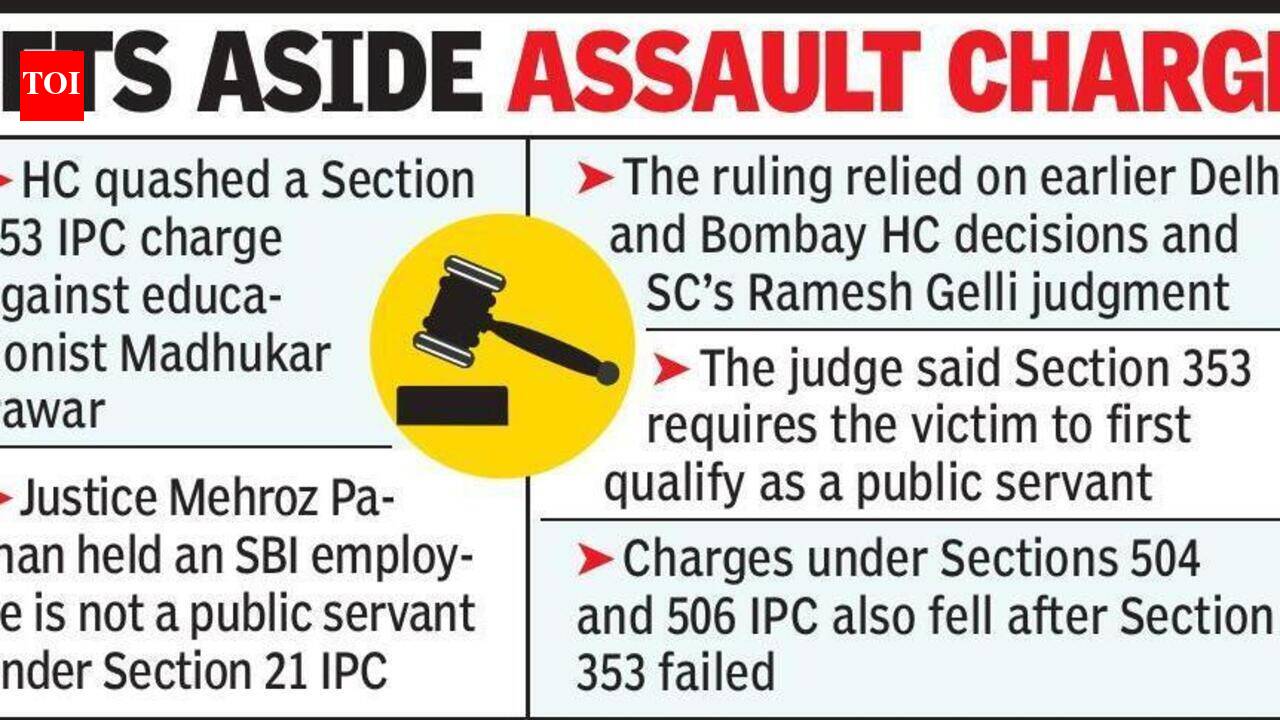
Justice Mehroz Pathan, last week, allowed the criminal revision by Madhukar Pawar, resident of Akola district. The judge set aside the district sessions court's Nov 2025 order, which rejected Pawar's discharge application and framed a charge against him under Section 353 IPC.
The case arose from a complaint by an SBI employee. Pawar's counsel, V R Deshpande, argued that Section 353, which criminalises assault against a public servant to deter him from performing official duty, could not be invoked because the complainant himself did not fall within Section 21's definition of a public servant.
Justice Pathan accepted the argument, relying on earlier rulings of Delhi and Bombay high courts concerning the status of bank employees under IPC. He also examined Supreme Court's 2016 judgment in CBI, Bank Securities & Fraud Cell versus Ramesh Gelli, which the prosecution cited to contend that bank employees were public servants.
The State, represented by additional public prosecutor Prachi Joshi, relied on Supreme Court's interpretation of Section 46-A of Banking Regulation Act, 1949.
'The apex court's observations in the case of Ramesh Gelli show the accused, who was a bank employee, was not a public servant within the meaning of Section 21 of IPC,' Justice Pathan observed.
The court said the same principle had to apply to the bank employee who was the complainant in the present case.
'For proving the offence under IPC's Section 353,' the court said, three essential clauses need to be established: the victim must be a public servant; the accused must have committed an assault or used intentional criminal force; and the act must have been intended to prevent or deter the public servant from performing official duties.
'In so far as other offences under Sections 504 and 506 of IPC are concerned, the same are non-cognisable offences,' the judge further held. Since the Section 353 charge itself was not sustainable and the requisite magistrate's permission under Section 155 of Code of Criminal Procedure had not been obtained, those offences too could not stand in the case, it said.
The court consequently quashed the Nov 1, 2025, order rejecting Pawar's discharge application and set aside the order framing the Section 353 IPC charge against him.
You Can Also Check:
Gold Rate in Nagpur
|
Silver Rate in Nagpur
|
Bank Holidays in Nagpur
|
Public Holidays in Nagpur
|
Petrol Price in Nagpur
|
Diesel Price in Nagpur
|
CNG Price in Nagpur
|
LPG Price in Nagpur
Stay updated with the latest Nagpur news. Download the TOI App.
A note on cookies
Newshunt uses essential cookies to keep you signed in and to remember your language and country, so the site works the way you expect. With your permission, we'd also like to use analytics cookies to understand how people use Newshunt and improve it over time.
Accepting only affects analytics. To learn more, view our Privacy Policy or Terms & Conditions.
(0)Comments