


Pakistan's grape heartland battles heatwaves, drought and falling water tables
Category: Financial
Share
Archive
Like
QUETTA: Malik Muhammad Younus Shahwani entered his grapes orchard on a sunny morning this August and walked by grapevine plains stretched upon acres of land in Killi Khalli area in the west of Quetta, the capital of Pakistan's southwestern Balochistan province.
The 72-year-old has been carrying the legacy of his ancestors by taking care of the grape orchards planted by his grandfather 125 years ago, but fears that these century-old plantations would disappear in few years due to intense heatwaves, droughts and plummeting water-levels.
Pakistan produces around 88,000 tons of grapes annually and Balochistan accounts for the country's 70-80 percent yield, according to the local farmers association. Quetta, Mastung, Kalat, Pishin and Killa Abdullah districts are known for cultivation of this small berry that starts from July and lasts till August-end.
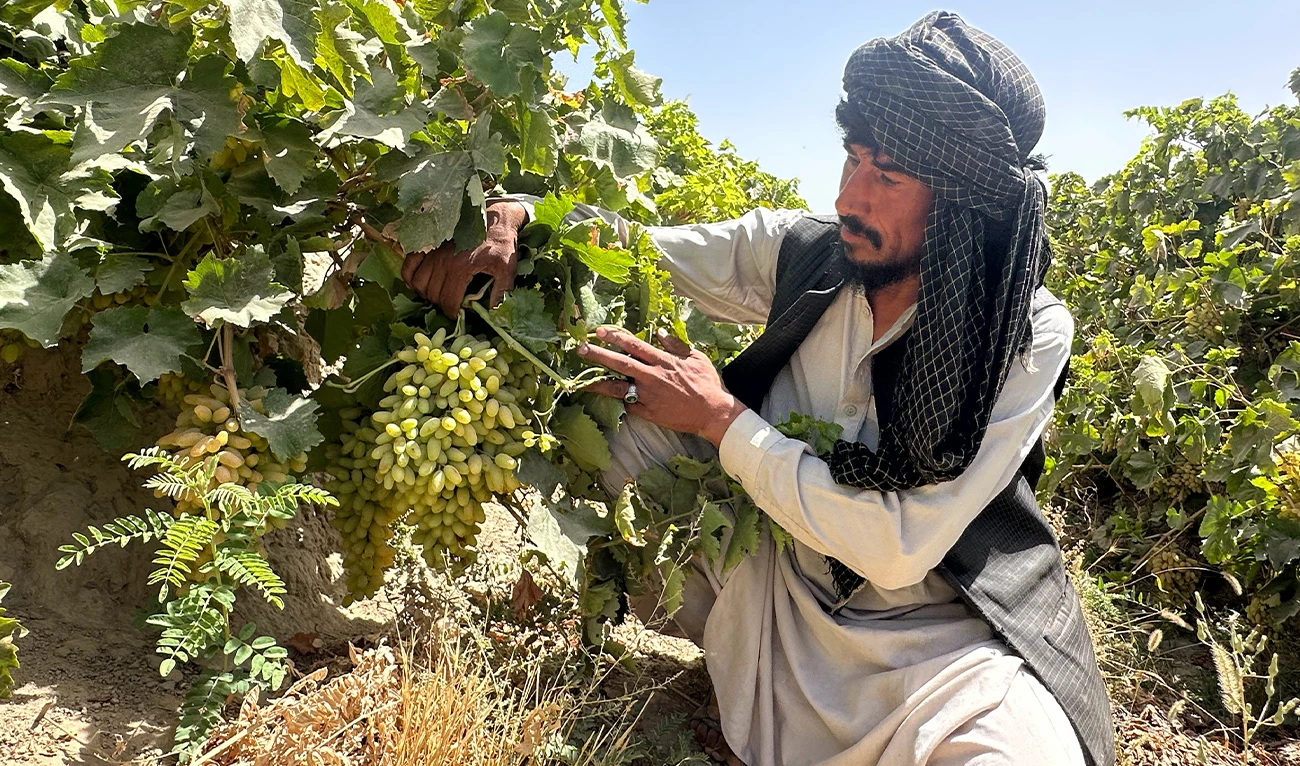
Clusters of ripe grapes hang from vines at a vineyard in Quetta, Pakistan on September 30, 2026. (AN photo)
But over the past few years, the production of grape, apricot, peach and apple have drastically reduced in the region, which farmers and experts attribute to climate change in the South Asian country of more than 240 million people.
'This weather unpredictability has severely affected my orchards,' Shahwani told Arab News. 'If you walk into these traditional grapes' vineyards, you will find many dried grapevines and insects will get all over your clothes.'
Pakistan is considered one of the most vulnerable nations to climate change and has experienced increasingly erratic weather events, including heatwaves, droughts, cyclones, extreme rainfall and floods, in recent years.
In 2022, climate-induced floods washed away 4.5 million acres of farmland in Pakistan, destroying agricultural fields and fruit orchards, including hundreds of grape vineyards in Balochistan.
'This province used to be called a fruit bucket with hundreds of thousands of tons of annual fruit production but the fruit yield and quality have decreased over the years due to drought and extreme heat,' Abdul Rehman Bazai, secretary-general of Balochistan Zameendar Action Committee, told Arab News.
'Today, our water-level has dropped down to more than 1,000 feet,' he said, criticizing the government for not doing enough to tackle the issue.
LOW-DELTA CROP
Responding to the concerns, the Balochistan Agriculture Research Department (BARD) said they are working to inform grapes' farmers of new production techniques, maintaining that the situation is 'controllable.'
'Grapes are a low-delta crop which can survive amid depleting water-table and drought,' said Fazal Muhammad Bangulzai, a senior horticulturist at BARD, adding that climate change has affected around 30 percent of grape production in Balochistan.
'Majority of grapes' farmers have been cultivating the berry on old traditional trench-shaped vineyards but now we are working on projects to introduce wire trellis grape cultivation with the local farmers that would enhance their production and quality.'
Despite government's plans of modern grape production methods, farmers are pestered by economic losses for this year's crop.
Shair Ali, a resident of Quetta who got a grape orchard contract for this season, is facing a 40 percent decline in production due to scorching heat.
'Last year, the weather was somewhat normal, but this year there is severe heat that is damaging our orchards,' the 30-year-old told Arab News.
'It is clear for me that there will not be as much profit as I received last year,' he said. 'In the previous grapes season, I earned Rs1 million ($3,597) but for this season it would be hardly around 600,000 rupees ($2,158).'
Mehboob Shah, a farmer in Hanna Urrak valley some 35 kilometers from Quetta, said most of his grape, apple, peach and apricot crops are falling off because of the dry and extremely hot weather conditions.
'There have been no monsoon rains at all in Quetta and several other districts of Balochistan this year... I used to spray my orchard with pesticides only three times a year, but in this season, dust has accumulated on all the trees, so we have already done six sprays, each costed Rs25,000 ($89),' Shah said.
Recalling his childhood memories, Shahwani recounted how they would visit this orchard in the last weeks of August and burn grape leaves due to cold in the morning, but now they are sweating due to extreme heat.
'There used to be dew on grape leaves in the morning that enhanced the sweetness of our grapes but now the sun is also affecting the taste of our grape yield,' he said, fearing if his orchards would survive the coming years.
A note on cookies
Newshunt uses essential cookies to keep you signed in and to remember your language and country, so the site works the way you expect. With your permission, we'd also like to use analytics cookies to understand how people use Newshunt and improve it over time.
Accepting only affects analytics. To learn more, view our Privacy Policy or Terms & Conditions.
(0)Comments