


Museo Guggenheim Bilbao and its titanium curves
Category: Entertainment
Share
Archive
Like
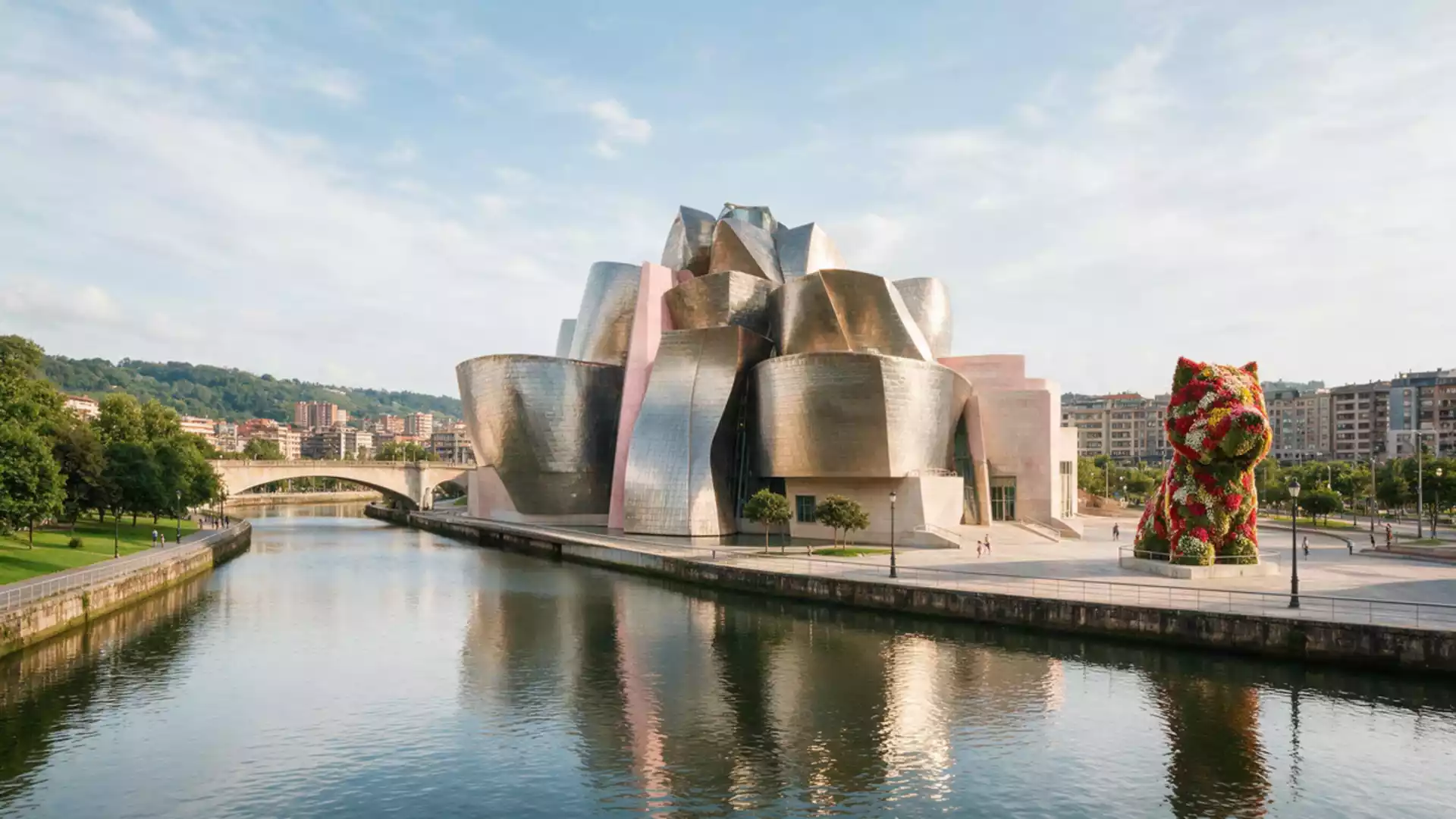
Museo Guggenheim Bilbao in Bilbao turns titanium, glass and stone into a riverfront landmark with an unmistakable outline.
Museo Guggenheim Bilbao rises on the Nervión riverfront in Bilbao as a building of titanium, glass and stone, designed by Frank Gehry and opened in 1997. Its curved surfaces make the museum as much a sculptural object as a gallery.
Titanium, glass and stone on the Nervión
The exterior combines three materials with very different character: titanium plates, clear glazing and pale stone. The building's forms fold and bend around a central atrium, creating a profile that changes as the view shifts along the riverbank.
Frank Gehry's name belongs to the building's identity as firmly as its materials do.Frank Gehry's design is one of the clearest examples of his late twentieth-century work, and the museum remains closely tied to his metal-clad vocabulary.1997 opening
From riverfront site to museum form
The building stands by a curve of the Nervión, with its mass stretched low and wide rather than rising as a single tower. That long, layered profile gives the museum a strong presence from the water and the opposite bank.
Its three levels cluster around the atrium, and walkways, elevators and staircases connect the interior into a sequence of voids and bridges.three levels The result is a building whose inside reads as clearly as its outer skin, with structure and circulation exposed rather than hidden.
Bilbao's museum as a civic landmark
Museo Guggenheim Bilbao is part of the wider identity of Bilbao, and its form is inseparable from the city's river edge.Bilbao's river edge The museum's materials catch light differently across the day, and the outer surfaces make the building read as a changing shell rather than a fixed block.
The museum's setting beside the Nervión places it within an urban landscape shaped by water, bridges and hard industrial edges.river curve Gehry's building translates that setting into architecture without copying it, using volume, reflection and curvature instead of ornament.
Visiting Museo Guggenheim Bilbao: what travellers from Western Europe should know
The museum stands on Avenida Abandoibarra in Bilbao, near the Nervión riverfront. Bilbao's city centre is the clearest reference point for reaching it.Avenida Abandoibarra
The approach is urban rather than rugged, with paved streets and riverfront promenades around the building. The museum's low, spreading form is easier to read at close range than from a distance.
The interior is organised around a central atrium with curved walkways and staircases. Visitors encounter galleries as part of a larger spatial sequence, not as isolated rooms.
The official language is Spanish and the currency is the euro.
Searching for Museo Guggenheim Bilbao on social platforms
These links open searches for Museo Guggenheim Bilbao on each platform.
Frequently asked questions about Museo Guggenheim Bilbao
Where is Museo Guggenheim Bilbao?
It stands on Avenida Abandoibarra in Bilbao, beside the Nervión riverfront. The museum is part of the city's central urban fabric.
What does a visit feel like?
The building is organised around an atrium, with galleries connected by walkways, staircases and elevators. The experience is shaped by moving through a large interior rather than a simple sequence of boxes.
What makes Museo Guggenheim Bilbao distinctive?
Its identity comes from the combination of Frank Gehry's design, the titanium exterior and the riverfront setting. The building reads as both museum and sculptural form.
A note on cookies
Newshunt uses essential cookies to keep you signed in and to remember your language and country, so the site works the way you expect. With your permission, we'd also like to use analytics cookies to understand how people use Newshunt and improve it over time.
Accepting only affects analytics. To learn more, view our Privacy Policy or Terms & Conditions.
(0)Comments