


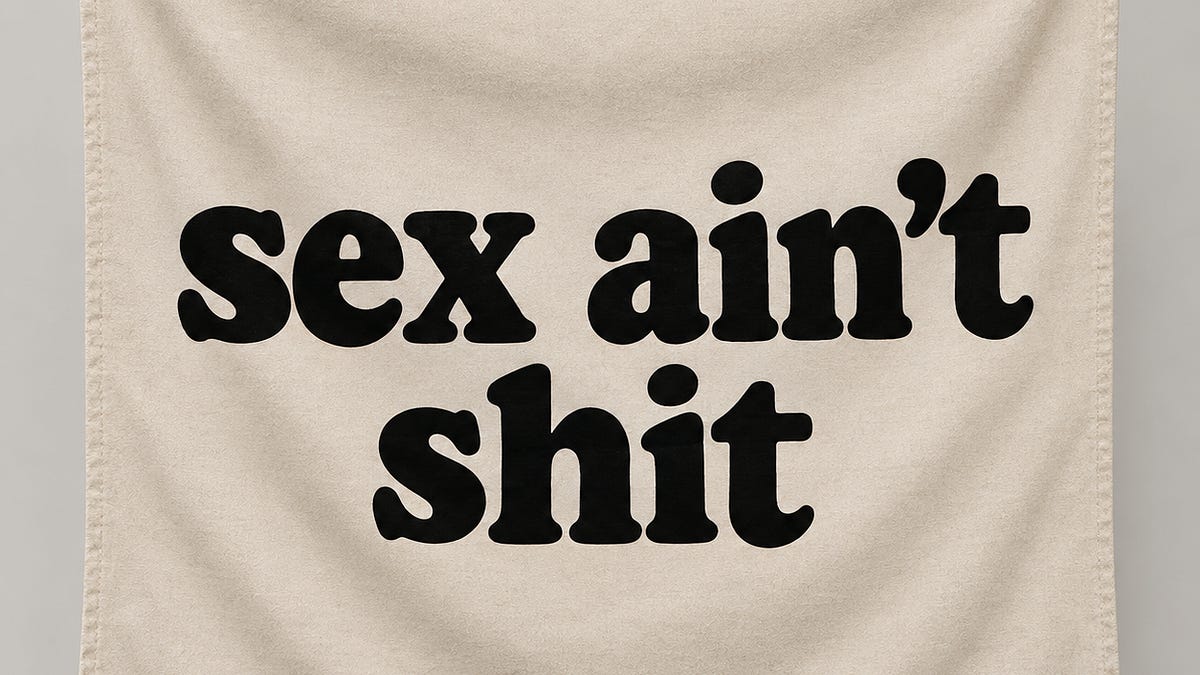
Is sex really a human need?
Category: Health
Share
Archive
Like
I'm sure you've come across this statement before. If you haven't, this is a good time to know that there are people who genuinely place sex as a humanneed.Not a desire, not a want, not a physical act or a sin as many African homes would have you believe – but aneed.Some people even take it a step further and categorize it as abasic human needi.e virgins (like me, and you if you're like me) are walking corpses with limited time to function. I've always wondered – if this assertion of sex being a human need is true…how then do nuns, priests and eunuchs survive, assuming they abide by the creed?
For the record, I do not claim to be an expert in any of the things I'm about to spew. I'm not a doctor, a philosopher, a scientist or sex therapist – who would be better suited to address this question, and give answers you can confidently run with. What I am, however, is curious and horny. I'm writing this to itch both a personal and intellectual pain point.
Recently, I've become fascinated by sex. And not just the act itself, but the idea of it and how much it has mingled with this era. I am personally of the view that we live in a very hypersexualized generation. It's bizarre.
You would find a whisper of sex in almost everything we say and do. It's in the slangs like'fuck'and'bitch'which could be used in different contexts (to express anger, frustration, even joy and surprise) but are inherently sexual words.
It's in the songs we sing. Astudypublished inSexuality & Cultureanalyzed 1,250 of Billboard's biggest hits between 1960 and 2008. It found that references to sex in songs by male artists jumped from about 7% in the 1960s to roughly 40% by the 2000s. And this is before we even get to the 2010s and Cardi B's iconic W.A.P. (sneak recommendations: Noah Kahan, Olivia Dean, N.F – cleanse your Spotify Wrapped before the year ends).
Sex and sensuality are in our dance too. Rarely would you be inclined to dance bátà at your local club. The first recourse many times is to move your waist and your body seductively. It's to rub your hands all over your figure, trace your fingers around your neck and grind against undeserving – or deserving men. If this doesn't apply to you, kindly ignore.
Point is, this era is hypersexualized and I am intrigued by the power sex seems to hold over us. It also doesn't help that I've found someone I've nicknamed 'My Astronaut' – a man under whose skin, muscles, breath and limbs I want to be buried. My desires have consumed me enough to ask whether sex is really a human need as people tend to say?
Most of us, put on the spot, would list 'food, water, shelter, clothing' as the basic human needs and call it a day. That's the primary-school version and it's not particularly wrong but in the history of psychology, there's a better and more famous model proposed by this dude named Abraham Maslow in 1943.
Maslow had a lot going on in his life. He was the first son of a Jewish immigrant family, had 6 younger siblings, encountered antisemites a few times, hated his mum and — thanks to her habit of mocking his 'ugly, skinny body' — grew up convinced a 'true male' had to be physically strong. But he was also quite a nerdy kid, so little wonder he never really achieved that Henry Cavill look.
Also, little wonder that probably under the influence of the many sources of dissatisfaction in his life, he yearned for what he termed 'Self actualization' and saw this as the ultimate way to live. Maslow created a 'Hierarchy of Needs' that puts your 'food-water-shelter-clothing' categorization to sleep. He illustrated it using a pyramid you've probably seen somewhere.
There are five tiers stacked – from 'bare survival' (physiological) at the bottom to 'self actualization' at the top. Now, what is interesting is that Abraham Maslow placed sex at the very base, in the same tier as breathing, eating, drinking and sleeping. One would think that something as emotional as sex would be on the same tier as love and belonging, but nope. Maslow thinks'as necessary as oxygen, as necessary as sex.'
Note;Maslow spent years studying dominance, sexuality and human behavior – so safe to say, his categorization was more than mere guesswork. One explanation for placing sex on the first tier is its role in reproduction and the survival of the human species.]
His postulation was impressive for his time, but decades of research has shown weaknesses in his hierarchy of needs. First, it was based on his own philosophy. Second, he only observed people he considered 'exceptional'. In other words, the lives of Ms. Bell and Sir Edwards were the basis of his hierarchy, but definitely not Uncle Bode or Aunty Precious. They were not 'exceptional' or 'self actualized' enough. Third, his pyramid reflects a very Western, very individualist idea of what a 'need' is. But for some reason, many people are blind to these loopholes and still run with the 'sex is a human need; it's even on the first tier' argument.
Oh well. But it gets better.
Decades after Abraham Maslow has had his fame, two psychologists – Edward Deci and Richard Ryan spent over thirty years building what is now called the 'Self-Determination Theory'. This theory is one of the most heavily researched, cross-culturally replicated frameworks in motivational psychology and is backed by hundreds of peer-reviewed studies. In other words, it's solid to an extent.
Their theory is that humans have three core psychological needs:
Autonomy (feeling in control of your own choices)
Competence (feeling capable), and
Relatedness (feeling connected to other people)
When these three needs are met, people's wellbeing and resilience are higher. When they are not met, people suffer, sometimes severely, regardless of how much food or shelter they have.
My thoughts on this are nuanced to be honest. Better a man in prison with food and a roof than one in a grave. Physical survival still outranks everything else when it's on the line. But then again, if I have no control over what I eat, constantly feel incompetent, and have no one to share a meal with, is that really a life worth living?
'Survival' and a 'life worth living' are not the same, and I think that's why this whole question keeps getting interesting.
I also came across another popular breakdown by writer Mark Manson, who adds a fourth need: Security. He 'borrowed' from Maslow's tier and reframes 'Esteem' as another core human driver. So now we have autonomy, competence, relatedness, security, and esteem as core psychological needs instead of the food, water, sexetceteracategory Brother Maslow gave us.
All of this taken together shows that sex functions as a strategy for meeting several needs at once, but is not in itself aneed.Good sex (and guys, please confirm this) can make you feel desired (esteem), close to someone (relatedness), safe within a relationship (security), and powerful in the moment (autonomy),simultaneously. It is the efficiency of sex that makes it feel indistinguishable from a need. It is not that sex fulfills a need of its own. It just happens to be remarkably good at fulfilling several needs at the same damn time.
The test for a genuine biological or psychological need is the existence of exceptions. A true psychological need has no exceptions. There is no population of healthy adults who have gone decades without food or oxygen and are thriving. There's no ninety-year-old grandmother proudly telling a documentary crew she hasn't touched water since 1974 and feels amazing about it. Remove any of those, and the body fails on a predictable, universal timeline, regardless of culture, belief system, or willpower. That's how you know it's a non-negotiable.
Sex does not pass the test. There are entire populations — celibate clergy, monastics, asexuals — who go their whole lives without it and do not physically deteriorate. If sex belonged in the same category as water, this shouldn't be possible at any scale. The fact that it is possible, across cultures and centuries, is the evidence that it is not aneed.You're just promiscuousand it's one of those'Yakubu manage! You will feel it like you want to die but you'll not die'things.
But a question that tends to pop in my head is:'What if all these people are suffering, but are too stubborn to admit it? Worse off, what if they don't even know they are suffering?!A blind man won't know he needs light because he has never seen it. A sex-deprived population won't know theyneedit because they have never experienced it'.
Then I stumbled on an Americanstudythat surveyed over two thousand Catholic priests and found that roughly nine in ten of them report being happy. The rates of depression were below the general population and priests who took celibacy as a personal calling, rather than an imposed restriction, were the most satisfied.
Anotherstudyof a smaller group of priests in Malta actually did find a link between celibacy and loneliness. But on a closer look, the loneliness had more to do with little social support and long-term professional isolation, than with celibacy itself.
Basically, there's a pattern.
It's never really been about the presence or absence of sex. It's about whether someone had community, purpose and people who genuinely looked out for them. If a person can access these things through other channels (a calling, a sisterhood, a found family), sex stops bearing the load and meaning a lot.
In summary,
Some people argue that human needs have evolved over time but I'm drawn to disagree.
Evolutionary psychologists rather call it an 'evolutionary mismatch'. The idea is that the brain and body you currently have was shaped almost entirely by conditions that existed thousands of years ago – and not by the last two hundred years of industrialization, or the last fifteen years of smartphones. Evolution moves on an agonizingly slow genetic timescale, while culture moves on an instant, fast technological timescale. The result of this collision is a mismatch. Ancient drives are operating in a wildly modern environment they weren't built for. It's why a 'sweet tooth' that once helped your hungry ancestor find rare, calorie-dense fruit, would give a modern person who is surrounded by cheap sugar, a health problem instead of survival advantage.
Sex and reproduction follow a similar pattern.
Humans, as a species, need reproduction. It's a non-negotiable need for the continuation of the species. You, personally, do not need to reproduce to remain alive. Evolution doesn't care about whether you're satisfied or not, it only cares about whether genes get passed on. So it has built sex to feel enormously, urgently good, and has effectively bribed individual bodies into doing something for a goal that doesn't directly benefit them.
It still doesn't explain why the drive feels the way it does in the moment, but neuroscience sheds more light on this.
Desire, of almost any kind, runs through a piece of brain circuitry called the mesolimbic dopamine pathway. Researcher Kent Berridge split reward into two separate systems:
'wanting,' driven by dopamine, and
'liking' – the actual pleasure part — driven by a different set of chemicals entirely (mostly opioids).
They are not the same thing. You canwantsomething intensely withoutlikingit nearly as much once you have it. However, the same 'wanting' circuit lights up for food and for sex.
Your brain doesn't run two separate alarm systems of 'this keeps me alive' and 'this helped my ancestors' genes survive.' It runs one. The craving you feel before a meal when you're starving and the craving you feel for a person you want are, neurologically, running through identical machinery, at comparable intensity. This explains why sex feels like a need on the same tier as food, even though it isn't one.
So, answering the question that began it all: No.Sex is not a need.Much less abasichuman need.
What it is however, is the single best-disguisedwantin human history. It has disguised itself so convincingly as a need that people have built entire identities, religions, and moralities either chasing it or trying to outrun it.
In other words,you people are lowkey harlots.
With concern,
Ruth.
Non-harlots register:
A note on cookies
Newshunt uses essential cookies to keep you signed in and to remember your language and country, so the site works the way you expect. With your permission, we'd also like to use analytics cookies to understand how people use Newshunt and improve it over time.
Accepting only affects analytics. To learn more, view our Privacy Policy or Terms & Conditions.
(0)Comments