


Remembering the strange, brilliant life of ZZ Top's Frank Beard
Category: Entertainment
Share
Archive
Like
ZZ Top's Worldwide Texas Tour was no ordinary live show. Spanning 98 concerts in arenas and stadiums across the US in 1976 and 1977, the touring production featured live buffalo, longhorn steers, rattlesnakes, javelinas and more.
Each night, Frank Beard, the band's drummer – who later described the tour as 'one giant piece of craziness' – would play with buzzards placed on perches behind him.
Oblivious to the clamour of audiences in venues as vast as Anaheim Stadium and Boston Garden, the birds' attention would be piqued only when ZZ Top fell into the kind of measured and murderous groove for which they were justly known.
'The buzzards were right behind me,' Beard said in a rare interview for the documentary That Little Ol' Band from Texas, 'and if I was playing a slow blues, they would get very interested – like, 'Is he dead?' So, I had to start moving my arms a lot more.'
Read more ZZ Top drummer, Frank Beard, dies at 77
As it turned out, the scavengers would have a wait of a further half-century before the drummer was ready to surrender to their appetites.
In what sounds like a blessed way to go, Beard died at his ranch in Richmond, Texas on Monday. He was 77.
It says something about the musical and personal chemistry of ZZ Top that, before the death of bassist Dusty Hill, in 2021, the group were recognised by Guinness World Records for having played together the longest with the same line-up.
Collectively, the three members of the 'Little Ol' Band From Texas', as they were at first disparagingly described, spent 52 years in the saddle. In the wake of the death of their drummer, today, guitarist nonpareil Billy F Gibbons is the last man standing.
Formed in Houston, Texas, in 1969, ZZ Top spent the first act of their long career many miles from the mainstream. Widely mislabelled as a southern rock act, the group were dismissed by coastal critics who viewed them as unsophisticated hayseeds from a state populated by primates.
Drummer Frank Beard of American rock band ZZ Top in concert at the Carling Apollo, Hammersmith, London © PA
For their part, the trio did little to advance their collective cause. Under the tutelage of Bill Ham, their longtime old-school manager, according to Beard: 'We were [told] not to play on anybody else's records. We were not to do TV shows. We were not to do interviews that weren't approved. We were not allowed to do anything like that.'
Instead, they made records and gigged. Featuring the all-but-omnipresent La Grange – a song that is almost as notable for Beard's laconic shuffle as it is for Gibbons' breathtaking lead guitar parts – the band cracked the US Top 10 in 1973 with their third album, Tres Hombres.
When its successor, Fandango!, became their second successive gold record, the trio were afforded the luxury of embarking on the expensive and, frankly, entirely insane Worldwide Texas Tour.
'We finally had a little money to make a production,' Beard would later recall. 'We'd never made a production before; we didn't know how to make a production.'
Come the end of the tour, inevitably, the band were fried. As the three musicians went their separate ways, for what was originally intended as a three-month break, Frank Beard retreated into a cocoon of needles, powders and pills.
Such was his appetite for the dangerous cliches of rock'n'roll that his first foray into drug use saw him inject himself with LSD. In short order, the drummer spent every red cent of the $72,000 cheque he received on narcotics.
'I never had enough money to become a proper addict,' he said. 'But in 1977, I accomplished that.'
In the wake of acid, his use of pills 'came about just from the [group's] workload'. Cocaine and junk duly followed.
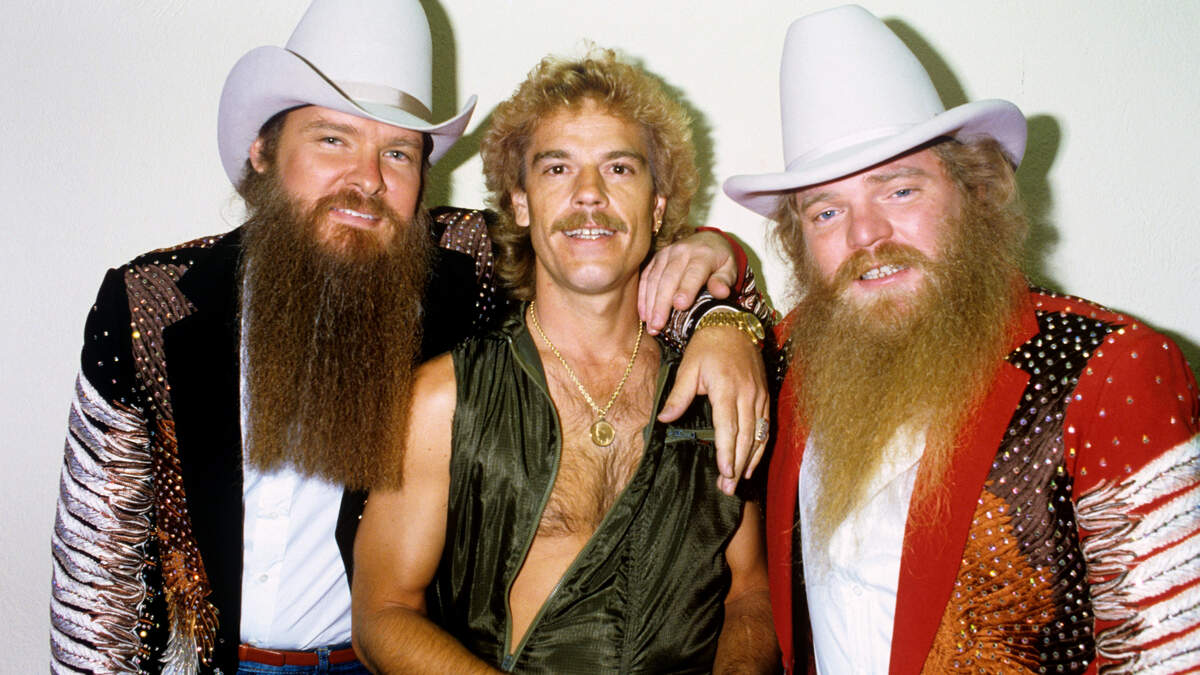
Billy Gibbons, Frank Beard and Dusty Hill of ZZ Top © Getty
'The heroin thing came about just because I liked it,' he would later recall. 'If you've never tried heroin, it's great. It's a vacation for the mind. And I liked it. I liked it a lot.'
But he knew it couldn't last. 'In the back of my mind, I knew that I needed to kick heroin,' he said.
'I needed to stop doing cocaine. I had done it all and I couldn't go any further. So I called [Bill] Ham and said, 'I'm going into a 30-day programme.' And Bill Ham said, 'Alright, take as long as you need.' [I entered] a 12-step programme to get sober.
'I wanted to be like the people I admired who could sit home and watch TV and go to bed and that was OK.'
In accordance with the law of unintended consequences, the three-year hiatus that separated 1976's Tejas album and its successor, Deguello, would be the making of ZZ Top.
Removed from the hamster wheel of recording and touring, the group were afforded the time to gain perspective on their music and on themselves as individuals in the public eye.
While Beard got clean, and Gibbons pogoed with punks at the Marquee Club in London, Hill took a job as a baggage handler at Dallas/Fort Worth International Airport. His workmates thought his name was Joe.
'Success is a great thing, [but] it can also really screw with you,' the bassist said. '[You're] not really sure who you are, or if people around you are treating you badly or are treating you really nice according to who they think you are.'
By the time ZZ Top transitioned from one of the world's premier cult bands to a bona fide pop sensation, with 1983's Eliminator, the trio had it all figured out.
With a look that can justifiably be described as instantly recognisable, in videos for the blockbuster singles Gimme All Your Lovin', Sharp Dressed Man and Legs, the band became human cartoon characters that could be seen but never known.
Eliminator was certified diamond in the US, representing 10 million units. As Billy Bob Thornton, the actor, astutely noted in That Little Ol' Band From Texas, 'seeing them live was like seeing Bugs Bunny in person'.
In a fitting testament to the group's fundamental otherness, today there is much dispute as to the extent of Beard's contribution to his band's highest-selling album.
Dusty Hill, Frank Beard and Billy Gibbons at a Rock and Roll Hall of Fame dinner in New York in 1991 © Getty
Some say that the metronomic drumming on Eliminator is the work of a machine, while others – and this seems more likely to me – insist that his drum parts were overlaid with and augmented by electronic technology.
In fact, most of Beard's acoustic drumming was replaced by drum machines or Simmons electronic drums, although his tom-tom fills and cymbal accents were retained on many tracks.
Either way, the top-tier stardom that awaited them was no match for the drummer's determination to remain assuredly anonymous.
Even the one thing for which he is universally known is somewhat off the money. The oft-repeated claim that Beard was the only member of the band who didn't have a beard was true only until 2013, when he grew a tasteful goatee.
In truth, ZZ Top were two distinctly different groups. Onstage, they were a chicken-in-a-basket turn whose year-to-year rigidity made AC/DC look like the Grateful Dead.
They were stingy, too – rarely did sets last longer than 75 minutes. Of the 10 times or so I saw them live, only rarely did I think they were much cop.
On record, though, they remain one of the world's great bands. In the decade after the blockbuster success of the 1980s, on albums such as Rhythmeen and XXX, ZZ Top embraced weirdness of a kind that I've never before heard from a major-league act.
With this, Beard truly came into his own. As the motor at the core of genuine magnificence, his playing on the subterranean groove of Vincent Price Blues and the so-heavy-it's-actually-distressing Made Into a Movie is the work of an indubitable master.
I hope the send-off for Beard befits a man who helped bring 'cool' to his home state without once surrendering a single gram of his Lone Star DNA.
Who else but he could play consistently innovative music on a kit on which the double bass drums were fashioned into beer barrels?
Read more Bonnie Tyler fans gather in her hometown for the singer's funeral
With effortless finesse, his was an integral role in a band that appealed to beer drinkers, hell-raisers and sophisticates alike.
In closing, then, in memory of a man who remained both unknown and unknowable, I'd like to nominate a line from the ZZ Top song Jesus Just Left Chicago as an epitaph.
Frank Beard: taking care of business was his name.
A note on cookies
Newshunt uses essential cookies to keep you signed in and to remember your language and country, so the site works the way you expect. With your permission, we'd also like to use analytics cookies to understand how people use Newshunt and improve it over time.
Accepting only affects analytics. To learn more, view our Privacy Policy or Terms & Conditions.
(0)Comments