


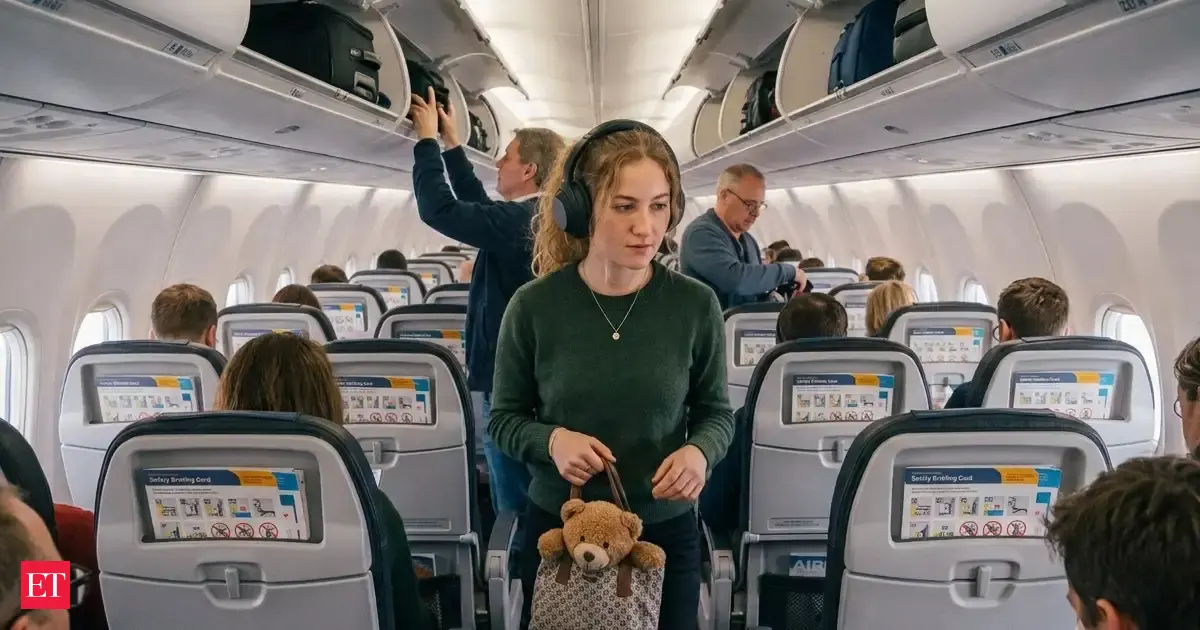
Psychology says people who use extra-large headphones on flights aren't necessarily antisocial: What this habit may mean?
Category: Entertainment
Share
Archive
Like
Psychology says
people who use extra-large headphones on flights
aren't necessarily trying to avoid everyone around them. For some passengers, the headphones are a way to manage noise, reduce unwanted conversations and create a sense of
personal space
. Flying can expose people to engine sounds, announcements, conversations and crying children for several hours. Passengers also cannot choose who sits beside them or control the sounds around them. Large
over-ear headphones
can help reduce this sensory input. They can also send a clear social signal that the person does not want to talk. This behaviour can therefore be understood through ideas linked to personal boundaries, sensory management and selective attention.
What Psychology Says?
Wearing
large headphones
can be a form of self-regulation. A person may understand that certain sounds or social situations make it harder to relax. Instead of waiting until they feel overwhelmed, they use headphones before or during the flight to control part of their environment. This does not automatically mean the passenger dislikes other people. It also does not mean the person is being rude or unfriendly.
An aircraft cabin can contain several sources of sensory information at the same time. There is the sound of the engines, conversations between passengers, announcements from the crew and movement around the cabin. A person may also be dealing with the pressure and restrictions that come with
air travel
.
Large headphones can reduce some of these inputs. The behaviour can therefore be connected with awareness of one's own sensory limits. The person may be choosing to control what they hear because they want to reduce mental strain.
You Might Also Like:
Psychology says people who adopt strays and give a home to abandoned animals aren't making the choice randomly: What the behavior reveals?
What Does This Mean?
Extra-large headphones can serve two functions at the same time. First, they can reduce unwanted sound. Second, they can communicate a social boundary. Small earbuds may not always be noticed. Large over-ear headphones are easier for other people to see. A passenger wearing them may therefore be communicating that they are listening to something and are not looking for conversation.
This does not mean that every person wearing large headphones wants to be left alone. Some may simply prefer the sound quality, comfort or noise cancellation provided by the headphones. The important point is that the behaviour should not automatically be interpreted as hostility.
Why Is It Done?
There are several reasons why passengers may choose large headphones during flights.
They can signal that the person does not want to talk
Large headphones can act as a visible social signal. A passenger may not want to explain that they need quiet time. Wearing headphones can communicate this without requiring a conversation. For someone sitting beside a stranger for several hours, this can make social boundaries easier to establish.
They can help with sensory management
Airplanes produce a continuous engine sound. Other sounds can appear without warning. These may include announcements, conversations, movement in the aisle and children crying.
Noise-cancelling headphones
can reduce some of these sounds. Some people may find this useful because they can focus on music, a podcast, a film or silence instead of processing every sound around them.
They can create a sense of control
Passengers have limited control over the aircraft environment. They cannot decide who sits beside them. They cannot change the volume of the engines. They cannot control conversations in nearby seats. They also cannot stop announcements when they occur.
Controlling the sound entering their own ears gives passengers one part of the environment that they can manage. This can create a sense of personal agency during a situation where many other things are outside their control.
Which Psychology Theory Explains This Behaviour?
Two psychological ideas can help explain why headphones may become useful in crowded environments: environmental psychology and selective attention.
Environmental Psychology
Environmental psychology examines how people interact with their physical surroundings. One part of this area concerns personal space and territorial behaviour. People generally have an expected amount of space around themselves. When that space becomes smaller, discomfort can increase.
An economy-class aircraft can place passengers close to strangers for long periods. Large headphones may function as a symbolic boundary. They do not create physical space, but they can create a visible and psychological boundary around the passenger. The headphones can therefore act like an invisible wall.
Cognitive Load And Selective Attention
The brain receives information from the surrounding environment throughout the day. It cannot give equal attention to every sound and event. This is where selective attention becomes relevant.
A passenger may choose to focus on music or another audio source while ignoring conversations, engine noise and other sounds. Headphones can help direct attention toward one chosen source.
Reducing the number of sounds that a person actively processes may also reduce the amount of mental effort required to filter the environment. For some passengers, this can make the flight easier to manage.
This Psychology Study Says
The information behind this explanation suggests that headphone use can be viewed as proactive self-regulation. Instead of responding to overstimulation after it happens, a person may take action before the situation becomes uncomfortable.
The same principle can appear in other situations. People may choose quiet rooms, reduce phone notifications, listen to white noise or spend time alone when they feel overloaded. Headphones are one tool that can be used to manage sensory input.
However, this behaviour should not be treated as a psychological diagnosis. Wearing large headphones alone cannot tell us what a person is thinking or feeling. A passenger could be wearing them because of sound quality, music, entertainment, comfort or noise cancellation.
The Principle Behind It
The main principle is control. When people cannot control their surroundings, they may look for smaller areas where they can make choices. On a flight, a passenger cannot control the cabin, but they can control what they listen to.
The headphones can therefore provide:
Control over some surrounding sounds
A way to reduce unwanted conversations
A visible personal boundary
A way to focus attention
A method of managing sensory input
A way to create quiet time
This can explain why the habit may have more meaning than simply listening to music.
What To Learn From It?
The behaviour can offer several lessons about boundaries and overstimulation.
Intentional boundaries can help
People do not always need to wait until they feel drained before establishing a boundary. A person can prepare for a stressful environment in advance. This can include choosing headphones, limiting notifications or planning periods of quiet.
Overstimulation can be managed
People may have different levels of tolerance for noise and social interaction. When an environment becomes difficult to process, controlling some sensory input can help. Music, silence, white noise and other forms of controlled audio can be used according to personal preference.
Silence should not always be misread
A person who does not speak during a flight may not be angry or unfriendly. They may simply want to rest, read, watch something or remain in their own space.
Life Lessons From The Behavior
The use of extra-large headphones on flights shows why visible behaviour should not always be given one explanation. A person may appear disconnected from the people around them while simply trying to manage their environment.
There is also a wider lesson about personal boundaries. People can use simple actions to communicate that they need time alone without rejecting others. At the same time, boundaries work best when they are understood as personal choices rather than judgments about other people. The next time someone boards a flight with large headphones, the behaviour does not necessarily mean they are antisocial or standoffish.
They may be trying to reduce noise. They may want to avoid small talk. They may want to watch a film. Or they may simply prefer listening through over-ear headphones. The habit can be understood as one possible way of managing attention, sound and personal space in an environment where passengers have limited control.
A note on cookies
Newshunt uses essential cookies to keep you signed in and to remember your language and country, so the site works the way you expect. With your permission, we'd also like to use analytics cookies to understand how people use Newshunt and improve it over time.
Accepting only affects analytics. To learn more, view our Privacy Policy or Terms & Conditions.
(0)Comments