


Google Mapped a Fruit Fly's Brain. Now It's Playing Doom and Super Mario 64
Category: SciTech
Share
Archive
Like
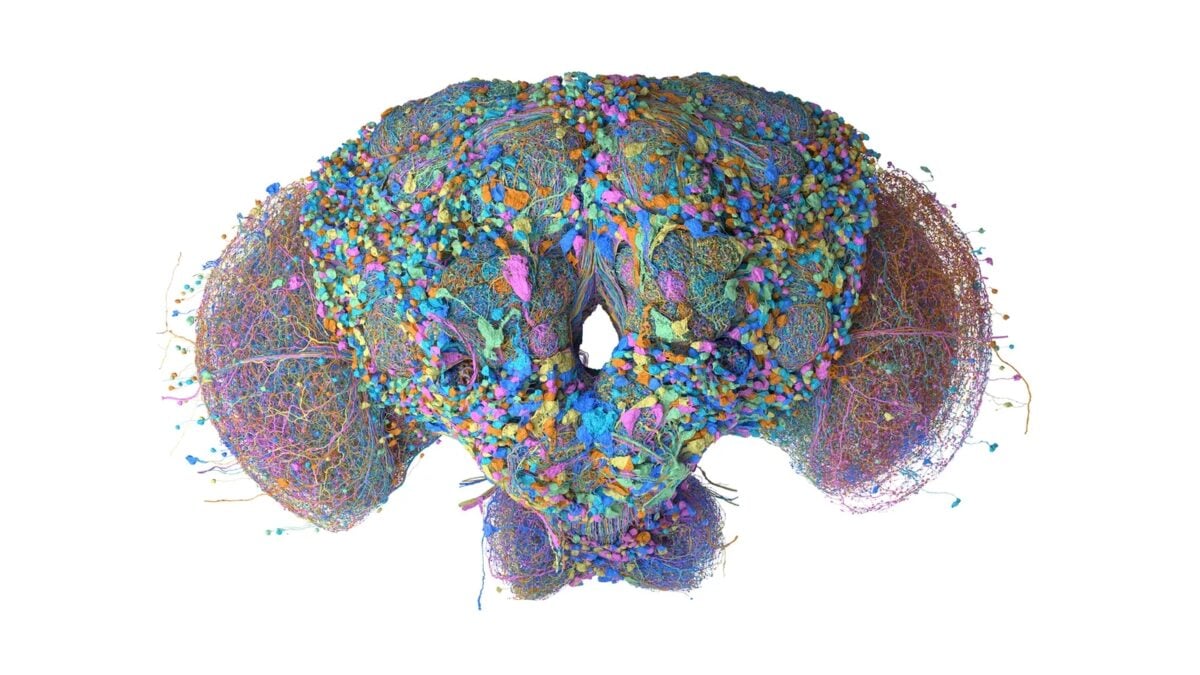
Researchers at Google and the Howard Hughes Medical Institute's Janelia Research Campus last week announced a major milestone in neuroscience. On Sept. 3, the scientists published the results of a decade-long project to map every neural connection in the brain and central nervous system of an adult male fruit fly.
And of course, just days later, the internet started making it play video games.
'With over 166,000 neurons and 125 million synaptic connections, this is the largest brain map by number of neurons to date, providing a fundamental resource for scientists to use fruit flies as a model organism for studying how the brain works,' Google said in a blog post.
The map, known as a connectome, is essentially a wiring diagram showing how the fly's neurons are connected. Researchers created it by slicing the nervous system into millions of extremely thin sections, imaging them with an electron microscope, and then using computers and AI to turn those 2D images into 3D reconstructions of neurons. Scientists then spent years verifying and annotating the results.
Google says that because mapping the roughly 86 billion neurons in a human brain is not possible yet, scientists are starting with smaller organisms like fruit flies.
The project aims to help scientists learn how animal nervous systems 'perceive the world, react to stimuli, and how damaged neural pathways might one day be repaired.'
But for now, people online are using that same data for their own experiments.
For instance, software engineer Alex Wormuth posted on Sept. 6 that he is using the project's data to train a simulated fly brain to play Doom.
'Each Doom frame stimulates sensory neurons. Neural activity is mapped to game controls. Damage triggers a stimulus to two PPL101 dopamine cells as reinforcement,' he wrote in a post on X.
I'm training a fly brain to play Doom using the full MaleCNS v1.0 fruit fly connectome.
Each Doom frame stimulates sensory neurons. Neural activity is mapped to game controls. Damage triggers a stimulus to two PPL101 dopamine cells as reinforcement.
Will the fly learn to… https://t.co/ObCJ03gxy3 pic.twitter.com/H2YDBtyuR8
— Alex Wormuth (@nftechie_) September 6, 2026The project is being livestreamed online.
Another developer, Jessica Paquette, posted Monday about a similar project using the fly brain data to play Super Mario 64. In a video she posted, Mario can be seen jumping and repeatedly bumping into walls.
playing mario 64 using a fly's brain pic.twitter.com/G4BmfMSWb8
— Jessica Paquette (@barrelshifter) September 7, 2026Paquette also posted the project's code on GitHub, where she wrote that the code is '100% vibe coded with GPT Astra.'
'I've successfully run the full retained MaleCNS v1.0 fruit fly connectome, all 166,700 neurons, inside Minecraft, with its simulated neural activity driving a fly's movement,' wrote yet another user on X.
And it wasn't just video games people experimented with.
One X user said he fine-tuned the simulated fly brain to make Y-M-C-A poses in response to four different tones. And another user made the simulated fly brain 'watch' the viral Bad Apple!! animation to see how it reacted.
It wouldn't be surprising to see even more fly brain projects pop up online in the coming months, at least until programmers get a new brain to play with.
Conveniently, Google is already looking beyond flies. The company is working with researchers on connectomes for fish and mice.
A note on cookies
Newshunt uses essential cookies to keep you signed in and to remember your language and country, so the site works the way you expect. With your permission, we'd also like to use analytics cookies to understand how people use Newshunt and improve it over time.
Accepting only affects analytics. To learn more, view our Privacy Policy or Terms & Conditions.
(0)Comments