


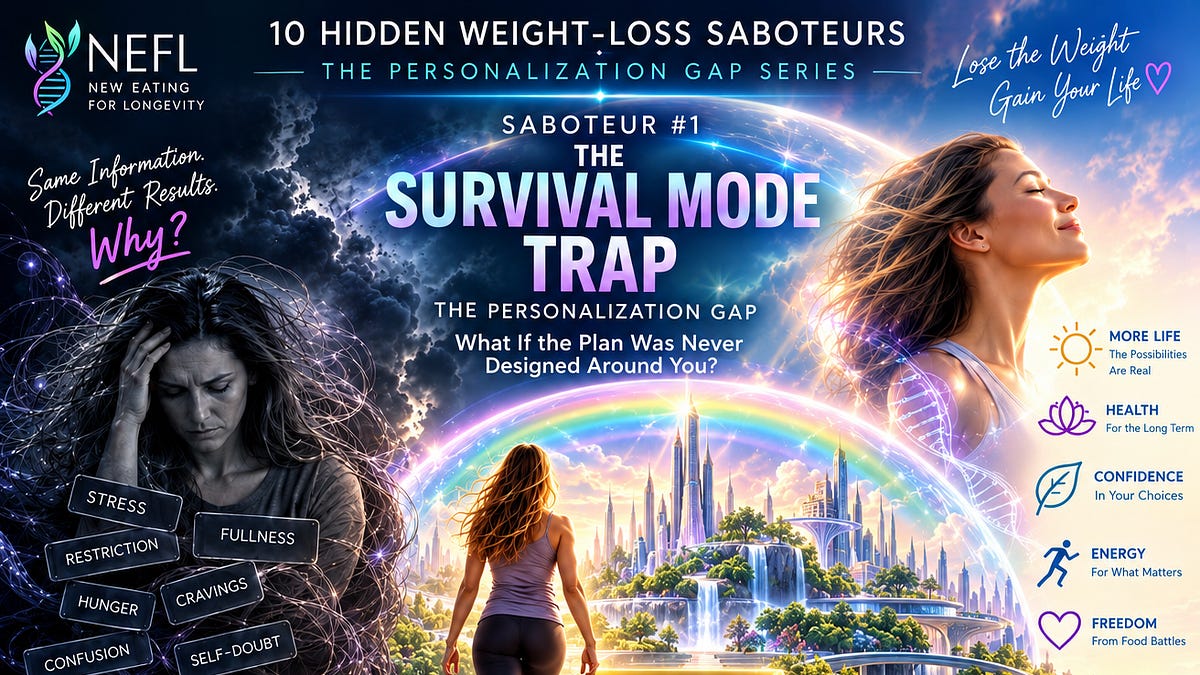
The Personalization Gap: What If the Plan Was Never Designed Around You?
Category: Health
Share
Archive
Like
By: Dr. Wendy Tighe
Have you ever started a new diet feeling completely determined?
You bought the food.Followed the rules.Cut the portions.Changed your schedule.Ignored foods you loved.
And for a while, you did it.
Then hunger got louder.
Cravings became harder to ignore.
You started thinking about food more often.
Your schedule got hectic.
Life happened.
And eventually you found yourself eating in ways you hadn't planned.
Then came the familiar conclusion:
'I failed again.'
But what if there's another question worth asking?
What if the plan failed to account for the person expected to live it?
Welcome to a brand-new exploration of my10 Hidden Weight-Loss Saboteurs.
We're keeping the same Saboteurs—but looking at them through a completely different lens:
🧩
The Personalization Gap
Because after losing175 poundsmyself, working in education and counseling, presenting my experience at Forever Young in Medford, Oregon, and listening to other people's experiences, one thing has become increasingly important to me:
General health principles can be valuable.
But they still have to work inside an individual human life.
And that's where our first Saboteur becomes especially interesting.
🧠 KNOWLEDGE
What Is the Survival Mode Trap Really Telling Us?
You've probably heard phrases such as:
'Your body went into starvation mode.'
The actual physiology is more complicated than that.
Our bodies don't simply flip a mysterious switch that makes weight loss impossible because we ate less.
Energy balance still matters.
But the human bodyis adaptive.
As body weight and energy intake change, energy expenditure and appetite can change too. Stress, sleep, food availability, activity and other factors can influence the experience of trying to maintain a calorie deficit.
And then there's the behavioral side.
Imagine repeatedly telling yourself:
Don't eat that.
You can't have this.
Wait until noon.
Stop eating even though you're miserable.
You already used your calories.
Just have more willpower.
Even when a plan looks mathematically perfect on paper, the experience of living it can become increasingly difficult.
That's what I want us to examine throughThe Survival Mode Trap.
Not a magical metabolic shutdown.
A collision between an adaptive human being and an approach that may demand more than that individual can sustainably maintain.
And this is where personalization enters the conversation.
🧩 THE PERSONALIZATION GAP
Mainstream health information necessarily speaks to large groups of people.
That's useful.
But consider what happens when those recommendations reach two actual individuals.
One wakes at 5:00 a.m.
Another works nights.
One loves breakfast.
Another has little appetite early in the morning.
One loves vegetables.
Another has spent a lifetime hating the foods every diet keeps putting on her plate.
One currently feels satisfied with a relatively small meal.
Another has conditioned herself over many years to expect much larger amounts before experiencing comfortable fullness.
One lives alone.
Another cooks for an entire family.
One has a calm week.
Another is juggling work, caregiving, financial pressure and a crisis she never expected.
Same advice.
Completely different lives.
So perhaps an important question has been missing:
How does this recommendation work for THIS individual?
💜 CONNECTION
Stop Studying the Diet for a Moment. Study Yourself.
This is where I want you to do something different.
Instead of immediately asking:
'What should I change?'
First ask:
'What is actually happening with me?'
Think about your previous attempts to lose weight.
Did you have to eat foods you didn't particularly enjoy?
Were you trying to follow someone else's meal schedule?
Were your portions suddenly dramatically smaller?
Were you hungry much of the day?
Did you spend hours fighting cravings?
Did the plan work wonderfully Monday through Thursday but collapse when your weekend looked completely different?
Did stress make the entire thing harder?
Did one difficult day convince you that you lacked discipline?
These aren't excuses.
They're information.
And that's an important distinction.
🌱💜🩵 CONNECTION WITH YOUR THREE FORCES
This is where my three forces become incredibly useful.
Instead of judging yourself, begin listening.
🌱 HUNGER = NEED
When does hunger actually appear foryou?
What makes it stronger?
How does your schedule affect it?
How predictable is it?
💜 CRAVING = DESIRE
What are you genuinely wanting?
Are you craving one particular thing—or searching through multiple foods without ever becoming satisfied?
Do the foods in your 'healthy plan' leave you continually thinking about something else?
🩵 FULLNESS = ENOUGH
What amount currently feels like enough?
Are you comfortably satisfied?
Still hungry?
Or eating until you're extremely full because you've been deprived all day?
These three signals provide something a standardized meal plan cannot completely provide:
Feedback from the individual living inside the plan.
🎤 SOMETHING MEDFORD, OR REINFORCED FOR ME
When I presented at theForever Young conference in Medford, Oregon, I had the opportunity to do something I value tremendously:
Listen.
People weren't identical.
Their questions weren't identical.
Their health experiences weren't identical.
Neither were their needs, preferences, schedules or pressures.
It reinforced something my own weight-loss journey had already taught me.
Two people can receive exactly the same information and have completely different experiences trying to apply it.
That doesn't make health recommendations useless.
And it doesn't mean every person needs entirely different science.
It means there is another step:
Translation.
How do we translate sound principles into something an individual can realistically practice?
That's the Personalization Gap we're going to explore throughout this entire series.
And it's also a question I'm carrying with me toThe Longevity Code in Las Vegas.
✨ TRANSFORMATION
What If You Didn't Have to Become Someone Else to Begin?
One of the things I appreciated about the eating approach I used was where I could start.
With me.
Foods I actually liked.
Amounts I was accustomed to eating.
Eating times I could establish within my life.
I didn't have to suddenly become the world's most enthusiastic eater of somebody else's prescribed 'diet foods.'
And I didn't begin by making exercise a requirement for the eating system to work.
Movement became increasingly valuable to my health, mobility and life—but my eating strategy wasn't dependent upon burning off what I ate.
That distinction mattered tremendously to me.
Because instead of trying to change everything simultaneously, I could begin establishing consistency and then progressively work with my eating patterns.
🧬 4 STAGES • 3 FORCES • 2 SECRETS • 1 INDIVIDUAL
This is where the larger framework behind my approach becomes important.
4 STAGES
Change can develop progressively rather than demanding instant perfection.
3 FORCES
🌱 Hunger💜 Craving🩵 Fullness
2 SECRETS
I learned to move away from multiple competing cravings toward clearer cravings—and togradually reduce my fullness level over time.
1 INDIVIDUAL
Me.
And now, when I share this approach:
You.
That last piece is crucial.
Because personalization doesn't mean abandoning structure.
It means using structure to work with the individual.
🌱 KNOWLEDGE → 💜 CONNECTION → 🦋 TRANSFORMATION → ✨ ELEVATE
These four words have become especially meaningful as I prepare for my interactive workshop atThe Longevity Code:
KNOWLEDGE
Learn the principles.
CONNECTION
Discover how those principles interact withyourbody and life.
TRANSFORMATION
Use that information to make intentional changes you can practice consistently.
ELEVATE
Carry what you've learned beyond the scale into health, mobility, independence, confidence, longevity and the life you're trying to create.
Notice something important:
Transformation doesn't begin with punishment.
It begins with knowledge and connection.
That's a very different starting point.
🌿 3 THINGS TO TRY
Your Personalization Experiment for Saboteur #1
For today, I'm not asking you to overhaul your eating.
I want you to investigate it.
1️⃣ FIND YOUR BIGGEST POINT OF FRICTION
Think about your last weight-loss attempt.
Complete this sentence:
'The hardest part for me to live with was ______.'
Was it hunger?
Food choices?
Portions?
Timing?
Cravings?
Social situations?
Your schedule?
Don't judge the answer.
Identify it.
2️⃣ CHECK YOUR THREE FORCES BEFORE ONE MEAL
Before eating, ask:
🌱Am I hungry?
💜What am I actually craving?
Then while eating:
🩵When do I begin experiencing enough?
Don't try to produce the 'right' answers.
Notice your answers.
That's connection.
3️⃣ IDENTIFY ONE RULE THAT DOESN'T FIT YOUR LIFE
Maybe you've been told:
Never eat after a certain hour.
You must eat breakfast.
You must skip breakfast.
You can never eat your favorite food.
You must exercise every day.
Don't automatically break the rule.
Instead ask:
What purpose is this rule supposed to serve—and is there a sustainable way to accomplish that purpose within my actual life?
That question moves us from obedience toward understanding.
🌳 ELEVATE
The 30-Year Question
Now comes the question we'll carry throughout this entire Personalization Gap series:
Could I realistically live this way for the next 30 years?
Not:
Can I tolerate it until Friday?
Can I survive it for 30 days?
Can I white-knuckle it until I lose 20 pounds?
Could I actually build a life around it?
Because I didn't lose 175 pounds merely because I wanted a smaller body.
Ultimately, I wantedmore life.
More movement.
More freedom.
More possibility.
More years in which I could actually participate in the life I was trying to save.
That's why weight loss and longevity became connected for me.
Losing the weight was never supposed to become my entire life.
It was supposed to help megain my life.
🧩 MAYBE YOU WEREN'T THE MISSING DISCIPLINE
Maybe another meal plan isn't the first thing you need.
Perhaps we need tounderstandthe person who will be eating those meals.
Your needs.
Your preferences.
Your schedule.
Your pressures.
Your Hunger.
Your Cravings.
Your Fullness.
Your life.
Science can give us principles.
Your body gives us feedback.
Your life tells us what must become sustainable.
And somewhere between those three may be the personalized approach you've been searching for.
KNOWLEDGE • CONNECTION • TRANSFORMATION • ELEVATE
We're going to use all four as we travel through the 10 Hidden Weight-Loss Saboteurs again—this time looking at each one throughThe Personalization Gap.
Because perhaps sustainable weight loss isn't about becoming better at following someone else's rules.
Perhaps it's about becoming better at understanding yourself.
Lose the weight. Gain your life. 💜
🎁 Discover Your Hidden Weight-Loss Saboteurs
The Survival Mode Trap is only #1.
My free10 Hidden Weight-Loss Saboteurs + Simple Fixesguide can help you identify other patterns that may be quietly interfering with your progress.
👉 Get your FREE guide here in my profile.
Coming next: Hidden Weight-Loss Saboteur #2 — The Fullness Confusion
Through our Personalization Gap lens, we're going to investigate a fascinating question:
Who taught you what 'enough' is?
Because your current fullness level didn't necessarily appear overnight—and changing it may require something very different from simply being handed a smaller plate.
A note on cookies
Newshunt uses essential cookies to keep you signed in and to remember your language and country, so the site works the way you expect. With your permission, we'd also like to use analytics cookies to understand how people use Newshunt and improve it over time.
Accepting only affects analytics. To learn more, view our Privacy Policy or Terms & Conditions.
(0)Comments