


Majestic Outdoors Announces Runoff Guidance Ahead of Peak Storm Season
Category: Entertainment
Share
Archive
Like
Majestic Outdoors has issued guidance for homeowners on how drought-hardened soil changes the way residential properties handle heavy rainfall, as the Atlantic hurricane season enters its most active months.
Researchers at North Carolina State University forecast 12 to 15 named storms for the 2026 Atlantic season, including six to nine hurricanes and two to three major hurricanes. The season runs through November 30, with activity typically peaking between August and October.
The timing carries particular weight in central North Carolina because much of the region has spent the year in drought. State meteorologists have said that ending the current deficit would likely require a tropical system, which means the rainfall the area needs may arrive in a small number of large events rather than gradually across a season.
"The rain everyone has been waiting for is the same rain that gives a property the least amount of time to absorb it," said Jay Beswick, owner of Majestic Outdoors. "Ground that has been dry for months does not behave like ground that has stayed damp. It takes water in more slowly at first, and the water that does not soak in has to go somewhere."
The North Carolina Geological Survey documents that clay soils change volume with moisture content, shrinking through dry periods and swelling as moisture returns. Piedmont soils are predominantly clay-based, which makes the region more responsive to that cycle than the sandier soils found across the Coastal Plain.
Research from North Carolina State University's Stormwater Engineering Group has established that infiltration rates vary substantially by soil type. Findings developed on sandy subgrade in the Coastal Plain do not transfer directly to Piedmont clay, which is one reason the state has applied stormwater credits differently across regions.
Development patterns compound the effect. Studies of runoff behavior have found that a substantially higher share of rainfall infiltrates in wooded ground than in built-out subdivisions, where roofs, driveways and streets shed water rather than absorb it. On a residential lot, water that does not soak in generally travels downhill toward whatever sits at the low point of the property.
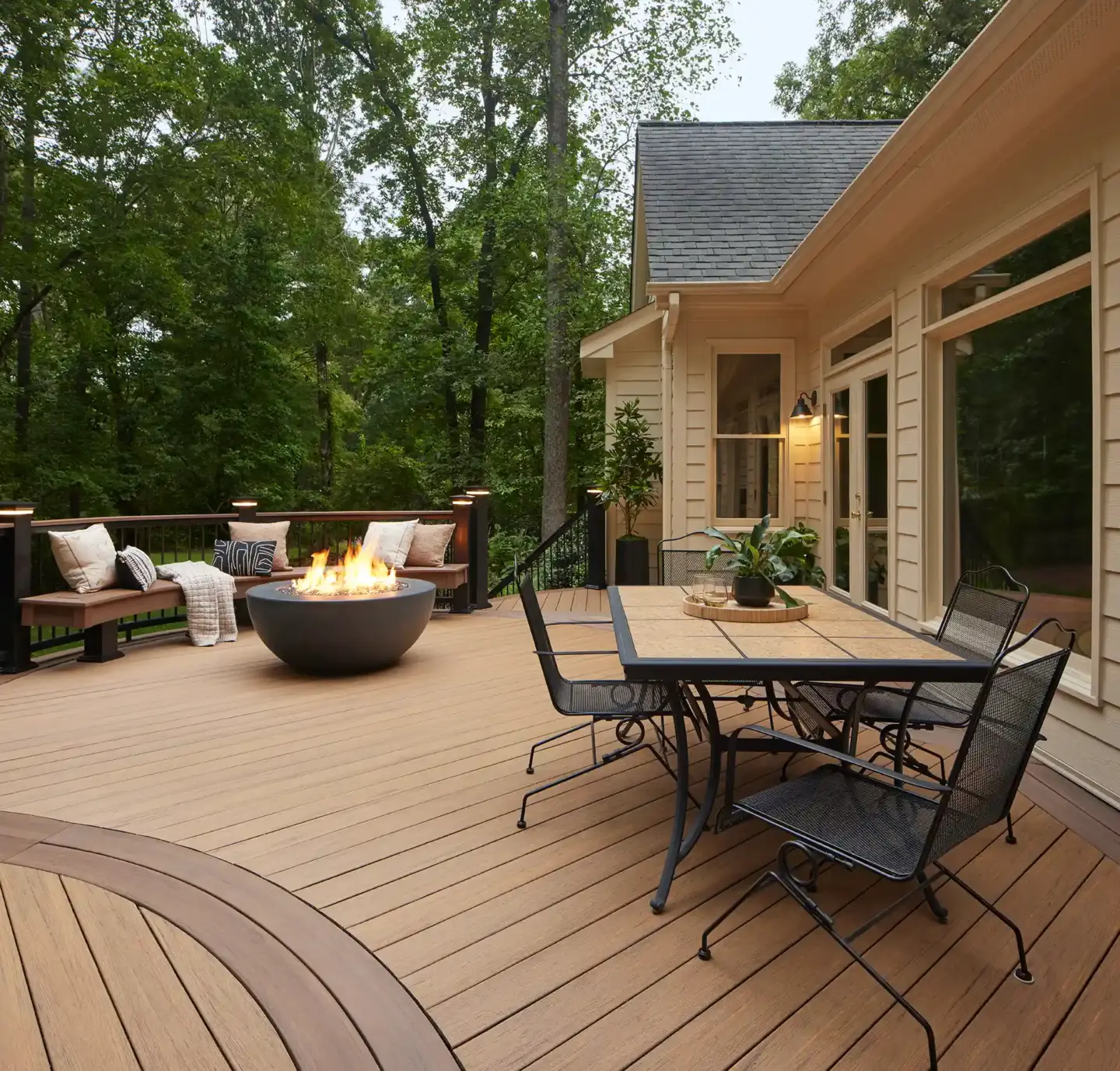
That is frequently where outdoor structures are located. Decks are often built off the rear of a house on the side that slopes away from it, and patios are typically set on the flattest available ground, which on many lots is also where water naturally collects.
Majestic Outdoors carries out site evaluation and structural preparation as distinct stages before construction begins, with each stage assessing conditions at the specific property rather than applying a uniform approach across every site in the region. Grade and drainage are read during those stages.
The company also handles permit acquisition and inspection scheduling as part of its process, which places site decisions on record with the reviewing authority before work proceeds. Majestic Outdoors notes that decisions about footings, grading and base preparation should follow applicable building codes and, where site conditions warrant, incorporate input from a licensed engineer.
For elevated structures, under-deck drainage systems capture water above the framing and route it to a chosen discharge point. That keeps the space below the deck usable and directs water away from the area around footings rather than allowing it to collect there.
Patio construction depends on a prepared aggregate base rather than on native soil alone. Majestic Outdoors builds patios using Belgard pavers set on a prepared base, an approach that separates the finished surface from subgrade that changes volume as moisture conditions shift through the year.
Structures already in place can be assessed as well. Observing how water moves across a property after significant rainfall indicates where the ground is shedding water rather than absorbing it, and where that water is being directed once it leaves the surface.
"Where the water goes gets decided before anything is built, not afterward," Beswick said. "A homeowner walking their property during a heavy rain will learn more about their yard in ten minutes than a drawing will tell them. That information is worth having before a design is finished."
The company designs projects using three-dimensional modeling, which allows grade and drainage considerations to be reviewed alongside layout and materials while adjustments can still be made without structural cost.
Majestic Outdoors recommends that property owners observe how water moves across their property during heavy rainfall, noting where it collects, where it moves quickly, and where it drains slowly. Those observations are most useful before design work begins, and they remain useful afterward as a way of confirming that drainage is performing as intended.
Majestic Outdoors designs and builds custom decks, porches, patios and outdoor living structures for homeowners across the Raleigh-Durham area, serving Durham, Wake, Orange and Chatham counties. The company has received multiple National Deck and Railing Association awards, including first place in the Framing category and first place in Alternative Decks in the 2025 competition, and first place in Alternative Decks in the 2024 competition.
###
For more information about Majestic Outdoors, contact the company here:Majestic OutdoorsJay Beswick+19842135584majesticpatiodeck@gmail.com
5409 Lumley Rd STE 106, Durham, NC 27703, United States
A note on cookies
Newshunt uses essential cookies to keep you signed in and to remember your language and country, so the site works the way you expect. With your permission, we'd also like to use analytics cookies to understand how people use Newshunt and improve it over time.
Accepting only affects analytics. To learn more, view our Privacy Policy or Terms & Conditions.
(0)Comments