


The Euro's rate hike does not come with a gas cargo
Category: Financial
Share
Archive
Like
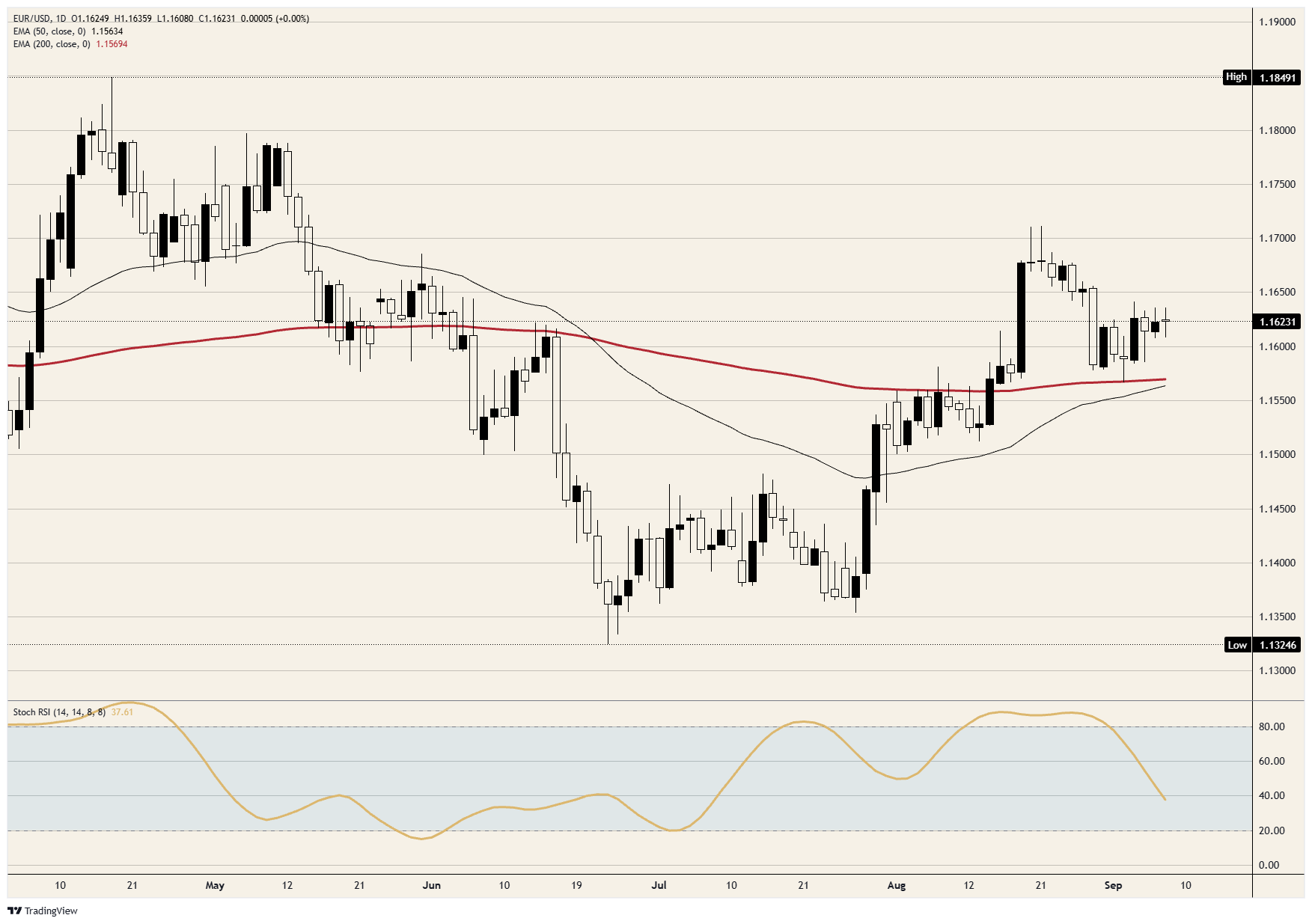
EUR/USD holds above 1.1600, unchanged on the day inside a 28-pip range.
European gas at a three-year high, up close to 128% on the year.
EU storage 67% full against a seasonal norm of 83%.
EUR/USD holds above 1.1600 after a session that has covered 28 pips and left the pair half a pip from where it opened. European gas hit a three-year high on the same clock, and the European Central Bank (ECB) is expected to raise the deposit rate on Thursday. The pair has priced both at nothing. What chains the Euro is a bill that comes due before winter, and no rate gap fixes it.
Dutch front-month gas rose as much as 3.4% on Tuesday to its highest since January 2023 and trades near €75.00 a megawatt-hour, close to 128% above where it stood a year ago. European storage is 67% full against a seasonal norm of 83%, with less than a month before the heating season. The Strait of Hormuz has been shut since February 28, and Qatar has extended force majeure on European and Asian cargoes through the autumn.
The bloc now buys more than 120 billion cubic metres of seaborne gas a year and bids for every cargo against Asian buyers, with the United States Gulf Coast and Qatar the two largest suppliers. Russian pipeline gas has fallen from roughly 40% of demand to under 15%, so the marginal molecule is priced on a global market rather than in a long-term contract. Gas-fired plants set European power prices for several hours on most days, which is how a cargo auction in Asia reaches an Italian electricity bill.
Utilities across the bloc held off buying through the summer on the expectation that the strait would reopen and Qatari volumes would return. Storage is now the lowest for the date since the series began in 2011, and the mandatory November target has already been relaxed from 90% to 80%. The first Qatari cargo to clear Hormuz since July is signalling Pakistan.
The ECB is expected to lift the deposit rate to 2.5% from 2.25% on Thursday, with the main refinancing rate going to 2.65%. That is a quarter point of extra annual return on Euros left on deposit in Frankfurt. The gas the currency area cannot produce has to be bought from outside it, at whatever price the next bidder will pay, and that purchase repeats every week until the tanks are full.
A rate differential moves a currency by changing where money parks. A terms-of-trade shock moves it by changing how much of the bloc's income leaves. Higher energy prices argue for the tightening and against the currency at the same time, which is why a hawkish Council and a rising import bill produce a flat chart. The deposit rate goes up a quarter point a year on Thursday, and the gas price has gone up 23% in a month.
Tehran says an accord with Oman on Hormuz transit is close and will include a temporary safe route. That is the one headline that lowers the import bill without touching either central bank. Traders spent Tuesday waiting on the terms of that deal rather than on the rate decision.
The four-week average of American private payrolls lands Wednesday at 12:15 GMT after 11.75K, the last labour reading before the Federal Reserve meets. Rates and the statement follow at 12:15 GMT Thursday and the press conference at 12:45 GMT, with the American Producer Price Index (PPI) printing between them at 12:30 GMT. Consensus there is 0.4% on the month after a flat July and 5.3% YoY after 4.7%, with the core measure at 0.3% and 4.6%.
Friday belongs to the Dollar leg. The Consumer Price Index (CPI) at 12:30 GMT is seen at 0.4% on the month, 3.4% YoY and 2.4% on the core, the last inflation reading before the Federal Reserve meets September 15-16 with a quarter point priced near 58%. The Michigan survey follows at 14:00 GMT, with sentiment seen at 51 after 51.7 and one-year inflation expectations last at 4%. The ECB President has four scheduled appearances between Wednesday and Saturday.
Resistance: The 1.1650 area caps the range and the session high has stopped short of it again. Above that sits the late-August peak just under 1.1700, which defines the whole three-week range. A daily close through it opens 1.1750 and then the May highs in the 1.1800 area.
Support: The 1.1600 handle has held all session, with the low resting just above it. Beneath it the 50-day and 200-day Exponential Moving Averages (EMA) now sit six pips apart just above 1.1550, which puts the entire downside case at one price. Under them 1.1500 is the next round figure, with the early-August base below that.
Bias: Bearish while 1.1650 caps, with the moving average cluster just above 1.1550 the objective and a daily close beneath 1.1600 the trigger. The daily Stochastic Relative Strength Index (Stoch RSI) has fallen from above 85 to under 40 in five sessions while price held its range, which is momentum leaving without price following it. Two exponential averages six pips apart describe a daily chart with no trend to fade or follow. A daily close above 1.1650 voids the case and puts 1.1700 back in play.
The Euro is the currency for the 20 European Union countries that belong to the Eurozone. It is the second most heavily traded currency in the world behind the US Dollar. In 2022, it accounted for 31% of all foreign exchange transactions, with an average daily turnover of over $2.2 trillion a day. EUR/USD is the most heavily traded currency pair in the world, accounting for an estimated 30% off all transactions, followed by EUR/JPY (4%), EUR/GBP (3%) and EUR/AUD (2%).
The European Central Bank (ECB) in Frankfurt, Germany, is the reserve bank for the Eurozone. The ECB sets interest rates and manages monetary policy. The ECB's primary mandate is to maintain price stability, which means either controlling inflation or stimulating growth. Its primary tool is the raising or lowering of interest rates. Relatively high interest rates – or the expectation of higher rates – will usually benefit the Euro and vice versa. The ECB Governing Council makes monetary policy decisions at meetings held eight times a year. Decisions are made by heads of the Eurozone national banks and six permanent members, including the President of the ECB, Christine Lagarde.
Eurozone inflation data, measured by the Harmonized Index of Consumer Prices (HICP), is an important econometric for the Euro. If inflation rises more than expected, especially if above the ECB's 2% target, it obliges the ECB to raise interest rates to bring it back under control. Relatively high interest rates compared to its counterparts will usually benefit the Euro, as it makes the region more attractive as a place for global investors to park their money.
Data releases gauge the health of the economy and can impact on the Euro. Indicators such as GDP, Manufacturing and Services PMIs, employment, and consumer sentiment surveys can all influence the direction of the single currency. A strong economy is good for the Euro. Not only does it attract more foreign investment but it may encourage the ECB to put up interest rates, which will directly strengthen the Euro. Otherwise, if economic data is weak, the Euro is likely to fall. Economic data for the four largest economies in the euro area (Germany, France, Italy and Spain) are especially significant, as they account for 75% of the Eurozone's economy.
Another significant data release for the Euro is the Trade Balance. This indicator measures the difference between what a country earns from its exports and what it spends on imports over a given period. If a country produces highly sought after exports then its currency will gain in value purely from the extra demand created from foreign buyers seeking to purchase these goods. Therefore, a positive net Trade Balance strengthens a currency and vice versa for a negative balance.
Disclaimer: For information purposes only. Past performance is not indicative of future results.
A note on cookies
Newshunt uses essential cookies to keep you signed in and to remember your language and country, so the site works the way you expect. With your permission, we'd also like to use analytics cookies to understand how people use Newshunt and improve it over time.
Accepting only affects analytics. To learn more, view our Privacy Policy or Terms & Conditions.
(0)Comments