


Pigments under the skin: ancient and indigenous tattooing among men
Category: Entertainment
Share
Archive
Like
After covering traditional tattoos among women in a previous post, in the second part of my posts about pigments and ancient tattoos, we turn to traditionally male tattoos. While researching this topic, I noticed a pattern in worldwide traditions: while women's tattoos were (mostly) connected to beauty, fertility and spirituality, male tattoos were usually tied to hunting and war—especially war.
Male tattoos, in many cases, had to be earned after proving oneself in battle, and they could also adorn particularly skilled hunters. They generally signaled reputation, prestige and the men's role in the tribe. Physical strength, courage and how deadly you were against your enemies were the most valued traits. In cultures where male tattoos are predominant, the tattooers are also men (same as it happened with women).
Subscribe now
I started to research ancient tattoos becauseI was curious about the pigments used in the ink. The materials to make tattooing ink are fairly similar everywhere until the 19th century.Most tattoos everywhere were black, based on my observations due to two reasons: one, it is the easiest color to see in contrast with human skin. Even in the darkest skin colors, black would have been easier to notice than say red or blue. The other reason is that making black pigment only required charring something (plants, wood, roots, resins) and I think people knewcharcoal and soot were harmless for the body.
The reason I suspect this is that mineral pigments are extremely rare in tattooing before the 19th century. There were many other pigments used for other purposes, but none of them are used for tattoos. The only few exceptions to charcoal are the use ofindigo or turmericin some cases (in Asia), also plant-based and not a health risk when used in tattooing.
It makes sense, since even today the inks allowed in tattooing are closely monitored (the EU has pretty strict rules about it). Many colorants are toxic, andprone to cause allergic reactions. I imagine if anyone tried to use certain pigments for tattooing in the past, they would have learned very quickly that it wasn't a good idea. Many traditions that are considered superstitions were actually based in practicality and observation. Anything that's survived for thousands of years must have a firm basis in experience.
In this post, I focus mostly ontattooing related to warrior traditions, but it is worth remembering that warriors weren't the only ones who got tattoos.As I covered in the previous post, tattoos were important as a rite of passage between childhood and adulthood, to mark one's ethnic identity or spiritual believes, and asmedicine. Getting a tattoo was always significant, and it was often surrounded by specific rituals and rules.Tattoo artistswere revered, had an important role in the community andcould charge highly for their work. This meant in many cases only the elite could afford tattoos.
There are hundreds of tattoo traditions all over the world. The ones I mention here are just a few that caught my attention, but this is not a complete list by any means. If you want to know more, I recommend the book I used for my research:Indigenous tattoo traditions: humanity through skin and ink, by Lars Krutak. There are also some interesting developments about ancient tattoos in archeology, especially in Egypt and both North and South America.1
Get 20% off a group subscription
North America had a strong warrior tattoo culture. In Native American tribes, tattoos were more common among men and distinctly linked to war. In many traditions, teenage boys had to undergo a rite of passage in which they fasted and wandered the wilderness for days until they madecontact with a tutelary spirit(calledmanitouomanito). Their tattoos were connected with this manitou, their helping spirit, and with marks of merit earned on the battlefield.
Tattoos were individual and the designs could be used assignatures. For example, woodlands warriors carved their facial tattoos patterns into their war clubs indicating it was their weapon and leaving them on the battlefield as a calling card for a fight challenge.
The Haida and Tlingit of the Northwest coast hadtattoos depicting clan crests. They were applied through the hand-poking method in blue/black and red mineral pigments (one of the few examples where mineral pigments were applied). Tattooed crests united individuals to their ancestors who, over the generations, either earned or maintained the right to use the crest with their deeds and accomplishments.
In the Great Plains, tattoos had to be earned throughwar honors, and only that way: killing a number of enemies, stealing horses, or killing an enemy for the first time. Among the Osage, the honor of receiving a tattoo required extraordinary feats of courage, and only those who had achieved all 13 sacred war honors could hope to be tattooed.
Some of the most interesting aspects of tattooing in Native North America are thetools: cactus thorns, animal bone needles, or lithic lancets were employed to puncture the skin; while the pigments were carbon based from plants and natural substances (many of them with medicinal properties to heal the skin faster). Some groups employed sedatives or local anesthetics to relief the pain. Tattooist's tools could have been embodied with ancestral, apotropaic (protective), or supernatural power: they functioned asbundlesand portable shrines in and of themselves.
Getting a tattoo could be veryexpensive, and it required great payments to the tattooist in the form of valuable goods. Not only did you have to earn tattoos through your courage in war, but you had to pay in a way that equal the importance of receiving a tattoo.
InSouth America, we are aware of very old tattooing practices thanks to well-preserved mummies. A 3.800 years old mummy from the Chinchorro people, Chile, has one of the earliest recorded tattoos: a mustache on his upper lip. However, the most heavily and elaborately tattooed people of South America were the ancient Chimús of Perú. For tattooing, they employed fine needles made of fish bone, parrot quill, and spiny conch, which had been found in some mummy burials. The method was likely hand poking or incision tattooing.
One of the most interesting examples of ancient tattoos in South America is theLady of Cao, a Moche mummy from the site ofEl Brujo, in Perú. The mummy has intricate tattoos of supernatural creatures and geometric designs covering much of her forearms, hands, legs and feet. Since her tomb had war clubs and spear throwers, the Lady of Cao is considered to have been apolitical leader or even a warrior(the presence of weapons in women's burials is often rationalized, trying to justify that women 'could not be warriors', and therefore the presence of weapons had to respond to other motives—but less and less so). Interestingly, her tattoos' pigment has been analyzed and it is a mostly a ferrous oxide, but they look black.
In theAmazon, pigments were made from the soot of burnt copal resin mixed with genipapo juice, and pricked in the skin with a palm tree thorn.Facial tattoos identified tribesand were necessary to be a true person and to be recognized in the afterlife, same as I covered in the case of female tattooing. It also served to separate friend from foe—when you met another warrior while roaming the jungle, you could tell right away what if they belonged to the same ethnic group as you just looking at their facial tattoos. It was a good warning in case you had to run fast from an enemy.
The Marubo were tattooed between 10 and 14 years old by two experienced women, one pricked in the pigment with a bundle of three to four peach palm thorns and the other rubbed it into the wound. They used a mixture of mina (local leaf) twiwa (local fruit) and mei se (pitch soot), and a sedative in the form of a beverage to make the process less painful. After, the wounds would be clean and herbal medicine applied to avoid infection.
The ethnohistoric account of the Spanish who went to Yucatan in the 16th century talks about tattooing among theMaya. Voluntary tattooing was a very painful process undergone by young men. If signified bravery for warriors and hunters and may have been associated with nobility and privilege, while unvoluntary facial tattoos werea form of punishmentfor thieves. This is the other side of the coin with tattoos: same as they could represent positive things (honor, belonging, prosperity) tattoos were permanent, and therefore an ideal way to mark the skin as punishment for everyone to see.
Both Maya men and women were tattooed. Tattoos usually represented animals and Mayan glyphs. Based on ethnohistoric descriptions, solely black is mentioned as a color for tattoos, however, in Mayan artworks the face is the preferred place for tattooing, and they show black and red geometric designs.
Distinguishing between body paint, scarification and tattoos in Mayan archeology is a true challenge. Due to a humid climate, there are no human remains with visible tattoos, and the images and descriptions available are not clear enough. The Spaniards who wrote about tattooed skin possibly described it as 'painted' because they had no clear words to recount what they were seeing (or maybe didn't know at first the ink was permanent). But some tools found in archeological sites could have been used for tattooing—stone tools for puncturing the skin, and black pigment (charcoal or soot)—presenting some material culture connected to tattooing where no human remains serve as proof.
Thebushmen of Namibia and southern Angolaare a good example where tattoos are connected to hunting rather than war: they are tattooed when they are about to set out on a hunt for large game. An elder medicine man makes a cut between the eyes and inserts acarbonized pigment with magical ingredients(it could be burnt animal bone) because it is believed to give strength during the hunt. In this case, tattoos are not a symbol of something else (war deeds, being an adult) but they have power in and of themselves—both the pigment, the place where it is applied and the moment are significant, a kind of sympathetic magic to favor the hunt party.
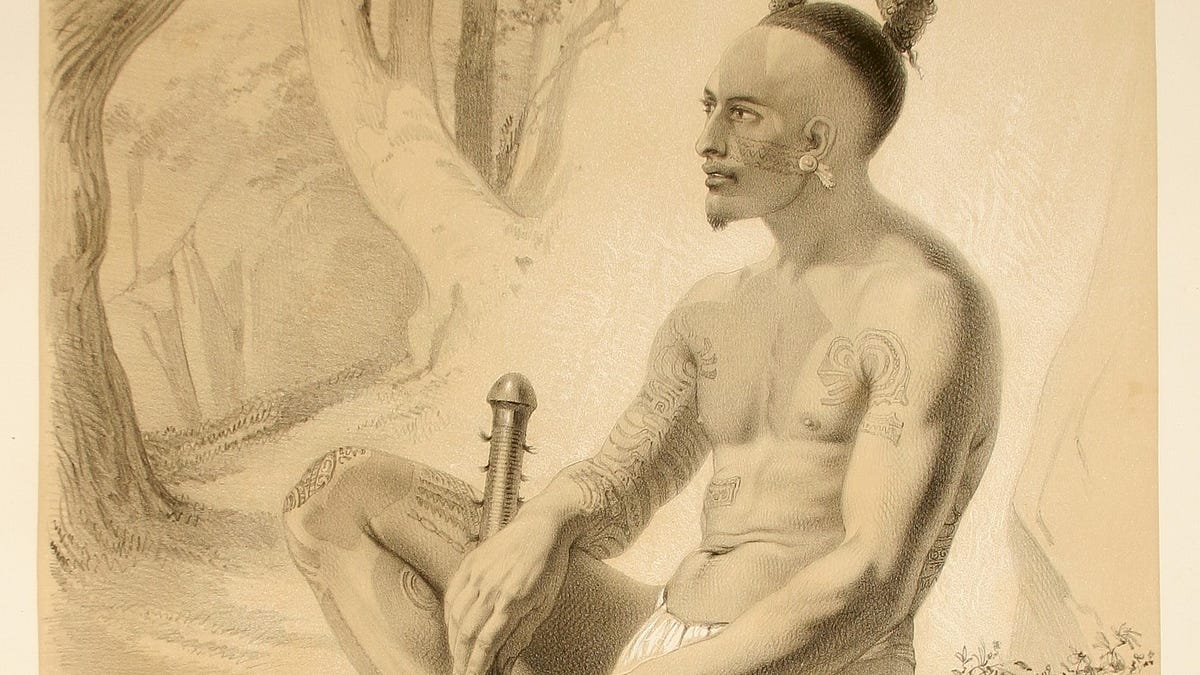
The indigenous culture that most people associate with tattoos is no doubt theMāori of New Zealand. Tattoo artists were namedTohunga ta moko, and they were always men. They used hand-tapping tools and chisels made from albatross or whale bone attached to a wooden handle that they then struck with a mallet on the skin. Tattoos were applied to the whole bodies and faces of chiefs and warriors, while for women they were usually located on the lips and chin (but could be in other parts of the body as well). Facial tattoos were very painful, and it was taboo to touch the face when the skin was healing. The lips got swollen, so food had to be administered through a tube for days.
In thePhilippines, in the region of northern Luzon, many forms of traditional tattooing have survived. Tattoos in the region were associated to men and their feats in battle, like slaying an enemy for the first time and taking their head. Themore enemies they had killed in battle, the more tattoos they earned, usually displayed on their chest, arms and faces. Tattoos had geometric designs from centipedes' or python's scales and the outstretched wings of eagles. The designs were like a map of their acts in battle, portraying their fearsome warrior reputation.
TheAtayal people from northern Taiwangained tattoos as warriors (headhunting was also a way to attain tattoos) and by performing the tasks that made them men: hunting, farming, and family care. It is interesting that in their tradition, with the marks a man gained the right to marry. That is, only after following a series of acts and becoming a proper member of society, could they get tattooed and married. A similar tattoo culture existed in thePaiwanof southern Taiwan, where some of the most beautiful tattoo designs still exist.
Tattoos were the privilege of chiefs and nobility, and only they could bear certain marks. In Taiwan though, women were the tattooists, even if tattoos were mostly a male warrior tradition. It was a revered profession that women inherited, and they had to be from a noble family. They hand-tapped the designs using a wooden handle that had citrus thorns on one end. The pigments were ash or soot from local plants.
Tattoos werehonors bestowed by the village leader. When a man or woman had accomplished a deed that merited a tattoo (becoming of age for girls, bravery and war exploits for boys), the leader would send and envoy to the family asking if their son or daughter wished to be marked with a tattoo. In this way, it was a rite of passage, like it happened in many other cultures around the world.
TheMarquesas Islandsprobably have one of the most remarkable tattoo traditions in the world. Everyone, independently from the class, rank or sex could be tattooed. Maletuhuna(tattooists) worked under the protection of a patron deity. Some tools were made of human bone (from sacrificed enemies) and the rest from the bones of birds. Marquesan warriors and chiefs weresome the most heavily tattooed individuals in history. From head to toe, they were covered with so many layers of ink, that their bodies were nearly black at the end of their lives.
Last but not least, theMentawai of Indonesiaare some of the most profusely tattooed Indigenous people living today. They follow the principle ofcaring for one's soul through body beautification. If one didn't adorn their body with intricate tattoos, pretty beads and fragrant flowers, they risked become unappealing to their soul and it leaving their body.
Subscribe now
I find this concept fascinating because it is the only tradition I have found where tattoos are simply considered beautification, and where beauty itself is a spiritual duty. I also find noteworthy the fact that the Mentawai, unlike almost any other culture in the world, are not about warrior tattoos, or killing to earn a tattoo. They simply like to look good, which is a nice alternative to the usual violence that accompanies ancient male tattooing.
Thanks for reading! This post is public so feel free to share it.
Share
This article is free for everyone to read, but my posts take a lot of time to research and write, and all the ideas are original, and mine. If you would like to leave me a tip, you'd help my research and I'll be immensely grateful to you.
Leave a tip 🧡
Check the work of Aaron Deter-Wolf for Native American tattoos in archeology or Anne Austin for tattooed Egyptian mummies.
A note on cookies
Newshunt uses essential cookies to keep you signed in and to remember your language and country, so the site works the way you expect. With your permission, we'd also like to use analytics cookies to understand how people use Newshunt and improve it over time.
Accepting only affects analytics. To learn more, view our Privacy Policy or Terms & Conditions.
(0)Comments