


From Local Communities to Global Influence: Why India Needs a New Model of Cultural Diplomacy
Category: Politics
Share
Archive
Like
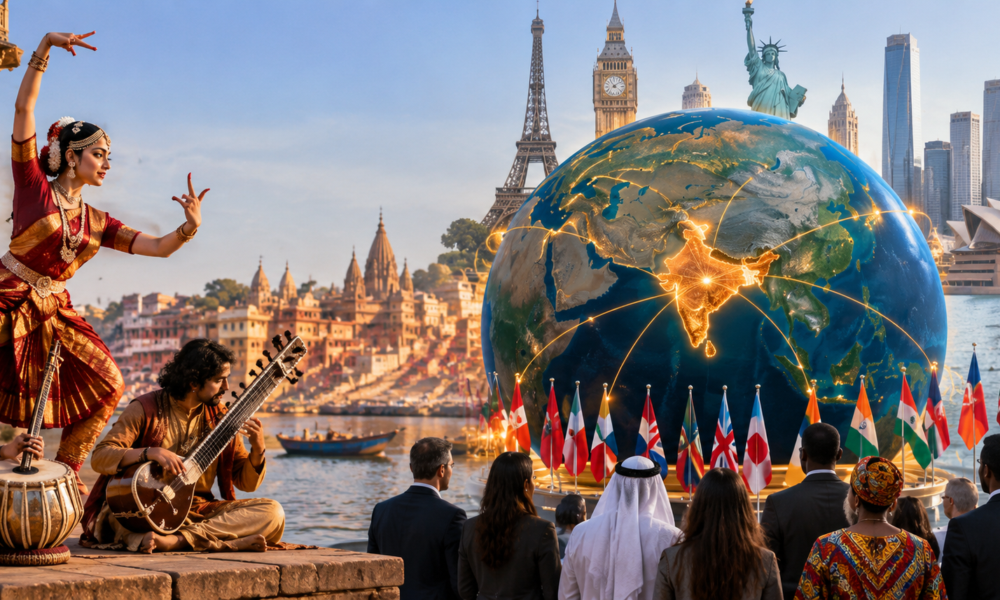
People's minds initially go to the familiar symbols of Indian cultural influence around the world: yoga, Indian cinema, classical music, festivals, cuisines and Ayurveda. These, undoubtedly, have helped in introducing Indian culture to the world. I think it is possible to do more with cultural diplomacy in India. Strength of Indian culture does not just lie in what it is seen on the international stage, but in the millions of communities, traditions and people that continue to live out that culture every day.
Out of the box actions that we take to link these local strengths to the world will contribute to India's global power over the coming years. It is necessary to develop a model of cultural diplomacy that transcends official events and major cultural displays and establishes a connection between communities, institutions and people between countries.
This has an excellent base in India. We speak hundreds of languages and dialects, eat different cuisines, have thousands of traditional art forms and a rich literary heritage, tribal cultures, crafts, festivals and knowledge systems. A large part of this variety is found beyond the metropolises of India. While villages and smaller towns can be the keepers of traditions which have been maintained over years, they are unlikely to be a part of India's international cultural story.
That needs to change.
I think cultural diplomacy should be more people-focused for this reason.
Traditional crafts of India, for instance, could be a very significant contribution to international cultural exchange. The handloom weavers of any rural district, an artisan or tribal artist should not be cut off from the global audience. The digital platforms now enable such people to share their stories, their work, and sell it directly to an international market. This would effectively act as a two-birds, one-stone approach, not only would cultural heritage be preserved, but also communities would have economic opportunities.
Another natural bridge is provided by the Indian diaspora. India already has an extensive world-wide network of cultural linkages, comprising over 35 million Indian citizens and overseas Indians with a variety of professions and living in countries. They raise awareness about Indian festivals, maintain Indian languages, encourage cultural institutes and make the local community aware of Indian culture. These individual initiatives could be combined to form a more cohesive cultural network with India, if there is a stronger institutional link between the two.
The time to make this model much more inclusive is now with the help of technology, India can make it happen. Ten years ago, the world of culture was more dependent on physical events, institutions and official networks than it is today. Today, a rural artist can access an audience in Europe, a student in a small town can be part of an international discussion, and a local entrepreneur can access customers overseas. The differences and divisions between local and global are getting very thin.
However, digital access will not be the answer. Training, language support, digital literacy and market access are required for communities. Institutions in the region need to be able to engage in cultural diplomacy in order to generate economic and social benefits. There are many partners in India's international outreach, such as the panchayats, universities, NGOs, cultural bodies and businessmen.
This is also a social aspect. The diversity of India has to be represented in its cultural diplomacy, not a single Indian identity. There is an international story to be told for tribal communities, rural women, young entrepreneurs, artists, educators and grassroots organisations. They would add credibility to the Indian story on the global stage.
My experience with communities on education, gender equity, child protection and citizen awareness has taught me one thing, sustainable change starts when people feel they have a stake in it. It is the same with international involvement. When the people are not spectators but participants of cultural diplomacy, it is more powerful.
This can also help enhance India's economic diplomacy. Culture and trade are more intertwined. International opportunities can be generated from tourism, handicrafts, creative industries, food, wellness, entertainment, and education and TK. With proper management cultural diplomacy can thus serve as a tool to enhance the image of India and the livelihood of the locals.
The coming 10 years will be a decade to reimagine India's narrative to the world. Investing in international cultural centres, festivals and diplomatic activities should be maintained but needs to be complemented with a much wider community-based approach.
Finally, Indian culture is not confined to the big cities or formal establishments. It is found in villages, classrooms, homes, workshops, farms and universities and communities throughout the country. Our task is to link these strengths with the rest of the world, remaining true to the local, the authentic. India doesn't need to build a cultural image for the rest of the world; it just needs to create opportunities for the world to learn about its incredible diversity.
A new cultural diplomacy model thus needs to shift in both directions, from the government to the people and from the local communities to the international arena. Once India is able to create those linkages in an effective manner, its cultural footprint will not only be a diplomatic instrument, it will be a source of trust, opportunity and global good will for India.
This article is authored by Ashok Thombre, International Business Advisor, The Quantico
A note on cookies
Newshunt uses essential cookies to keep you signed in and to remember your language and country, so the site works the way you expect. With your permission, we'd also like to use analytics cookies to understand how people use Newshunt and improve it over time.
Accepting only affects analytics. To learn more, view our Privacy Policy or Terms & Conditions.
(0)Comments