


Would Gov. Brian Kemp really shut down his Pathways Medicaid program?
Category: Health
Share
Archive
Like
This story also appeared in Georgia Recorder
Patient advocates reacted with alarm this week at the suggestion by the administration of Gov. Brian Kemp that it could end Georgia Pathways to Coverage, his signature Medicaid program that gives health coverage to about 18,500 poor Georgians.
Precious Andrews, an advocate who works for mothers' and children's health, said she was in shock when she saw the news.
'I was like, this is totally insane,' she said in an interview with the Georgia Recorder.
The state Department of Community Health said in documents filed last week that unless the federal government increases its financial support of Georgia's partial Medicaid expansion, the program is 'unsustainable.' The feds currently provide two-thirds of the cost to cover those 18,500 low-income people, the same amount it provides for the state's general 2 million-plus Medicaid population, old and young. But Georgia wants a special increase to 90% federal support. Washington has previously said Georgia doesn't qualify.
Georgia officials say that quirks in a new federal law change things. They say the law will increase the Pathways program's patient load not just with more patients, but with patients who are more expensive to care for – too expensive, they argue, for the state's budget.
'The financial burden of this federally-mandated coverage expansion is simply not sustainable for Georgia in the long run,' the state wrote in its application.
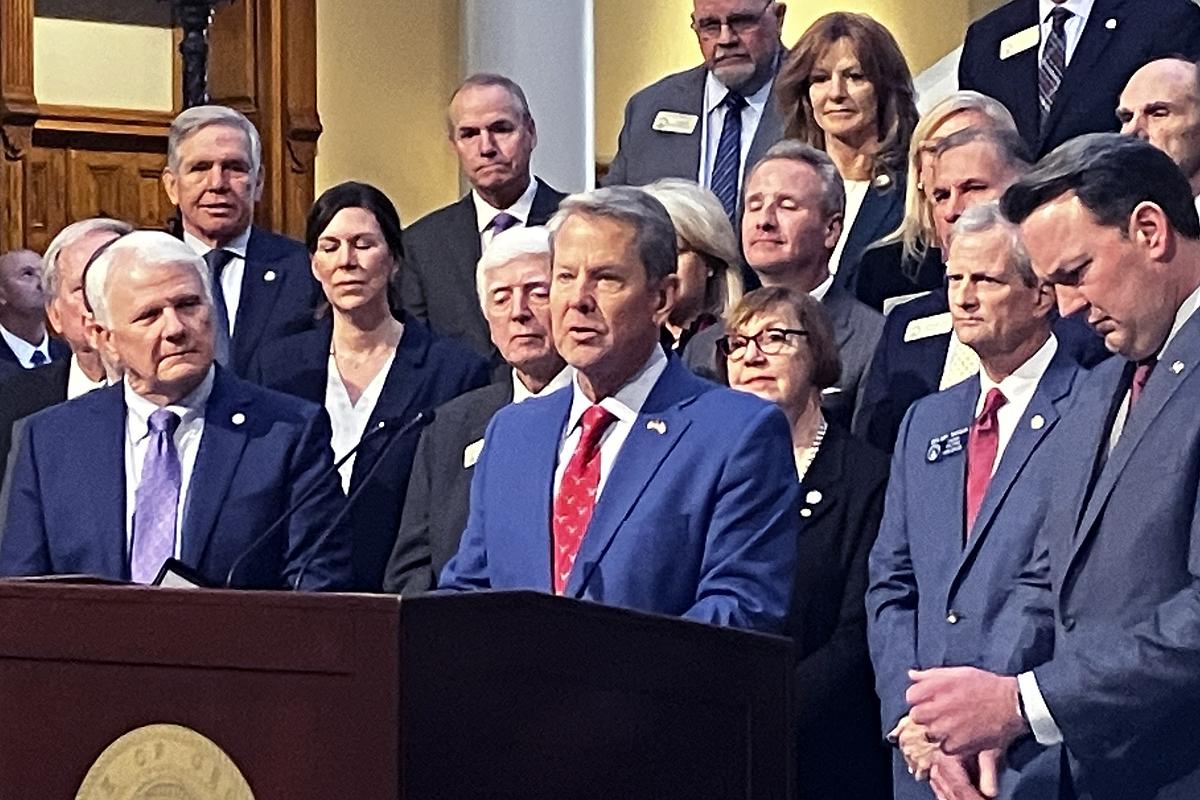
A spokesman for Kemp, Carter Chapman, said Wednesday that the governor still 'fully supports DCH's efforts to ensure Georgia Pathways remains a national model for other states while maintaining the integrity of the first-of-its-kind program.'
'While we cannot speculate on potential outcomes at this time with discussions ongoing' with the feds, Chapman said, 'the governor is committed, as he always has been, to ensuring Georgians have access to quality healthcare while maintaining fiscal discipline for the state.'
Federal changes would grow Georgia's partial expansion program
p>The uproar is a result of the passage last year of President Donald Trump's One Big, Beautiful Bill Act. That law made massive cuts to Medicaid nationwide and in Georgia. One nationwide cut was made by adding new eligibility requirements for Medicaid enrollment for the 40 states that expanded Medicaid to all their poor. Anyone who doesn't work or perform certain activities will be kicked off.
However, for Georgia, which already did a partial expansion with its own requirements, those new requirements are more lenient. That specific rule is not a cut for Georgia, but a loosening of the rules.
In one example, as a partial Medicaid expansion to the poor, Georgia now will be required to offer coverage to low-income parents who care for children as old as 13. Currently, Pathways covers those parents for kids up to age six.
The Kemp administration calculated that enrollment for the partial expansion group would increase by about 100,000, to a total of nearly 120,000 over 18 months. That's not much more than the Kemp administration forecasted when it first launched the program. But Kemp aides say they'll cost more per patient.
A spokeswoman for the department said the patients mandated for inclusion in the new federal law include more patients in expensive programs like active addiction recovery and the medically frail.
Is Pathways legally eligible for more federal funding?
Allowing Pathways to expire on schedule at the end of the year would be a major development politically, putting an end to the foremost initiative of Kemp's first year as governor and his policy response to the singular issue in his campaign to beat Stacey Abrams: dealing with Georgia's uninsured poor.
Kemp created Pathways in a new law in 2019, the Patients First Act. Among other initiatives, it lifted the state's ban on partial Medicaid expansion under the Affordable Care Act, and created work and activity requirements for newly eligible Medicaid members. Such requirements had previously been banned in other states, but they were not banned under the new ideas of President Donald Trump and recent court decisions.
The first Trump administration partnered closely with Kemp to develop the programs and make them work. Trump's administrator for the Centers for Medicare and Medicaid Services, Seema Verma, in 2020 flew down to Atlanta to announce her approval in a celebratory ceremony beside Kemp at the Georgia Capitol. She said no one had done more to make use of the administration's new flexibilities, and shook the governor's hand as cameras flashed.
Under the ACA, if Georgia had expanded Medicaid to all of its poor, it would already get that 90% from the feds for those patients. But federal law says that states that only do partial expansion don't get the special rate.
However, Georgia is making the case that Trump's tax cut and spending law makes Georgia more like those other states even though it didn't fully expand Medicaid. And they claim the federal law has created a dire situation for the state budget.
Joan Alker, executive director of Georgetown University's Center for Children and Families, said that giving Georgia the extra federal money that goes to full expansion states when Georgia has not done full expansion simply wouldn't comply with the law. Full expansion under the law means giving Medicaid to everyone under 138% of the federal poverty level, or about $22,025 for a single adult. Georgia only gives it to those under 100% of the federal poverty level.
But, she says, maybe the Trump administration could surprise everyone with its take on the law.
'From a legal perspective, waiving the match like this would be a bridge really, really far … The lawyers know that,' Alker said. 'I expect them to turn it down. But who knows?'
State Senate Appropriations Chairman Blake Tillery, a Vidalia Republican who introduced the Patients First Act for Kemp in 2019, said he's not surprised at the situation.
'I think that's consistent (with) what you've been hearing from the Governor and Legislature since Nathan Deal,' Tillery said in a text message. Deal as governor rejected full Medicaid expansion when it was first created as an option by President Barack Obama under the Affordable Care Act.
'Our two biggest expenses are education and Medicaid,' said Tillery, who was a floor leader for Kemp. 'Our two largest annual increases are also generally education and Medicaid. Georgians have been clear how they feel about the government – state and local – taking more of their money. The trend on these increases is unsustainable, much less with a change dictating more state funds.'
'So what happens to those 18,000?'
Advocates for patients who raised the alarm about the Pathways announcement made clear that they still would prefer the state to do a full Medicaid expansion as laid out under the original Obamacare law.
Andrews, who is director of special projects and innovations at Healthy Mothers, Healthy Babies Coalition of Georgia, spoke at a public hearing on the issue Wednesday. Speaking later with a reporter from her personal perspective, she said, 'So what happens to those 18,000? Are we now living in a society where – you have to basically sacrifice a certain number in order for a certain number to survive?'
Georgians for a Healthy Future has advocated for full Medicaid expansion and released a written statement.
'More than 18,000 Georgians could lose the only health coverage available to them, not because of anything they did, but because state leaders are using their coverage as leverage in a funding dispute with Washington,' Laura Colbert, the group's executive director, said in the statement. 'Whatever happens with this request, Georgia should not be threatening to take health coverage away from the people who depend on it.'
Before new restrictions in the One Big, Beautiful Bill Act, fully expanding Medicaid under the ACA would have given every low-income Georgian Medicaid. Estimates have varied over the years but it might have provided insurance to 200,000 uninsured Georgians. The new federal law passed last summer will lessen that number and experts aren't sure yet by how much.
The 18,500 current Pathways enrollment figure comes from state records obtained by the Georgia Budget and Policy Institute.
The Georgia Hospital Association, which represents powerhouse health systems as well as teetering rural hospitals, didn't comment on the claims that the state's Pathways program is no longer sustainable. It supports the request for more federal money, though.
'GHA supports affordable coverage options for Georgians and continues to support efforts by DCH and the state to expand those coverage opportunities in a cost-effective manner,' Anna Adams, the association's chief government relations officer, said in an email.
Laurisa Barthen, executive director of the Georgia Council for Recovery, said people grappling with addiction recovery and mental health problems need health insurance to climb out.
'Ending Pathways is not a feasible solution if the 90% match is denied,' Barthen said during Wednesday's public hearing. 'More than 18,000 Georgians currently rely on this coverage, and many more could potentially gain coverage under the new eligibility framework. So Georgia should be working towards reducing the need for preventable crisis services by expanding healthcare coverage, not creating the possibility that thousands of our friends and neighbors will lose it.'
Alker said that if the request is denied, it would mark the end of Kemp's signature Medicaid program, which has carried huge administrative costs compared to its low enrollment. (Kemp has long argued that Pathways has been a major success because it left hundreds of thousands of Georgians free to choose private Affordable Care Act plans instead of Medicaid.)
Legally, canceling the program would not be hard. It's officially a pilot program set to expire at the end of 2026 unless Georgia and Washington agree to renew it.
'He very well understands the twists and turns behind this, and that this has been turned down before,' Alker said. 'So, is this a face-saving way out? They get turned down, and then they can say, 'Oh, we couldn't do it,' – rather than having to admit failure?
'That's one possibility,' she said. 'We'll just have to see.'
Georgia Recorder is part of States Newsroom, a nonprofit news network supported by grants and a coalition of donors as a 501c(3) public charity.
A note on cookies
Newshunt uses essential cookies to keep you signed in and to remember your language and country, so the site works the way you expect. With your permission, we'd also like to use analytics cookies to understand how people use Newshunt and improve it over time.
Accepting only affects analytics. To learn more, view our Privacy Policy or Terms & Conditions.
(0)Comments