


Why Ships Never Start from Scratch—and Neither Should You
Category: Business
Share
Archive
Like
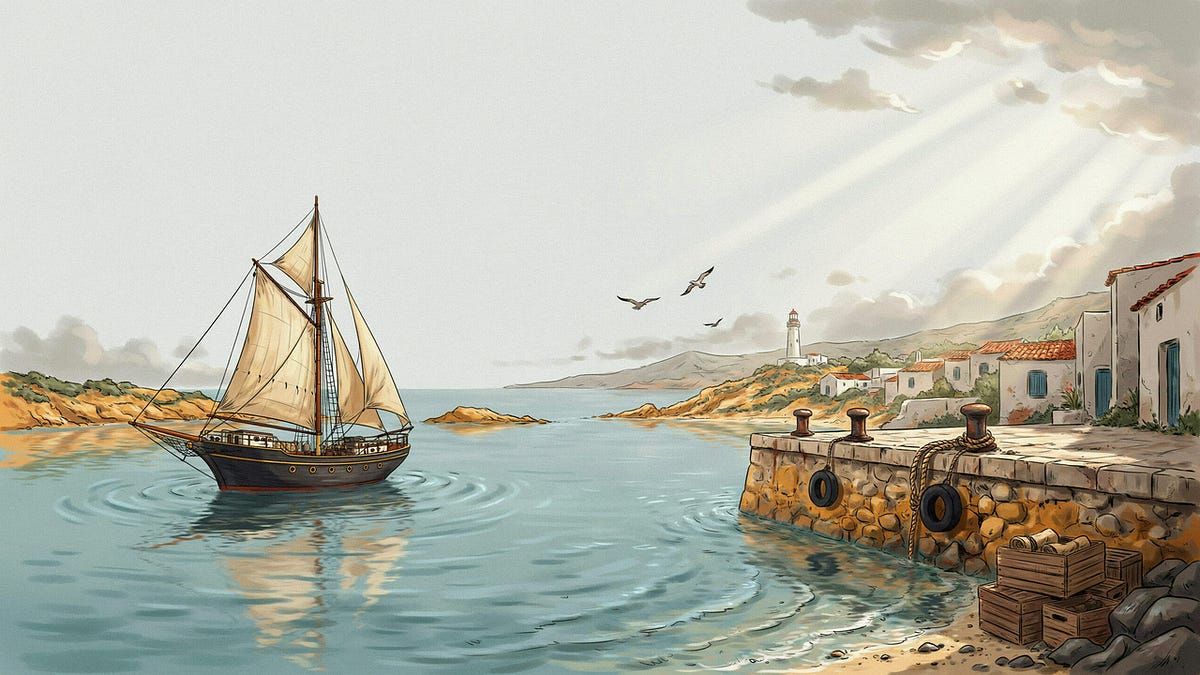
It looks for one that's already there, already functioning, and has already safely accommodated a thousand other ships.
That's exactly what this new series is about:docking.
Not as a pretty metaphor, but as a method you can use to get any new project off the ground more easily, quickly, and safely.
I had this thought while traveling, time and again, whenever I discovered a safe harbor somewhere.
On his voyage, Columbus declared the island of Porto Santo a safe harbor—the name says it all. Well-located, well-supplied, a place to catch your breath before continuing the journey.
People have always sought out such harbors, and I think there's a lot to learn from this: for business, for creative work, and for a perfectly normal, hectic everyday life.
If you have a safe harbor where you can dock, you don't have to start completely from scratch with every new project.
A ship connects in a controlled manner to a fixed berth, a dry dock, or another ship.
Speed, angle, wind, and current must all align exactly; otherwise, damage occurs instead of a secure connection.
Historically, the construction of a real dock was a small revolution:
The Old Dock in Liverpool, opened in 1715, was the world's first covered commercial dock; suddenly, ships could be loaded and unloaded regardless of the tides.artikel
But the term didn't stay confined to the water.
In communication theory of the 1970s, 'docking' became the first step in establishingrapport—attuning oneself to a counterpart before seeking a common direction together.
And in creative processes, it means consciously linking a new work to something existing:
A sequel to a novel
A new article in an ongoing series
A fresh project connected to a structure that has already proved it can hold weight
Docking means that you do not have to invent the whole harbor before you can begin the voyage.
His famous verse from 1624 sums up in just a few words why 'docking' works as a principle in the first place:
'No man is an island.'
No one exists completely detached from other structures.
Aristotle called humans azoon politikon, by nature dependent on community. Even space travel knows this moment of relief: when Apollo and Soyuz docked in 1975 and the radio transmissions briefly confirmed'Contact'and'Capture,'two rival programs were suddenly connected.
Attachment researcher John Bowlby demonstrated that a reliable, accessible attachment figure forms the foundation of every successful connection.
This is precisely the principle we'll be exploring over the next three weeks: methods from seafaring that can be effortlessly applied to everyday life and business.
Not because life is a ship. It isn't.
But because a good harbor, a reliable line, and a sensible approach can save an astonishing amount of unnecessary struggle.
The material I've collected and curated is enough for more than a week.
So look forward to what's coming next, because 'docking' isn't a one-time trick—it's a method you can apply time and again:
When you begin a new habit
When you launch a new project
When you enter a new professional environment
When you reconnect with an old contact
When your creative work needs a place from which it can continue
You do not need to be permanently moored.You only need a place where you can arrive safely, take stock, and prepare to set out again.
Faster, more secure onboarding
Greater sense of belonging
More stable new habits
Less fluctuation during transitions
Higher productivity through faster integration
Greater trust through rapport before leadership
Creative adaptability
Reduced friction and conflicts
Network resilience through multiple anchor points
Smoother transitions
Sustainable autonomy despite connection
Thanks for reading Klaus' Substac ! Subscribe for free to receive new posts and support my work.
A note on cookies
Newshunt uses essential cookies to keep you signed in and to remember your language and country, so the site works the way you expect. With your permission, we'd also like to use analytics cookies to understand how people use Newshunt and improve it over time.
Accepting only affects analytics. To learn more, view our Privacy Policy or Terms & Conditions.
(0)Comments