


AI Is Built to Save Humanity. Humanity Is on Food Stamps.
Category: SciTech
Share
Archive
Like
Amazon could take every worker on food stamps and give them enough to live on for less than a thousandth of what it is spending on AI this year. It has known about those workers for five years. Nothing has changed. We are told AI will eventually cure disease, end poverty and bring abundance. But before we get to the future, there is something worth looking at in the present.
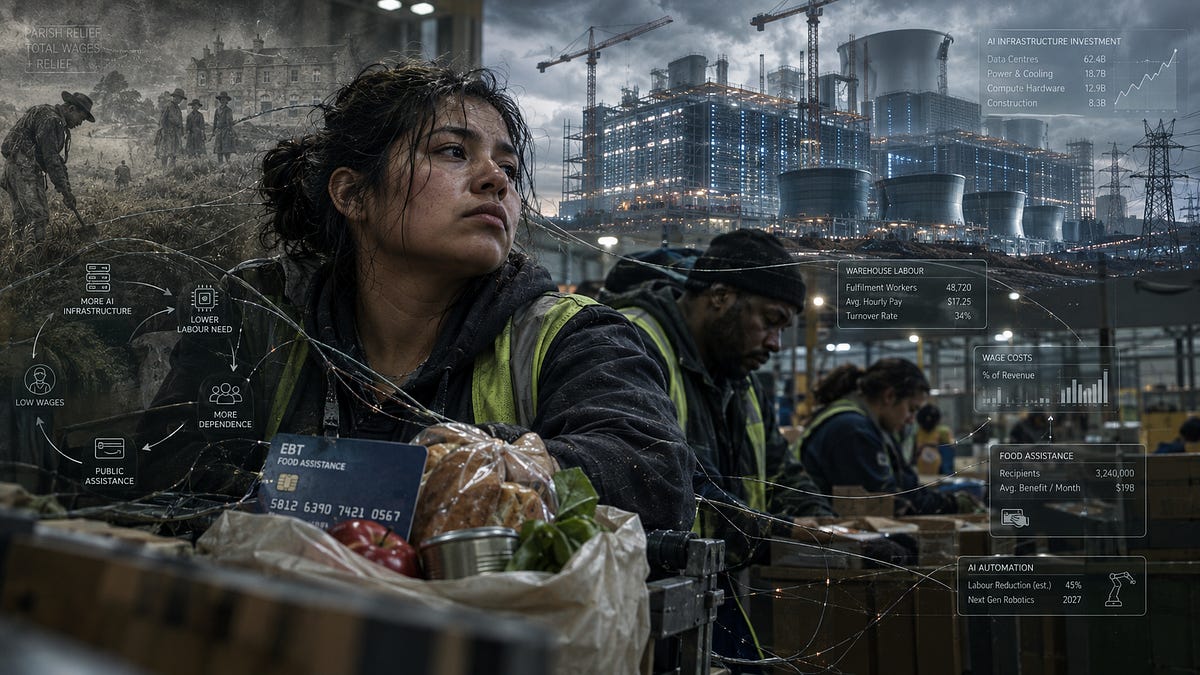
Amazon has around twelve thousand employees on food stamps. Not former employees, not contractors at arm's length, but people who were at work last week and will be at work next week, drawing federal food assistance to get to the end of the month. The company has said it will spend something in the order of two hundred billion dollars building AI infrastructure this year.
Neither of those two choices was forced on Amazon from outside. It set the wage that leaves twelve thousand of its workers on food stamps, and it approved the two hundred billion dollars going into AI this year.
That looks like a story about a company treating its workers badly, which is old, common, and by now barely capable of surprising anyone. It is not.
The case for building AI at this scale has never rested on better writing tools. Nobody raises hundreds of billions so that people can draft a little faster, summarise what they have not read, and hand over the dull repetitive part of the day. Anthropic's chief executive has written that powerful AI could compress a century of progress into five or ten years, curing disease and lifting the developing world out of poverty. OpenAI's has promised massive prosperity, an Intelligence Age, abundance. A lot of intelligent people believe these predictions will come true, and they are not fools for believing it. If disease is cured and poverty ends, almost any amount of money spent building AI will have been worth spending, and the people going hungry while it gets built will have been part of the cost of getting there.
Amazon itself does not give that speech. It does not need to. Few companies are spending more on the infrastructure those promises depend on, and that is what places it inside the same project.
You cannot check a promise about the future. But promises like these carry a claim about the present too, whether the people making them realise it or not. They say that people are the point, and that building AI is how to get there. That claim can be tested right now. What do these companies do when feeding people and building AI want the same money on the same day?
That contest is not scheduled for some later date. It has been running for years, inside every organisation making the promise, because each of them is already in a position to feed somebody. Not humanity, and not the abstract poor of the coming decades, but the people already on the payroll, whose hunger is written down in a government report.
Work out what it would cost to top up the wages of Amazon's own twelve thousand workers on food stamps. Give each of them ten thousand dollars a year more and the bill comes to a hundred and twenty million. In the meantime, two hundred billion is going into AI infrastructure. Lifting every one of those workers off food stamps would cost less than a thousandth of that, and the AI spending would carry on exactly as before. Nothing about the strategy would have to change, and nobody at the company would ever need to explain a gap that small to anyone.
That raise has never happened. The twelve thousand are still on food stamps, still paid too little to get through the month without help, and the government's own count of them has been on the record for five years, so the company cannot claim it did not know. Nor can it claim it weighed the raise against the AI budget and found it could not afford both, because at less than a thousandth of that budget, it plainly can. The calculation was never made. What the business needs wins, and wins so easily that no one inside the company experiences it as a contest at all.
Subscribe now
This is where the ordinary way of talking about hunger stops being useful.
We discuss poverty as though it were an arithmetic problem. There is not enough. The money has to come from somewhere. Budgets are finite, choices are hard, and anybody demanding that workers be paid more is asked, reasonably enough, where they think the money will come from.
Look at what is actually happening and that question collapses. The money is there. It is there in quantities that have no precedent, moving faster than money has ever moved, into land, power contracts, cooling systems, chips and buildings. The sums going into AI infrastructure in a single year exceed the entire annual budgets of most countries on earth. Whatever else is true, there is no shortage.
So hunger among people in full-time work is not a shortage of money. It is a feature of the system. Somebody decided what matters most when the money is divided up, and who gets paid first, and the workers packing the boxes came nowhere near the top of that list.
None of this is hidden. That a living wage is not the priority is not a secret, and neither is where the money goes instead. The figures come out every quarter, in public, in the accounts.
That is a different claim from the one people usually make about poverty, and a harder one to answer. If there were no money, the answer would be to grow the economy and wait. There is money. The waiting has nothing to do with it.
Look at how a single company handles both sides of the equation, because the accounting is the only place any of this is visible.
Labour sits in the books under costs, and the whole point of a cost is that you get it down. Every system inside a large firm exists to do that: scheduling software, productivity targets, route optimisation, attrition modelling. Compute sits under assets, and the whole point of an asset is that you grow it, and the market pays you for growing it.
So the same organisation, on the same day, works to spend as little as it can on the people and as much as it can on the infrastructure. That was chosen. Getting the cost of labour down is not a side effect of the business model, it is the business model, and filing the two under different headings is how it gets done without anybody having to stand up in a meeting and argue for it.
What closes the gap on the labour side is the public. Food assistance, health cover, whatever the state puts in to get somebody to the end of the month. The wage covers part of what it takes to live and the taxpayer covers the rest, and both payments arrive, and the person eats, and the transaction completes. It completes with two parties paying and only one of them appearing in the accounts.
This is also why almost nobody objects to it. When your tax goes out, it does not arrive labelled as a contribution to a company's wage bill. It arrives as food assistance, going to a family that needs it, which is exactly what you would want your money to do. Every method anybody has for resisting a transfer of money requires noticing the transfer, and there is nothing here to notice. The money does good on its way through. That it also relieves an employer of a cost happens somewhere else entirely, in a set of accounts nobody outside the company reads.
Meanwhile, on the other side of the same ledger, the money that could close that gap outright is going into AI infrastructure instead. The public was never asked about any of it, and it is not as though it were being hidden. It is happening in the open, in the quarterly accounts, described as an investment in humanity.
The same arrangement ran here once before, and the differences matter more than the similarities.
In 1795, in a village in southern England, magistrates met to deal with a real emergency. Bread had become expensive, agricultural wages had not moved, and people were going hungry. They agreed that parish funds would top up a labourer's wages on a sliding scale tied to the price of a loaf of bread and the number of children he had. It worked, in that people ate, and it spread across the southern counties because it was cheap and it kept the peace.
Within a generation, across those same counties, a man could work a full week on a farm and still end up on parish relief. Everybody could see it happening and nobody could agree on why, and the argument ran for forty years. Farmers were accused of paying less because the parish would cover the difference. When a Royal Commission was appointed in 1832, that was substantially its conclusion.
Historians still fight about how much of that was true. Polanyi built a chapter of The Great Transformation on the claim that the top-ups drove wages down and pauperised the English labourer, others say the effect was smaller, and the dispute does not need settling here. What matters is the condition it ran under. England in 1795 was a poor country in a real subsistence crisis. There was not much money and there was not much bread. The parish was rationing scarcity because scarcity was real, and those magistrates had no third option in front of them.
The same arrangement is running now in the richest economies there have ever been, alongside a private construction programme without modern precedent, all of it for AI. The structure is the same. The excuse is gone. Those magistrates could say there was no money, and they would have been telling the truth. Nobody can say that today. The money exists, it has been counted, and it is going into data centres.
Two remedies were obvious, and Parliament took neither. It could have set a legal minimum wage, and did not. It could have made the farmer pay a man enough to feed his own family, the exact shortfall the parish had been covering for forty years, and did not. The farmer, who was the one benefiting, was asked for nothing and carried on as before.
What Parliament went after instead was the relief. Until then, a family that could not manage received money from the parish while carrying on living in its own home. The law of 1834 ended that for anyone judged fit to work. From then on, if you were able-bodied and still could not feed your children, there was one place left to go: the workhouse.
The workhouses were built to be dreaded, and the men who designed them wrote that down rather than hiding it. The rule was that life inside had to be worse than the life of the worst-paid labourer still coping on the outside. Families were split at the door, and entering was meant to feel like a disgrace.
Look at what that did to each of the two parties. The employer who had been paying below subsistence was left untouched. He had property, standing, and the ear of the same class that sat on the Commission, and forcing him to raise wages would have meant a fight nobody wanted to start. The labourer was told he could have his relief inside the workhouse or not at all. Nobody had to negotiate that with him, because he had nothing to negotiate with. Passing the law and building the workhouses was enough on its own.
Corrections of this kind land wherever the resistance is weakest. That is never the side that has been saving the money.
The same imbalance is in place today. On one side are warehouse staff drawing food assistance. On the other is an industry that has spent years writing itself into national energy policy, drafting its own regulatory proposals, and being told by governments that its expansion is a strategic priority.
People will tell you this gets noticed eventually and put right. Ask them which of those two they think the correction reaches.
Subscribe now
What is so important about AI that a company will let the people who work for it go hungry to build it, and almost nobody thinks there is anything wrong with that?
Start with what the two hundred billion being spent on AI infrastructure does not buy. It does not buy food, and it does not get food to anybody who is short of it.
Most people assume hunger exists because there is not enough food to go round. That assumption is worth taking apart. The world grows more than enough. Enough is produced for every person alive to eat well over two thousand calories a day, and that has been true for years. Around six hundred and forty-five million people went hungry last year anyway, and roughly three million children under five died of causes tied to not having enough to eat, which is close to half of all the deaths in that age group.
Those two facts sit together because food is not distributed, it is sold. It goes wherever there is money to pay for it, which is why a large share of the world's grain is fed to livestock or burned as fuel in countries that can afford to do that, while people go without in countries that cannot, and why roughly a third of the world's food is lost or wasted before it is eaten. The people who go hungry are the people who cannot pay, and that has been the mechanism the whole time.
It is the same for the twelve thousand. They are not hungry because America is short of food. They are hungry because they do not have the money for it, and how much money they have is decided by somebody else.
Deciding who gets what, at speed and across large numbers of people, is what the two hundred billion is buying. There are already systems doing it.
In the American health system, an algorithm decides whether the treatment a doctor has asked for will be paid for. In the Netherlands, the government built a system that scored its own citizens according to how likely they were to be committing benefit fraud, and a court ordered it shut down for violating basic rights. In Denmark, Amnesty International spent years investigating a similar system, concluded it amounted to scoring people socially, and when its investigators asked to look inside it the government refused and kept the system running.
Not one of those three systems grows any food or puts a meal in front of anybody. What each of them does is decide who is entitled to something and who is not, across far more people than any office full of civil servants could work through. And each of the three was presented to the public the same way: as a fairer method, or a faster one, or a way of catching people who were cheating.
That description is why nobody objects. Nobody is being asked to accept hungry workers in order to build a system for deciding who eats. They are being asked to accept a temporary shortfall on the road to curing disease and ending poverty, and put that way it is not only tolerable, it is the responsible thing to do. The cost becomes an investment, the people bearing it become an unfortunate detail of the timeline, and anybody who complains is standing in the way of the cure.
Now the company's behaviour makes sense. Leaving twelve thousand of your own staff on food stamps while spending two hundred billion on AI looks like a contradiction. It isn't. Deciding that a warehouse worker will be paid too little to feed himself is the same kind of decision as building a system that works out who gets what across millions of people. In both cases somebody settles what a person will receive, and that person has no say in it. Right now a payroll department does that to twelve thousand people. What is being built will do it to everybody.
The jobs go. A UK minister has said basic income is already being discussed inside government because of what AI is expected to do to employment, and the same man at Anthropic who promised to lift the developing world out of poverty has described his own product as a general labour substitute for humans. Few of the people building this dispute where it leads. Something replaces the wage. Whatever replaces it will be granted rather than earned, and it will be handed out by the systems that two hundred billion is building.
Which is where the twelve thousand come back. They are the test case for the whole arrangement: people whose work is still needed, at a company that could take them off food assistance for a sum it would not notice, and that has said no every year for five years.
When the jobs have gone, there is no wage left to argue over, and somebody still has to decide what you are given instead. That is the same decision as the one about the warehouse. It has arrived in a different form, at a point when you have nothing left to bargain with.
If they will not feed you while you are working for them, there is no reason on earth to expect generosity once you are not working at all. The thinking that keeps those wages where they are will not have changed. And you will have gone from somebody whose work they need to somebody they have no use for.
Share
None of this is a problem of timing. Curing disease and ending poverty are still in the future, where nobody can check them. The spending is here now. Where it goes, and who it passes over on the way, is the only part of the whole thing that has actually happened, which makes it the only evidence anybody is ever going to have.
There is an old instruction for this exact problem, which is how to judge a claim about somebody's intentions when their intentions are the one thing you cannot inspect. You shall know them by their fruits. The instruction is not to listen more carefully to what is being promised. It is to stop weighing the promise and look at what is already coming out.
So look. The number of Amazon workers on food assistance has nearly tripled in five years. A government office counted them, wrote it down, and sent it to a Senate committee, so nobody involved can say they did not know. Over those same five years the money going into AI went from large to unprecedented. Somebody approves that spending every year. Somebody declines to raise those wages every year. They are the same people, holding the same figures, on the same day.
And this is where it stops being about wages.
Those twelve thousand have jobs for one reason: somebody has to pack the orders. What they are paid has nothing to do with that. They are paid what the company can get away with paying, which turns out to be less than it takes to keep a household fed, because the shortfall lands on the public and nothing obliges the company to pick it up instead.
What the two hundred billion is building is the thing that removes the one reason they are there at all.
Nobody has yet said what a person is worth once their work is not needed. Somebody will. You do not have to wait for it. The same sum is being worked out right now on people whose labour is still wanted, and the result is public. Twelve thousand of them, in full-time work, on food stamps, at a company spending two hundred billion dollars to make them unnecessary.
That is what this arrangement pays the people it still needs. There is no version of it where the figure goes up once it does not.
Further reading:
AI's Hidden Cost: A Pattern We've Seen Before.You paid for the research and you cannot afford the cure. The war on cancer worked this way first, and no one had to hide it.https://thinkingwithainewsletter.substack.com/p/ais-hidden-cost-a-pattern-weve-seen
Stripped to the Bone: What AI Is Really Costing You.The data centres draw power at the scale of small towns. They were never on anyone's ballot, and they are already on everyone's bill.https://thinkingwithainewsletter.substack.com/p/stripped-to-the-bone-what-ai-is-really
AI: The New Oil. The Oldest Bargain in the World.The company that says your job is going has already drafted what you will live on instead. The question is who was in the room when it did.https://thinkingwithainewsletter.substack.com/p/ai-the-new-oil-the-oldest-bargain
Sources
Government Accountability Office report on employer public-assistance enrolment, released through the Senate HELP Committee:https://www.help.senate.gov/dem/newsroom/press/news-new-gao-report-finds-taxpayers-continue-to-subsidize-poverty-wages-at-walmart-amazon-other-large-corporations-as-corporate-welfare-spikes-since-2020
Dario Amodei, 'Machines of Loving Grace':https://www.darioamodei.com/essay/machines-of-loving-grace
Sam Altman, 'The Intelligence Age':
https://ia.samaltman.com
FAO, The State of Food Security and Nutrition in the World 2026:https://www.fao.org/publications/fao-flagship-publications/the-state-of-food-security-and-nutrition-in-the-world/en
Amnesty International, 'Coded Injustice: Surveillance and Discrimination in Denmark's Automated Welfare State':https://www.amnesty.org/en/latest/news/2024/11/denmark-ai-powered-welfare-system-fuels-mass-surveillance-and-risks-discriminating-against-marginalized-groups-report/
Leave a comment
A note on cookies
Newshunt uses essential cookies to keep you signed in and to remember your language and country, so the site works the way you expect. With your permission, we'd also like to use analytics cookies to understand how people use Newshunt and improve it over time.
Accepting only affects analytics. To learn more, view our Privacy Policy or Terms & Conditions.
(0)Comments