


BRICS rejects 'punitive and discriminatory' EU carbon border tax
Category: Financial
Share
Archive
Like
The mechanism is inconsistent with international law and a "significant trade barrier for developing countries," ministers have said
BRICS countries have opposed the European Union's Carbon Border Adjustment Mechanism (CBAM), calling it"unilateral, punitive, discriminatory, and protectionist."
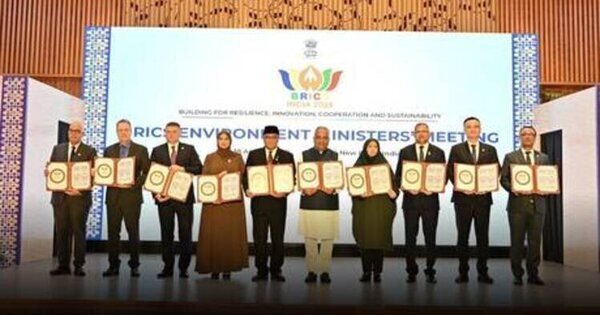
The meeting of the bloc's environmental and climate ministers in New Delhi, chaired by Indian Minister for Environment, Forest and Climate Change, Bhupender Yadav, expressed concern on Monday that the measures specifically undermine efforts by developing countries"aimed at addressing the adverse impacts of climate change."
The BRICS group of emerging and developing economies includes the original members Brazil, Russia, India, China, and South Africa, as well as Egypt, Ethiopia, Iran, Saudi Arabia, the UAE, and Indonesia.
The EU mechanism, which came into effect on January 1, aims to reduce"carbon leakages"through a certificate-based pricing system. In effect, it puts a carbon price on emissions-intensive goods entering the 27-nation EU bloc.
Importers have to buy certificates matching the weekly carbon price of the EU Emissions Trading System, with deductions allowed for any carbon prices already paid in the goods' country of origin.
The CBAM's professed aim - to ensure foreign goods face a carbon cost equal to products made inside the EU - puts producers in developing countries at a disadvantage. It imposes extra carbon costs on the key exports of developing countries and reduces their price competitiveness in European markets.
Producers in the Global South are forced to undertake costly tracking of factory emissions to sell to the EU, while it reduces overall market opportunities for carbon-intensive emerging economies - which in effect are forced to pay for the historical high emissions of Western developed nations.
The higher carbon costs make Indian exports of steel, aluminum, and cement to the EU less competitive. New Delhi has raced to create a domestic carbon trading framework and mechanism to keep the value of the carbon savings within the country instead of ending up as EU taxes.
India and the EU signed a trade deal in January, calling it the"mother of all deals.""India is the world's fastest growing major economy,"European Council President Antonio Costa said at the time."The trade agreement reinforces a rule-based economic order."
The BRICS statement noted that the EU carbon border tax was"not in line with international law."
India had in 2024 labelled the proposed CBAM as unfair and detrimental to domestic market costs.
A note on cookies
Newshunt uses essential cookies to keep you signed in and to remember your language and country, so the site works the way you expect. With your permission, we'd also like to use analytics cookies to understand how people use Newshunt and improve it over time.
Accepting only affects analytics. To learn more, view our Privacy Policy or Terms & Conditions.
(0)Comments