


Trump threatens to declare Hormuz US territory
Category: Politics
Share
Archive
Like
US President Donald Trump said on Friday that the United States would hit Iran with severe economic measures as Washington and Tehran struggled to reach a deal to end the nearly six-month conflict.
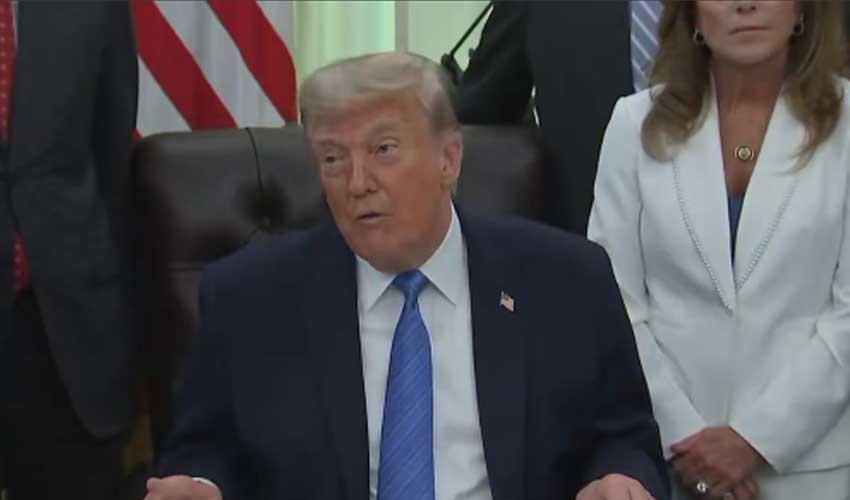
Speaking at a police academy in New York state, Trump also said he would 'soon' declare the Strait of Hormuz a territory of the United States, although it was unclear whether the remark represented a serious policy proposal.
Trump's comments to Fox News came a day after US Treasury Secretary Scott Bessent said Washington would introduce measures against Tehran that had 'never been seen' as soon as next week.
Trump has defended the economic pressure campaign, telling Americans who have had to pay slightly more for gasoline that higher prices were the cost of preventing what he called a 'very evil country' from obtaining a nuclear weapon.
He also said he would never apologise for attacking Iran, arguing that US actions were serving the interests of the wider world as well as the United States.
Trump escalates rhetoric over Strait
During a political rally and later remarks at the Police Academy Center for Training and Intelligence in New York, Trump said the United States would declare the Strait of Hormuz US territory after what he described as the defeat of Iran.
'After we finish defeating Iran,' Trump said, he would 'pretty soon' declare the strategic waterway a US territory.
Trump has also claimed on his Truth Social platform that the United States has 'full control' of the Strait of Hormuz and suggested that Washington could maintain that control.
It remained unclear how seriously the president intended the territorial declaration or whether it represented a new formal policy position for his administration.
Also Read: US says can keep naval blockade on Iran 'indefinitely'
A day earlier, Vice President JD Vance said preventing Iran from obtaining a nuclear weapon was the administration's secondary objective, after keeping oil and gasoline affordable for Americans.
Iran rejects Trump's claim
Iran immediately rejected Trump's remarks, insisting that Tehran alone controls decisions over whether the Strait of Hormuz is open or closed.
Iranian Deputy Foreign Minister Kazem Gharibabadi said Tehran would not be intimidated by US threats or a display of military force.
He argued that the strategic waterway could not be seized through a social media post, an aircraft carrier, an order or an election speech, and maintained that Iran would continue enforcing its blockade until Washington accepted what he described as its strategic defeat.
Gharibabadi reiterated that the Strait of Hormuz had been, remained and would continue to be Iranian, and said it would be opened or closed only under Iran's command.
Iranian officials have repeatedly said the strait will not reopen while the United States maintains its intervention and naval blockade and fails to meet the requirements of the June framework agreement between Tehran and Washington.
Shipping through Hormuz nearly stops
The confrontation has already brought commercial traffic through the Strait of Hormuz close to a standstill.
The waterway is one of the world's most important energy chokepoints, with roughly 20% of global oil and LNG shipments normally passing through it. The prospect of prolonged disruption has pushed oil prices higher and raised concerns about global energy supplies.
Also Read: Iran rejects US claims of control over Strait of Hormuz
The United States has said its naval forces can maintain the blockade of Iran indefinitely, while Tehran continues to restrict vessels it accuses of attempting to transit the strait without Iranian permission.
US Central Command said Friday that its forces had redirected 62 commercial vessels, disabled three and boarded two as of August 14 while enforcing the US blockade against Iran.
Two UAE vessels attacked
The standoff intensified after two additional ships were attacked in the Strait of Hormuz.
The United Arab Emirates' Abu Dhabi National Oil Company said two of its vessels were attacked while transiting the waterway on Thursday evening. The UAE government blamed Iran for the attacks, although Tehran did not immediately comment.
Since the collapse of the ceasefire under the June agreement, Iran has resumed attacks on ships it accuses of attempting to pass through the strait without its permission.
Iran says no decision made on US talks
Iranian Foreign Minister Abbas Araghchi said on Friday that Tehran had made no decision to resume negotiations with Washington.
Speaking to Iranian media, Araghchi said Qatar and Pakistan remained in contact with Iran and were exchanging messages, but stressed that the communication did not amount to formal negotiations.
He also rejected the interpretation that the Islamabad memorandum represented a 60-day ceasefire requiring an extension, saying the document referred to an 'end to the war' rather than a ceasefire.
Also Read: Trump says US has 'total control' of Strait of Hormuz
According to Araghchi, previous diplomatic channels were no longer effective and Iran was working on a temporary pathway that could eventually develop into a final framework.
Araghchi also said separate discussions with Oman were focused on defining a sea route through the Strait of Hormuz, while the United States would have to meet certain conditions before shipping could resume through the waterway.
Iran's position was reinforced by Ibrahim Zolfaqari, spokesperson for the Khatam al-Anbiya Central Headquarters, the country's highest military body coordinating the war.
Zolfaqari said no vessel would be permitted to pass through the Strait of Hormuz without Iran's permission and supervision.
The statements underline the sharp divide between Washington and Tehran, with Trump claiming US control over the waterway while Iranian officials insist that Iran retains authority over its passage.
Hormuz crisis threatens global energy markets
The Strait of Hormuz remains central to the wider confrontation because of its importance to global oil and LNG transportation.
Any prolonged disruption could place additional pressure on fuel prices and global energy markets, while the continuing US-Iran standoff leaves the future of commercial shipping through the waterway uncertain.
For now, Washington is maintaining economic and naval pressure on Tehran, while Iran continues to reject US demands and insists that the Strait of Hormuz will only reopen under conditions acceptable to Tehran.
A note on cookies
Newshunt uses essential cookies to keep you signed in and to remember your language and country, so the site works the way you expect. With your permission, we'd also like to use analytics cookies to understand how people use Newshunt and improve it over time.
Accepting only affects analytics. To learn more, view our Privacy Policy or Terms & Conditions.
(0)Comments