


How hard will settlement sanctions hit — and which industries are most at risk?
Category: Business
Share
Archive
Like
Israeli exporters are increasingly concerned that
new British economic sanctions targeting Israeli settlements in the West Bank
could spread to other countries and have a chilling effect on trade with Israel more broadly, even though the direct volume of exports affected is relatively small.
The concerns follow an announcement by
British Foreign Secretary Ed Miliband
of economic sanctions on settlements in the West Bank, alongside a joint declaration by the foreign ministers of Canada, Denmark, Finland, France, Iceland, Ireland, Norway, Poland, Portugal, Spain and Sweden signaling their intention to join measures restricting settlement trade.
Gallery
British Foreign Secretary Ed Miliband
(
Photo: AFP PHOTO / PRU )
The measures have alarmed Israeli exporters, who fear that importers could increasingly avoid Israeli goods altogether rather than attempt to distinguish between products originating inside Israel and those produced in territories captured by Israel in the 1967 Six-Day War.
Roy Fisher, head of the Foreign Trade Administration at the Economy Ministry, said the volume of goods exported from the areas covered by the measures is extremely small compared with Israel's overall exports.
The territories at issue include primarily the West Bank, East Jerusalem and the Golan Heights — areas sometimes collectively described in Israel as being 'beyond the Green Line,' the armistice line that separated Israel from the West Bank before the 1967 war. The international status of the territories differs, but Britain and the other governments involved do not recognize Israeli sovereignty or settlements there.
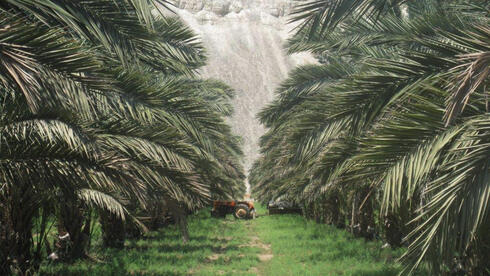
Fisher cited figures indicating that direct goods exports from the affected areas amount to only tens of millions of dollars, compared with roughly $44 billion in total Israeli exports of goods and services. He said agricultural produce, particularly dates, accounts for a significant portion of the affected trade.
For date growers, however, the relatively small national figure can obscure the potential impact on individual businesses.
'For the growers, it's their world,' Fisher said.
(
Photo: Dr. Oranit Raz )
The Economy Ministry had already developed a response plan before the latest expansion of European measures, Fisher said. It includes direct contact with each affected exporter, individualized assistance in finding alternative markets and grants of up to 200,000 shekels, or about $66,000, to help businesses enter new markets.
The timing is particularly sensitive because Israel's date harvest is approaching. Fisher described the coming harvest as a 'dramatic' moment for growers and warned that the economic repercussions could extend well beyond the date industry.
His larger concern is not the immediate loss of settlement exports but the possibility that foreign businesses will decide dealing with Israeli suppliers carries too much political or reputational risk.
'When you're a British importer, what you mainly remember is that your foreign secretary said Israel carried out ethnic cleansing in these territories,' Fisher said. 'I'm convinced there will be importers who won't want to take any risk with Israel at all.'
The Economy Ministry fears that could create a 'chilling effect' across Israeli exports, Fisher said, rather than remaining confined to products originating in settlements.
Fisher is traveling to London for an event involving 33 Israeli corporations at the London Stock Exchange, where hundreds of meetings are expected between Israeli and British companies.
'I hope we can demonstrate at the event that we continue to do business that is good for both sides and leave politics behind,' he said.
Avraham Novogrocki, president of the Manufacturers Association of Israel, urged Israelis to keep the immediate economic impact in perspective. He said the direct damage from restrictions on trade with Britain alone was not particularly significant.
The greater danger, he said, is that additional countries are joining Britain, potentially creating a much larger cumulative impact.
Photo: Michael Topyol
Novogrocki said relatively few Israeli companies operate in the affected West Bank areas, with those that do concentrated mainly in electronic components, food and plastics.
He also warned that a broader boycott could ultimately hurt Palestinians employed by Israeli companies in the West Bank. About 18,000 Palestinians currently work in Israeli factories in Samaria, the biblical name commonly used in Israel for the northern West Bank, he said.
Novogrocki called on the Israeli government to engage diplomatically with the countries involved to prevent the restrictions from expanding and to provide support to Israeli companies facing foreign regulators.
Among the steps he proposed were helping exporters diversify their markets, strengthening commercial ties with the United States, India and Asian countries and investing further in Israeli industry to preserve its technological advantage.
'You can boycott a crate of tomatoes, but it is much harder to boycott innovation and advanced technology,' Novogrocki said.
He argued that countries calling for boycotts would find it difficult to abandon Israeli products and technologies they consider essential.
His principal concern, he said, is the precedent created by the new measures and the possibility that targeted restrictions could develop into broader efforts to isolate Israeli businesses.
A note on cookies
Newshunt uses essential cookies to keep you signed in and to remember your language and country, so the site works the way you expect. With your permission, we'd also like to use analytics cookies to understand how people use Newshunt and improve it over time.
Accepting only affects analytics. To learn more, view our Privacy Policy or Terms & Conditions.
(0)Comments