


Photographers: Stop looking for your 'style!'
Category: Entertainment
Share
Archive
Like
You know some photographers are synonymous with their photographs.
One frame and you can name them — the grain, the light the way they crop a body out of the frame.
That's a style.
Most of them spent years building it. Once it's built it works like a signature — instantly recognizable, instantly sellable, instantlythem.
I still don't know when to stop editing a body of work. No false modesty, I mean it literally. There's a point in going through a photo set where the frames start to blur into each other, where you've looked at them so many times you can't tell anymore if an image is strong or if you're just too close to the work.
Some photographers can name the exact moment a set is finished and ready for the world to see.
Notthisbitch.
What I have instead is a set of rules I've created for myself — so I don't get lost in the sauce as it were.
4 hours to edit the same day I shot.
I am allowed to resist those edits the next day and look for anything I've missed.
Purge, baby purge!
Give it a month or two and revise again.
You may do another editing pass for grants, fellowships and gallery call applications.
Note: I never let myself spend more than 4 hours on a second pass of editing.
These rules may seem weird to you, but I've found it's really easy to get lost in editing.
It's easy to second guess yourself, or to come up with many alternative versions of the same picture.
Let's be honest, it's procrastination and a time suck.
This also trains you to trust your gut as a photographer. If we're constantly second guessing our taste we'll never get anywhere.
Ask ten photographers how they edit and you'll get ten systems, and half of them will contradict the other half.
Shoot loose,edit tight.
Never trust your first instinct,sleep on it.
Some of that is useful. Most of it is one photographer's workaround for their own specific neuroses, repackaged as a rule everyone else should follow.
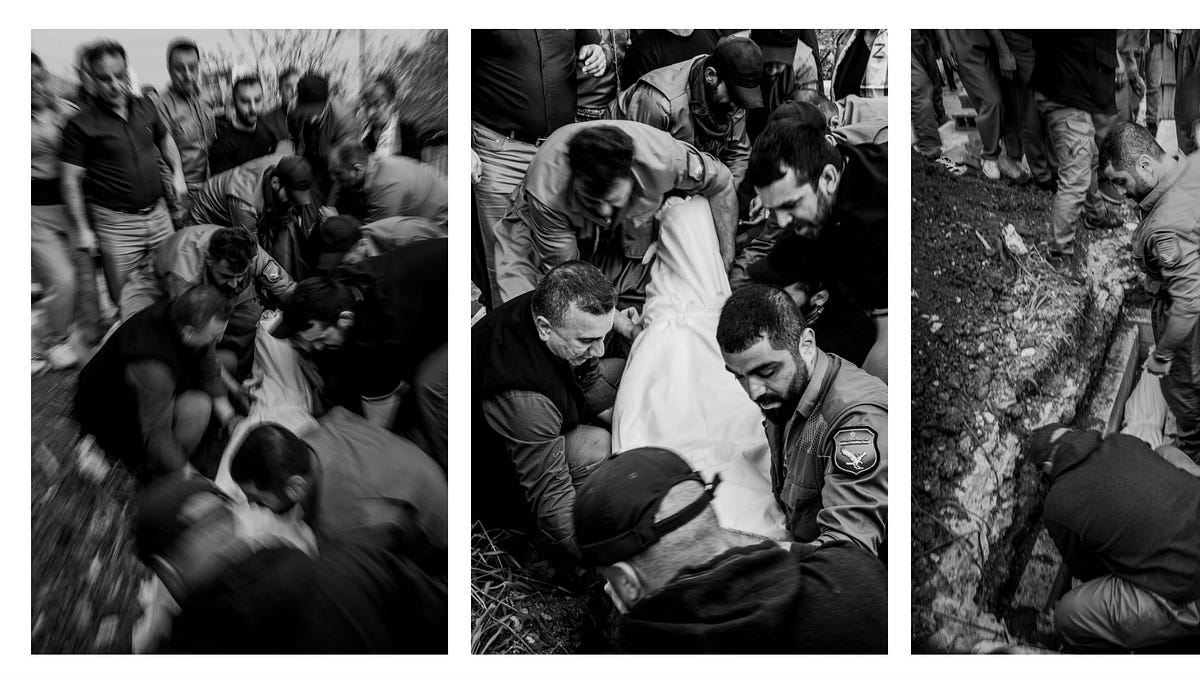
Take the burial sequence from Ghazal Molan's funeral, from the reporting I did in Iraqi Kurdistan. None of the individual frames worked on their own. I kept expecting one to hold up alone — and I'll be honest none of them did.
Subscribe now
But together, as a triptych, they built something the single images simply couldn't, and I knew where I wanted to take the body of work to tell a story.
Together they showed ceremony, reverence and grief laid out in sequence.
Combined, they bridged a gap in the work I hadn't realized was there. Now that I know what I'm looking for I plan to apply this strategy when I'm working on other documentary stories.
I shoot digital, and digital pushes you toward color. It's the default, and most of the time I stay with it.
But this set fought me.
The color was pulling attention away from what mattered, competing with the moment instead of serving it.
There was motion blur running through the sequence because we were losing the light, I had to crank down the shutter speed so the ISO wasn't INSANE!
With color, the visual chaos of the movement around the grave read as noise.
Once I stripped it out, it read as grief.
Subscribe now
I'm still working out what advice I keep from photographers I respect, and what I let go — especially when it comes to editing.
Everyone has a system, and most advice photographers give you contradict each other.
The one thing that's held up for me over time is distance. Putting a body of work down and coming back to it later, when you're not still standing in the moment you shot it.
That next triptych is also the exact opposite, formally, of the photos of Ghazal Molan that I posted above.
Subscribe now
.Strip the color from this and you lose most of the story — because, in this case, the color is the story.
Red, Yellow and What the Color Means Here:
Thailand runs on color symbolism in a way that's hard to overstate if you haven't spent time here, and it has bled directly into politics.
The people in these photographs are 'Red Shirts.'
Subscribe now
'Red Shirts,' are members of the United Front for Democracy Against Dictatorship, a movement that formed after the 2006 military coup that ousted then-Prime Minister Thaksin Shinawatra.
The UDD draws its base largely from rural and working-class voters in the north and northeast, and it advocates for populist economic policy, electoral democracy, and an end to what it sees as the dominance of Thailand's urban, royalist establishment.
Its opposite number is the YellowShirts, the People's Alliance for Democracy, who represent royalist, conservative, and urban middle-class interests.
Color in Thailand is the fastest way to identify which political camp you're standing in the middle of.
I shot this set on May 11, 2026, the day Thaksin was released from Klong Prem Central prison. Thaksin is worth an estimated $1.8 billion, making him one of the wealthiest people in the country.
Thaksin returned to Thailand in 2025 after more than fifteen years in self-imposed exile and was taken into custody immediately on arrival to serve sentences from corruption and abuse-of-power convictions.
That didn't stop the crows which turned out in the thousands hoping for a glimpse of him.
One supporter told me flatly that Thaksin should never have been imprisoned in the first place.
Conviction, exile, imprisonment — none of it has touched the loyalty these 'Red Shirts' feel.
Remove the color from those frames and you remove the point.
Red is the movement.
Strip it out and the pictures could be anyone waiting for anyone.
This is also, probably, an argument for not rushing toward a signature style. Photographers who lock into one early get instantly recognizable — and then they're stuck making that same picture over, and over, AND OVER for the next twenty years.
Because it's what sells.
What gets shared.
What people expect when they open your work.
Branch out and the audience gets confused.
But stick with the same style and you stop growing.
I'd rather stay slower. Black and white when the story asks for it, color when the story asks for that instead. Keep the range open long enough that I'm still learning something about how I see, instead of just refining the one thing I already know how to do.
Which is also why I pay attention to photographers doing work that's nothing like mine.
I don't want to copy them — I want to be inspired by them to continue pushing myself as well as keep the spark of inspiration glowing.
Because the worst possible thing in my mind is start resenting picking up my camera.
Photographers Worth Following:
Below is a list of photographers, across genres, whose work I keep coming back to. Some of these people fall into multiple categories — and some of them aren't on Substack, but I'll provide links to their other socials!
Wildlife:
— the lynx photo ischef's kiss!
Dara Ojo— Macro
Kobe Mengi
Travel:
Adventure:
Photojournalism:
— he just started his Substack, but he's an amazing photojournalist. You can see more of his work onInstagram.
Sean from SoCal
Dennis & Patrick Weinert
Benjamin Hanson
Nature/Landscape:
Street Photography:
Rosso
I have so many more people, and genres, that I could recommend — and I plan on it. But if there is anyone you think deserves to be on this list make sure to mention them in the comments!
I'd love to put together a comprehensive inspiration list!
I hope you enjoyed this article! If you did please make sure to smash all the buttons — the like, Subscribe the restack!
Every little bit helps so I can keep bringing you stories from around the world and in the field.
I write to'Five Pillars'here on'Diaries of a Freelance Journalist,'which includes;
Conflict & Frontlines:Access, fear, planning, money, and what doesn't make the finished story.
Breaking Into Freelance:The business nobody warns you about. Pitching, rejection, rates and the emails I sent that worked and the ones that didn't.
Environmental Reporting: Ecosystem collapse, extraction, corruption and the stories that aren't on your radar — but should be.
Unfiltered Fieldcraft: Gear, fixers, logistics and more. It's the unglamorous machinery behind every story that looks effortless once it's published.
Wild Things: The naturalist side of me! Silkhenge spiders, buffalo races and the stuff I photograph because I can't help myself — like all the cats I come across on my travels!
So if you liked it make sure to hit Subscribe below!
During this one-hour zoom meeting we can:
Go over your Bio/About page.
Talk about Pitching techniques.
Brainstorm how you can take your skills and available funds to go solo.
Figure out your talking pillars.
It's your time and we can go over anything you would like.
Note: I live in Bangkok, Thailand and my hours reflect that. Though I start my day early and end my day late so that my hours can overlap.
Book a 60 minute session!
"Diaries Of A Freelance Journalist" is a reader-supported publication. To receive new posts and support my work, consider becoming a free or paid subscriber.
A note on cookies
Newshunt uses essential cookies to keep you signed in and to remember your language and country, so the site works the way you expect. With your permission, we'd also like to use analytics cookies to understand how people use Newshunt and improve it over time.
Accepting only affects analytics. To learn more, view our Privacy Policy or Terms & Conditions.
(0)Comments