


Physicians' Shame and its Manifestations in Clinical Practice
Category: Health
Share
Archive
Like
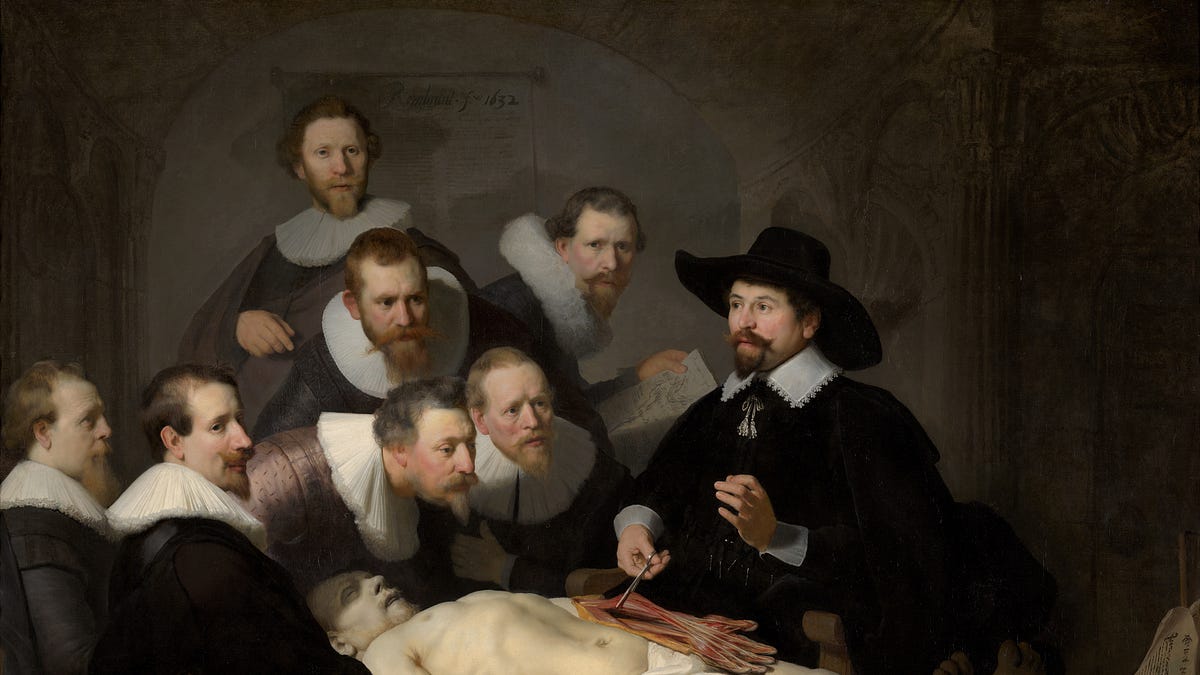
The Anatomy Lesson of Dr. Nicholaes Tulp, Rembrandt Van Rijn, 1632
Almost Human is a reader-supported publication. To receive new posts and support my work, consider becoming a free or paid subscriber.
Since shame often occurs within the context of a hierarchical and meaningful relationship, both medicine and psychotherapy constitute effective breeding grounds. Though it is easiest to identify with shame in patients, it's important to remember that doctors and therapists have an investment of self-esteem and knowledge, and therefore a powerful reason to feel ashamed when their arsenal or abilities fail.
I believe doctors generally have a particular fear of weakness or infirmity, perhaps even of death, which impels them to not only try to vanquish it, but to identify themselves as the treaters, rather than the afflicted. Doctors essentially draw a line in the sand: on this side is the doctor, on the other side, the patient. It is a sort of magical thinking. If I wear or own a white coat, I won't or can't get sick. Several physicians who have confoundingly found themselves diagnosed with serious illness have written about this experience as somehow incomprehensible. Such doctors often find themselves realizing for the first time in their careers how vulnerable the patient feels, and how subject to shame.
Many years before I attended medical school, I read about a medical college which required students to spend a week in a hospital as a patient. I've never been able to find the reference, but I imagine those students learned more in that week than in a year of conventional training. Because medical training is the process whereby students acquire increasing distance from their patients.
The first patient is a cadaver. Then there are books, describing pure forms of illness, often distilled by a picture. I still remember the black-and-white side-by-side photos of a depressed woman, before and after treatment:
On the left: gray-haired, face in a leathery grimace, looking about 60; on the right, after treatment: beaming, hair miraculously dark, appearing 20 years younger.
Not typically the sort of transformation I'd see years later, in my own practice.
In medical school, at least early on, students two fallacies that will later be relevant to physician shame:
1) The idea that most patients present with symptoms that can be easily sorted into identifiable patterns;
2) And the idea that most illness has a predictable arc that leads from symptoms to findings to diagnosis to efficacious treatment.
When patients' symptoms don't fit neatly into prescribed boxes, when diagnostic studies fail to elucidate, when patients 'refuse' to get well, when that pleasing arc is not followed, this subverts the narrative. Disease that cannot be stamped with a diagnosis and eradicated is a threat not only to the doctor's professional self-worth but also to his or her integrity. Patients with unclear diagnoses or who do not get better violate the premise that illness is within the doctor's control. Illness that defies understanding is, in fact, an existential threat.
Shame and Medical Training
Many decades ago, I read aNew York Times Magazinefeature about the impossible rigors of medical school and residency: hours upon hours of study followed by grueling on-call schedules, sleep deprivation, an abdication of routine pleasures and pastimes. For some perverse reason, I thought: 'This is for me.' It seemed like the hardest thing I could do, and therefore, if I prevailed, I would be worth something. (This was not the only reason I applied to medical school, but I vividly remember the longing I felt reading that article). I suspect many people enter medicine, or law, or doctoral programs, partly in hopes of making up some deficiency of self-worth, a sense of defectiveness or shame.
I was incredibly fortunate, during my pre-clinical years at Berkeley, to experience no shaming practices or attitudes. In fact, one physiology teacher made a point of telling us that it was perfectly fine to say, 'I don't know.' He went so far as to require that, when one of us admitted ignorance, the rest of the class would applaud. He may have adopted this practice with the awareness that we would later be fighting a system designed to shame us into never admitting ignorance.
Things changed once I crossed the Bay Bridge and began working on a hospital ward. The University of California, San Francisco was a vaunted institution, located just south of Golden Gate Park on Parnassus Hill, which was often dreamily enveloped in fog when I arrived in the early mornings. The place boasted gleaming hallways, monstrously sick patients and attendings who'd won Nobels or other prizes. As the most junior members of the 'Team' which rounded on patients, medical students were required to see the patients on their roster and then 'present' them on rounds. This set the stage for the notorious 'pimping,' the practice in which the attending physician asks esoteric questions potentially or tangentially related to the case.
'Who can tell me the five non-bacterial causes of endocarditis?' 'What is the genetic defect characteristic of this child's low-slung ears?' 'What are all the blood vessels feeding and draining this organ?' These questions would be directed to the most junior team member; if he or she could not answer, attention would turn to the intern, then the junior resident, and so on. Although I had done well in my pre-clinical studies, I could almost never answer the questions. My brain just didn't work that way. It seemed like I was playing a part, and no one had given me the script.
I think that medical training inevitably, to some extent, instills in young doctors a resentment of patients. It's simultaneously true that trainees have profound experiences of connection with patients. Just as literature, for me, has always provided an understanding of human nature, medical training is likewise an education inpeople: people who at this moment in their lives are scared, vulnerable, sometimes appreciative, sometimes ornery. (This is another reason I went into this field). One has, in training, the experience of being helpful to others, and also the experience of being utterly powerless. In this way, students learn what it is to be human, and inevitably gain compassion and respect for their patients who endure so much.
And yet, the fact that one's bodily and psychological needs are constantly repudiated in favor of patient care can't help but wear on trainees. I recall working 36-hour days during residency, several days a week (and I completed a relatively 'easy' Psychiatry residency.) There were months in internship when I had only one or two days off. Some nights, I was torn from sleep repeatedly to minister to a patient who was ill with pancreatitis, a result of chronic alcoholism. It becomes impossible not to be resentful.
Properly speaking, medical students and residents should be resentful towards the system that, while training them, also abuses them. But such attitudes are not tolerated in the hierarchical system. And so, hostility is repressed and re-directed towards those with less status: the patients.
Donald Winnicott, a pediatrician and psychoanalyst, famously pointed out the fact that analysts sometimes hate their patients, just as mothers sometimes hate their infants. It is in this sense that I am suggesting that physicians resent their patients; obviously, doctors also care for and about the people they treat. Doctors have a deep investment both in their patients and in their own ability to help them. This investment renders them susceptible to shame when patients don't conform to physicians' expectations or when their afflictions don't respond to the treatment regimen.
Manifestations of Shame in Medical Practice
Recently I attended an ethics conference at which a speaker noted that 'there is a lot of talk today about doctors and patients being equals'. Nonsense, he said. They are moral equals, but they are not equals in this encounter. The patient is vulnerable, exposed, scared. The inequality of these positions, along with patients' need for care and validation, make the encounter ripe for shame dynamics.
Aaron Lazare, in his 1987 JAMA article,Shame and Humiliation in the Medical Encounter, identified situations in which medical encounters can be shaming for patients. But I think in fact that there are endless permutations of shame in doctor-patient relationships, and innumerable ways for doctors to expression aggression towards patients when they come up against their own shame.
Being a doctor entitles you to ask very personal questions, not only about the medical problem at hand. Med students learn to write and present summaries of patients, including social and educational details as well as medical information. As I've noted elsewhere, we doctors hold the power of the pen; we write someone's story, and inevitably the language we choose is a reflection of our feelings about this person at this time.
The Perfect Patient
Since medical training is modeled on relatively idealized patient presentations and illness trajectories, physicians unconsciously enter practice with certain expectations.
The 'perfect patient' is a good historian, a 'reliable reporter.' She answers close-ended questions without too much elaboration. She doesn't introduce confounding or conflicting information. She doesn't nit-pick when asked a question.
The perfect patient shows a certain degree of deference to the medical provider. (She is 'cooperative.') She doesn't challenge the physician's diagnosis or recommendations. If she brings up her own research or desired treatments, she allows the doctor to be the final authority.
The perfect patient has the emotional resources to handle her condition; she expresses the amount of concern appropriate- not more or less- per the physician.
The perfect patient accept the limits of medicine in terms of finding answers.
The perfect patient takes her medicine reliably and dutifully persists with treatments even when they don't seem to be working, until the physician has time to reassess.
And of course: the perfect patient has findings- physical findings, labs, positive imaging studies- that support a particular diagnosis.
To be clear, even if patients don't fulfill their roles perfectly- and who does?- things may go fine between doctor and patient as long as the illness is readily, or within a reasonable period, diagnosed and treated. A cardiologist may wish her patient could give a slightly better description of his pain, but when cardiac catheterization shows a blockage in the left coronary artery, and the patient undergoes angioplasty and improves, the initial irritation is forgotten. A rheumatologist may feel her patient's complaints are odd and perhaps spurious, but when a diagnosis of Lupus is made, annoyance is quickly replaced by concern and determination, which strengthen the alliance. There is, in fact, a sense of triumph if an illness is slightly hard to diagnosis, but patient and doctor prevail. Doctors like to feel that they've overcome a challenge, it's a bit of an ego boost.
On the other hand, illness or symptoms that are resistant to diagnosis and impervious to treatments portend difficulty and shame-based interactions between doctor and patient.The clinical relationship is not static but evolves over time, often many years. Both the physician and the patient are inevitably under various stresses, leading to potential fault lines. Often a professional relationship starts well; a doctor might even be narcissistically motivated to solve a problem that has stumped previous treaters. Should the doctor fail to find the cause of illness in this case, he might be especially prone to shame and anger. Doctors in this situation are often apt to blame their patients.
I recall a visit to a pain specialist who was initially very warm and collegial with me. After a while, when injections didn't work, he got angry. One day he announced, 'I'm not going to keep trying things that don't work!' He walked out of the room and refused to see me again.
There are several ways in which doctors cast blame. One common refrain is that the patient has not taken a medication long enough to see an effect. Another is that she is not doing enough to help herself.
My patient, Deirdre, is a 40-year-old woman who has been experiencing fatigue and diffuse pain for at least a decade. Her primary care doctor has run the usual battery of tests, including Lyme, blood counts, metabolic panel, thyroid screen, and found nothing. Deirdre has a 12-year-old son and works part-time as a hairdresser.
Deirdre needs to work more to supplement her husband's income, but she can't. She has mentioned to her PCP the possibility of going on disability. Deirdre doesn't like this idea, but fears that she can't work enough to make ends meet. Her doctor told Deirdre that she didn't recommend disability; because there was no clear diagnosis, she wasn't willing to sign these papers. Deirdre should, instead, try to get up and exercise to get herself going earlier.
'I try to exercise!' my patient tells me, weeping a little. 'I'm just so tired and hurt all over.'
Obviously, Deirdre's doctor comes across here as insensitive and judgmental.
But let's be generous and take the doctor's place for a moment. She, too, very much wishes she could identify Deirdre's trouble; she is, in fact, probably annoyed with herself (ashamed) for not finding the answer. She is on her feet all day, seeing patients every 20 minutes, then must do her notes from home at night. She also must fill prescriptions and answer portal messages. In the brief time she is able to spend with Deirdre, the doctor's mind flashes back to the thousands of hours she spent working through fatigue in her training, and the thousands more since. Why can't this otherwise well-looking person simply get up and take a walk? Why is that so hard? (To be clear, this is likely unconscious.)
This may not only be an issue of resentment and shame, but in fact one of envy. Envy has forever been identified in connection with shame. Like shame, envy is found within the gaze and associated with seeing and being seen. The Evil Eye, found in traditional Mediterranean cultures, is a talisman meant to protect against envy. To covet is to experience oneself as lacking or inferior.
I wonder if doctors sometimes envy their patients the right to complain, and the right to be cared for in a solicitous manner. Certainly physicians don't envy their patients' illnesses, but then shame rarely arises in the context of well-defined illness and treatment. It most often occurs when things are unclear and protracted. Such situations are hard on both parties, yet in a clinical encounter, only patients have the opportunity for their distress to be heard and seen. Physicians aren't afforded this, and in their lives often defend against it.
For the patient, visiting the doctor may be the only chance he has to convey his symptoms in depth and with despair and sometimes hopelessness. These 20 minutes are precious and therefore the importance of the interaction with his doctor is magnified. But the doctor sees many patients in the course of his day. The emotional demands which accompany patients' recounting of their problems begin to grate after a while. At some point, I think the doctor can't help but wish, unconsciously, that one of these 20-minute blocks were devoted to his own woes or pains.
Under the thumb of insurance companies, doctors are forced to see patients in far from ideal circumstances. A recent study found that, in order for doctors to meet the needs of their patients,they would need to work 27-hour days. The same doctor who would probably take a thorough history and engage respectfully with patients is not at her best most of the time. When we are asked to do more than we can do, we clinicians feel ashamed, like anyone else. We're failing. We're not allowed to fail. Our frustration with ourselves is easily transmitted to patients who fall outside a prescribed pattern of illness identification and resolution. Back in 1987, Lazare identified this as a growing cause of physician shame, 'with no end in sight.' The problem has only worsened in the decades since.
Populations Affected by Medical Shame
I see a pattern of unconscious shaming affecting several different populations of medical patients. People with chronic pain are notoriously difficult for doctors to handle. Here, doctors' aversion to weakness is brought front and center. It is common for a doctor to suggest that someone has a 'low pain tolerance,' or, more delicately, has a 'increased pain sensitivity.' With the backlash against the misuse of opiates, doctors are often wary of prescribing these medications at all; patients are referred to 'pain clinics,' where they are often further stigmatized. To be a 'pain patient' is essentially to be someone weak-willed, dependent, unintelligent and potentially irresponsible. This is never said explicitly but is certainly the attitude, conscious or unconscious, of most physicians. Because, of course, none of these qualities applies to the (strong, smart, tough) doctors.
Unidentified pain- 'pain without lesion,' has historically been stigmatized and dismissed. As imaging technology has improved, there has been a tendency to doubt patients' report of pain, when such pain cannot be visualized. Miranda Fricker has coined the term'epistemic injustice;' according to Daniel Goldberg, 'Thus, denial of the illness sufferer's cry of pain is a manifestation of 'stigma power.'' We can now create classes of pain sufferers: those whose pain can be visualized and therefore treated as credible, and those who report pain which is untraceable visually and therefore inevitably discounted. (But, again, recall that a failure to identify a lesion is a source of shame to the treating physician.)
Many of my patients, who carry mental health diagnoses and often take multiple psychiatric medications, complain of judgment and discrimination from medical doctors. A female patient with a long history of depression had severe abdominal pain and fever which sent her to the ER twice. Abdominal pain, tenderness and fever are classic signs of appendicitis. But my patient was twice sent home without being given an ultrasound, the procedure necessary to make this diagnosis. At her third visit to the ER, an ultrasound was done and she was rushed to surgery. Another patient with Bipolar Disorder went to the hospital with severe pelvic pain. Again, no ultrasound was done, and no pain medication given. At a later gynecology visit, she was found to have a large ovarian cyst.
These patients felt shamed by their inferior treatment. They were quite aware that their symptoms were given less weight because of their psychiatric diagnoses and medications. (And, undoubtedly, their gender.) But let's look at the clinical encounters from the perspective of the clinicians. Patients are not the only ones who have seminal affective experiences. Medical training, as I've taken pains to show, is a literal bombardment of patient encounters which must be classified. Doctors arrive on the field of practice with countless examples of 'types' in their heads. Some of those types are based on social and gender prejudices as well as medical reasoning and algorithms. This isn't fair, but it's true. Two women arrive at the ER with symptoms. Both present as anxious, due to many possible factors: their anticipation of poor treatment, the pain, fear of what may be wrong. The doctors evaluating these women also have other patients. They see an anxious woman and they make a categorization, which is faulty. The physicians are wrong, but also their training led them in the wrong direction.
Certain medication classes have become grounds for a subtle, or not-so-subtle, shaming of patients. 'Controlled substances,' including anxiety medications (benzodiazepines) and stimulants cause anxiety among doctors. These medications are in fact monitored by the DEA, can be dispensed in limited quantities, and can only be prescribed via additional authentication steps. Physicians worry about prescribing these medicines in part because they are habit-forming. But I think the fact of increased monitoring also casts suspicion on patients, because misuse of these medicines can implicate doctors' licenses. It's not difficult for a doctor prescribing these medicines to become wary and distrustful of his patient. Many primary care providers, for example, are willing to prescribe anti-depressants but refer to a psychiatrist for controlled prescriptions. People arrive in these circumstances sensing the judgment of their primary physicians.
But shaming may also be innocent and inadvertent. A patient of mine was hospitalized and met with her psychiatrist for the first time. The attending doctor was accompanied by a resident, a young man about my patient's age. After the interview, the two doctors left, and my patient heard them laughing as they set off down the hall.
Most likely, the colleagues were sharing a joke and not laughing at their patient's tale. But the patient, already feeling ashamed at the circumstances of her admission, was mortified and enraged.
Because shame and anger are two sides of a coin, shame can result in acts of subtle aggression by both doctor and patient. As I've discussed, doctors are apt to channel shame into patient notes, which, fortunately or unfortunately, can now often be accessed by patients online. Doctors also complain about patients to their peers. If patients overheard some of these discussions, for example, about patients who are believed to have psychosomatic illness, or those with medication lists 'as long as your arm,' they would likely feel terribly ashamed. Of course, venting to peers may allow doctors to manage their shame. Still, I think such pejorative characterizations erode respect towards patients.
Patients have somewhat fewer options. They can vent, too, but mostly to those who are outside the medical system. If they're lucky, they can find sympathetic providers to whom they can complain. I've spent many hours receiving indignant complaints- clearly an expression of shame- about medical care. Patients can give a provider a negative review online. They can file a complaint; malpractice suits generally are known to correlate with poor physician-patient relationships.
Doctors Who Become Patients
Because doctors prefer to believe they are impervious to illness, doctors who becomes ill are a cause of serious concern for their colleagues. These people have transgressed the line in the sand, they are no longer one of us but one of them. (It is difficult for doctors to conceive of someone as being both.)
Mental illness carries profound stigma in medicine, so much so that doctors will go to great lengths to hide their own psychiatric problems. I treated a physician who paid out of pocket for medication, so that his insurance would have no record of it. Another physician patient drove an hour to have her prescriptions filled, so that she wouldn't be recognized by the pharmacist. In a study of 2000 female physicians with depression, more than half had avoided seeking help because of fear of discrimination or stigma. (See my article:Physicians, mental iIllness, and the problem with 'passing')
As Lazare wrote,
Physicians, many of whom enter the profession to conquer, master or control disease, and who are expected to know more about disease and its prevention than lay people, may be particularly shamed by their own disease.
The irony, in my view, is that there are really no permanent and enduring classes of doctors and patients. Most people who are patients minister to people in their own lives, sometimes in a professional capacity. And doctors, almost to a one, have been or will someday be patients. It reminds me ofGoffman'shumorous discussion of the rigorously enforced dichotomy between staff and patients in mental asylums:
Here, surely, is a magnificent social achievement, even though the similarity of the players, to which institutional ceremonies attest, can be expected to present some staging problems and therefore some personal strain.
Shame knows no categories- and asks us to question the very existence of those categories.
Almost Human is a reader-supported publication. To receive new posts and support my work, consider becoming a free or paid subscriber.
A note on cookies
Newshunt uses essential cookies to keep you signed in and to remember your language and country, so the site works the way you expect. With your permission, we'd also like to use analytics cookies to understand how people use Newshunt and improve it over time.
Accepting only affects analytics. To learn more, view our Privacy Policy or Terms & Conditions.
(0)Comments