


IMF-Cleared Auto Policy Ties Carmakers to $6bn Export Target
Category: Business
Share
Archive
Like
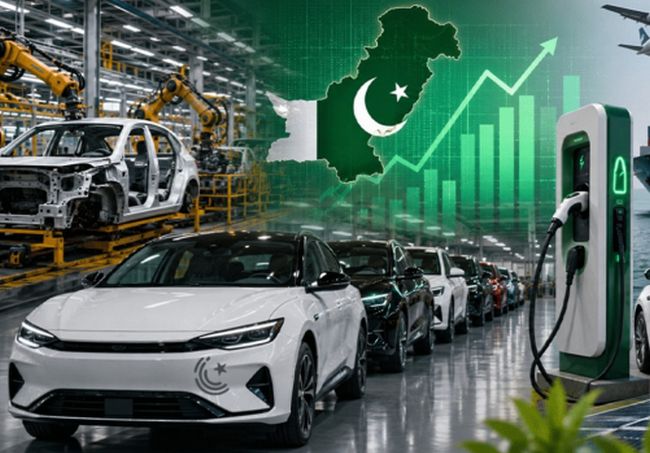
The 2026-31 plan rewards exports and local content, offers a 5% duty window for affordable EVs and threatens licence cancellation for firms that miss targets two years running.
ISLAMABAD/LAHORE: Pakistan has approved a five-year auto policy that, for the first time, ties carmakers’ tariff concessions to export and localisation targets and threatens to cancel manufacturing certificates of those who miss them, after the International Monetary Fund raised no objection to the draft.
Prime Minister Shehbaz Sharif signed off on the Autos and Auto Parts Manufacturing Policy 2026-31, which targets cumulative exports of about $6 billion, The Express Tribune reported on Nov 12. The government plans a money bill, described as a mini-budget, in parliament after cabinet approval to enact the tax changes.
Export or lose the licence
Under the policy, automakers are expected to deliver about $2.72 billion of the export target and parts makers about $3.29 billion. Exporters will get 5% support on net export value under the DLTL scheme, plus an additional 10% on qualifying incremental exports.
Companies that fail obligations face penalties of 1% to 3% of annual factory-gate sales, and two consecutive years of failure could lead to cancellation of their manufacturing certificate except in force majeure cases. Manufacturers are also expected to secure export orders within their foreign principals’ supply chains, a clause that applies to the Japanese, Korean and Chinese brands assembling in Pakistan.
“This is a comprehensive shift, moving away from import-dependent assembly towards export-oriented manufacturing,” industries adviser Haroon Akhtar Khan said, according to the newspaper.
Localisation floors and EV incentives
Local value addition for existing assemblers must rise 2% a year, with minimums by 2030-31 of 40% for petrol cars and SUVs, 45% for light commercial vehicles, 80% for tractors and 90% for motorcycles and rickshaws. Carmakers that do not sign localisation and export agreements with the Engineering Development Board will lose concessionary tariffs on imported parts.
Imported battery electric vehicles valued up to $15,000 will attract a concessional 5% customs duty for the first two years, but only for companies committing to local assembly, backed by bank guarantees that will be encashed if commercial production does not start by Sept 30, 2028. New energy vehicle localisation must reach 25% for cars and 30% for two- and three-wheelers by 2030-31.
The government last month rejected an IMF proposal to levy 18% sales tax on electric vehicles, opting instead for phased duty cuts, after talks with the Fund in early October ended inconclusively.
The IMF’s tariff road map
The policy sits inside commitments under Pakistan’s $7 billion IMF programme to lower trade barriers. Officials earlier told the Fund that the weighted average tariff on autos would fall to around 6% by 2030 under the National Tariff Policy, with additional customs and regulatory duties set to go. The IMF and Pakistan sealed a staff-level agreement for a $1.2 billion tranche in October.
The government projects about $17.7 billion in foreign exchange savings compared with importing fully built cars, and Rs2.1 billion has been set aside for a vendor upgradation and technology transfer programme for the country’s roughly 2,200 parts makers. Between 41% and 80% of existing industrial capacity is idle, according to estimates cited in the policy.
Will cars get cheaper?
Lower tariffs should eventually pressure prices, but the near-term effect depends on how quickly duties fall and on the rupee. Policy pressure dominated the Pakistan Auto Show in Lahore in September, and assemblers used to tariff protection now face a framework built around competition, while brands that launched electric models there are best placed to use the concessional duty window.
A mid-term review is scheduled for 2028.
A note on cookies
Newshunt uses essential cookies to keep you signed in and to remember your language and country, so the site works the way you expect. With your permission, we'd also like to use analytics cookies to understand how people use Newshunt and improve it over time.
Accepting only affects analytics. To learn more, view our Privacy Policy or Terms & Conditions.
(0)Comments