


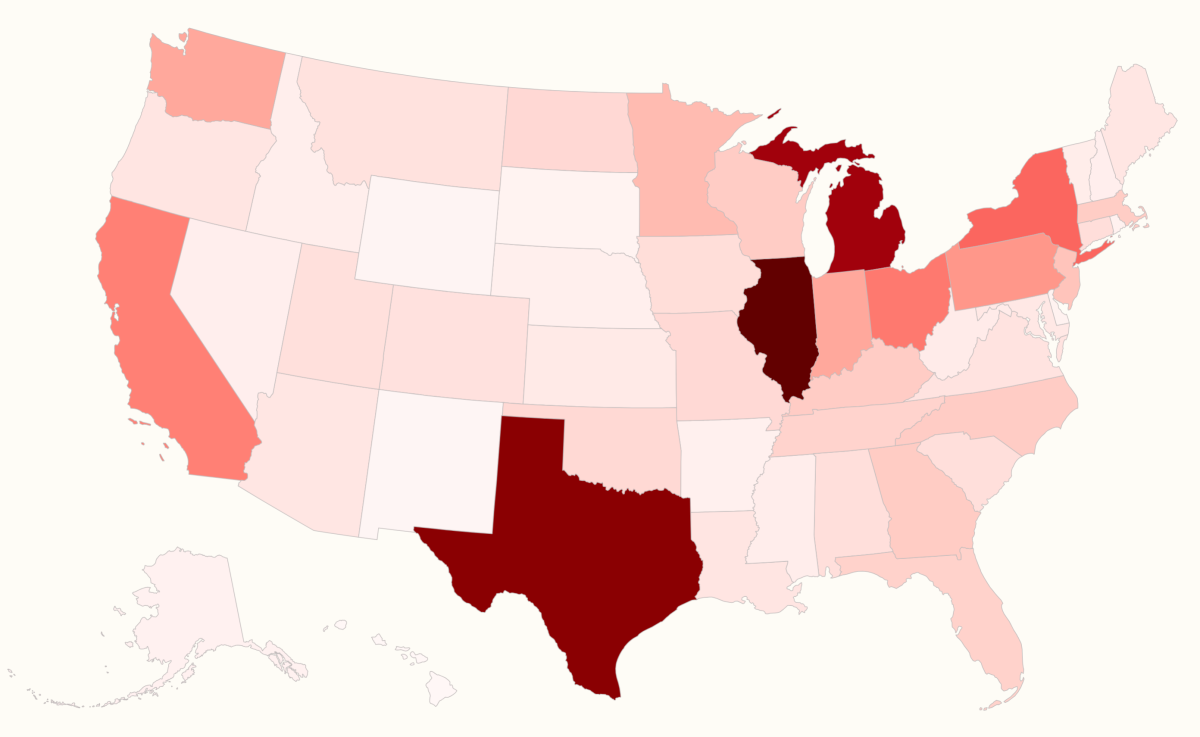
Map shows states' top exports to Canada as retaliatory tariffs kick in
Category: Financial
Share
Archive
Like
Canada's retaliatory tariffs on U.S. took effect on Tuesday, putting billions of dollars' worth of goods and the exports of dozens of states at risk in the latest chapter of the trade war between the historic allies.
Trade negotiations between the U.S. and Canada broke down in late August, after which President Donald Trump imposed 50 percent tariffs on $20 billion worth of Canadian goods entering the U.S. This is in addition to the 25 percent tariffs currently impacting Canadian car and trucks, and the duties on its metals and lumber.
Prime Minister Mark Carney pledged a "dollar for dollar" response, and his government has now enacted its own duties ranging from 15 percent to 50 percent on an estimated $27.6 billion of American imports. The targeted products cover hundreds of goods across dairy, agricultural equipment and electronics.
According to the Canadian Chamber of Commerce, a combined $1.3 trillion in two-way trade and $2 trillion in annual cross-border investments between the U.S. and Canada has fostered a "close economic relationship [that] fuels prosperity and security for both countries."
"Just like Canadian provinces, each U.S. state has a unique relationship with Canada," it writes on a website devoted to highlighting the scale of the commercial relationship, which notes that Canada was the top export destination for 26 states in 2025.
Figures cited by the Canadian Chamber of Commerce show that states bordering or close to the border with Canada do an outsized amount of trade with the country. Illinois—whose top export to Canada last year was energy resources and raw materials—saw its combined exports and imports to the country reach $75.9 billion in 2025.
Texas came in second despite its distance, thanks to the pair's deeply integrated energy sectors and manufacturing supply chains. Vehicles were Texas's top export to Canada last year, accounting for $14.5 billion of the overall $69 billion in goods traded in 2025.
In terms of the commonly traded goods, "energy resources and raw materials" were the top export for 15 states, followed by the "machinery and electrical" and "chemicals" categories, respectively.
Lawmakers from both parties have voiced concern about the opening of a new chapter in the trade war with Canada. Republican Susan Collins—locked in a tight contest for reelection to her Maine Senate seat—called Trump's latest tariffs a "mistake."
However, an analysis by Newsweek indicated that the economic effects would be felt more severely by Canadian consumers in the event of a tit-for-tat trade war.
"The bigger economy of the U.S. allows for production of more items at scale, which makes the U.S. relatively more self-sufficient," Andrey Pavlov, a professor of finance at Simon Fraser University in British Columbia, told Newsweek in late August.
However, some said that the ability to weather this period could lie in the political vulnerabilities of the respective leaders, rather than the countries' economic strengths outright. Polling from the Angus Reid Institute found that 76 percent of Canadians believe Canada "did the right thing by ending trade negotiations" with the U.S. in August, with 62 percent backing Carney's subsequent counter-tariffs.
"Trump commands no such backing at home," Karl Schamotta, chief market strategist at the financial services firm Corpay, wrote in response. "And the Canadian prime minister appears to be betting that November's midterms will blunt his tariff drive, opening the way to a mutually beneficial deal."
Many of Carney's duties will have a notable impact on states that are considered in play in this year's midterms—with Wisconsin cheese exports and seafood from Maine both falling within the list of targeted products.
And experts say the matter could prove critical in these races.
"A trade war with Canada will not be an important issue nationally, but it could be a very important issue in border states," said the political consultant and pollster Whit Ayres, who told Newsweek that Michigan and Maine could be affected in particular.
Ayres, president of North Star Opinion Research, said that the new trade tensions could "play a role" in non-bordering states like Texas and California, which enjoy substantial economic collaboration with Canada. However, he added that the issue is "likely to be overwhelmed by other concerns" such as inflation and economic growth across much of the country.
Reuters/Ipsos polling conducted in late August found that a plurality (46 percent) of Americans think their country bears most of the blame for the current dispute with Canada, with 57 percent opposing further tariffs on the country, compared to only 20 percent who supported this. And 10 times as many—40 percent to 4 percent—say the latest tariff exchange will have a negative impact on their finances.
But Trump is increasing the pressure on Canada, despite the apparent political risks. Late Monday, the president said he would prevent the Canadian aircraft manufacturer Bombardier from selling its planes in the U.S. unless it relocated its manufacturing facilities.
In response, Republican Senator Jerry Moran of Kansas—the location of Bombardier's U.S. headquarters—said he had contacted Trump to warn him against this move given the "significant contributions of Bombardier" to his state.
Several other states house Bombardier facilities and offices, including Texas and California. In a statement shared with Newsweek on Tuesday, the International Association of Machinists and Aerospace Workers (IAM) union said it was "firmly opposed to preventing the sale of Bombardier aircraft in the United States."
"The IAM Union represents thousands of highly skilled Bombardier workers in the United States and Canada who have built good, family-sustaining careers producing some of the world's most advanced aircraft," the statement read. "Thousands more IAM Union members and other workers across the United States and Canada depend on Bombardier's extensive aerospace supply chain."
Contact Newsweek editors on this story: Daniel Orton and James Debens
A note on cookies
Newshunt uses essential cookies to keep you signed in and to remember your language and country, so the site works the way you expect. With your permission, we'd also like to use analytics cookies to understand how people use Newshunt and improve it over time.
Accepting only affects analytics. To learn more, view our Privacy Policy or Terms & Conditions.
(0)Comments