


How Denialism Weaponizes Indigenous Grief
Category: Politics
Share
Archive
Like
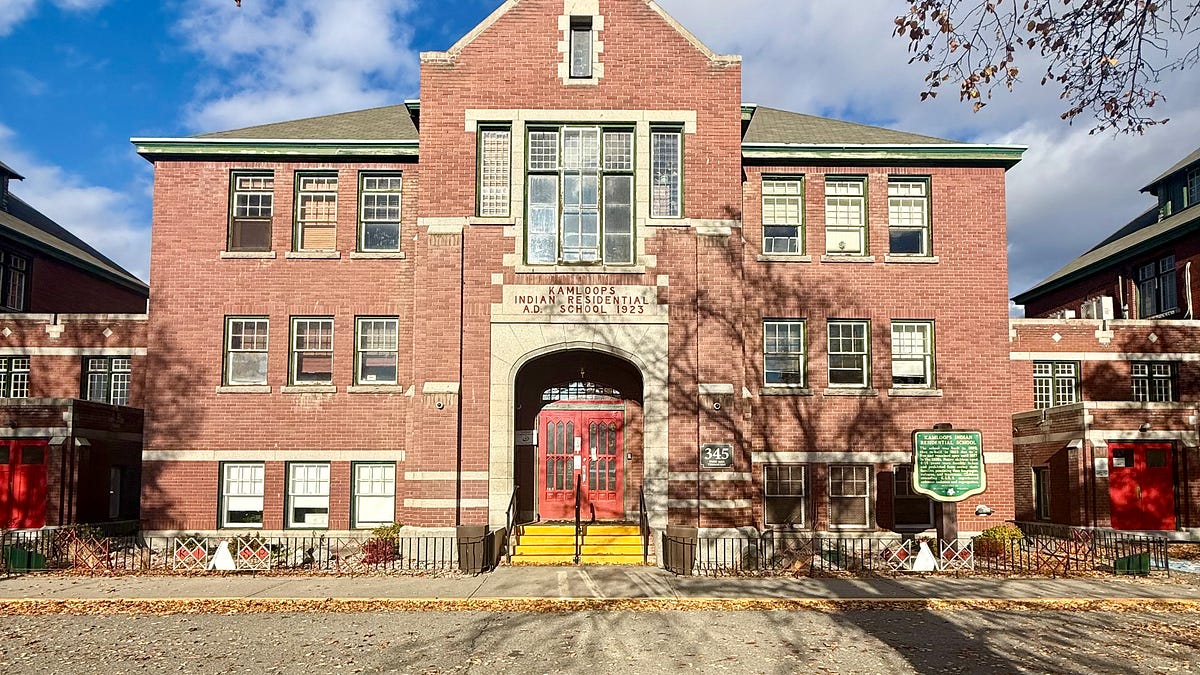
On May 27, 2021, Kukpi7 Chief Rosanne Casimir of the Tk'emlúps te Secwépemc First Nation announced preliminary ground-penetrating radar findings indicating 215 potential unmarked graves at the former Kamloops Indian Residential School. 'To our knowledge, these missing children are undocumented deaths,' she said. I remember feeling the shock of this news. It was a thunderbolt that jolted Canadians into refocusing on the issue of residential schools. For some it was a reminder of the outcome of the six years of work and testimonies gathered by theTruth and Reconciliation Commission(TRC). But more than this, the news unleashed an outpouring of grief that could no longer be silenced. The kind of grief and collective trauma that was already there but was largely ignored by Canadians.
From 2008 to 2015, over six years, the TRC gathered 6,750 statements from survivors, families, and former staff across more than 300 communities, totalling 1,355 hours of recorded testimony. The TRC's Missing Children and Unmarked Burials Project confirmed 3,200 deaths, entered on its Register of Confirmed Deaths ofNamedResidential School Students and its Register of Confirmed Deaths ofUnnamedResidential School Students. For just under a third of those deaths (32 percent), the government and schools never recorded the child's name at all. For just under a quarter (23 percent), they didn't even record the child's gender. The commission's chair, Murray Sinclair, said the number was likely only a fraction of the actual deaths at residential schools.
The devastation and loss documented in the report was real but words and numbers on paper can't adequately hold the grief associated with the atrocities. It was understandable that the news from Tk'emlúps te Secwépemc First Nation put a pin on a map as a place for the shared grief to physically land. Grand Chief Stewart Phillip reacted to the news with 'There are no words to express the deep mourning that we feel as First Nations people, and as survivors, when we hear an announcement like this. These were children, all belonging to a family and community, and a nation, who were forcibly stolen from their homes under the authority of the Canadian government, and never returned.' He also made a structural demand, saying Indigenous communities needed funded, sustained critical response teams rather than 'public platitudes and tearful apologies.'
Memorials sprung up across the country. Flags went to half mast. There were also anger-fuelled reactions as well. At least 33 Canadian churches burned to the ground between May 2021 and mid-2024, with 24 confirmed as arson by investigators and only 2 ruled accidental. Other churches were vandalized with red paint. Prime Minister Justin Trudeau denounced the vandalism and arson. He said, 'This is where hatred based on collective guilt for historic injustices leads us. Let's seek unity, respect & reconciliation instead.' A Calgary Presbyterian minister, Jake Van Pernis, whose own church was among those vandalized, declined to call it a hate crime, calling it instead 'an act of protest and grief,' and considered leaving the paint up rather than removing it.
There is another dark side that follows all of this but has its roots planted long before the news from Kamloops broke. The grief of Indigenous peoples is being weaponized against them through collective denialism and fabricated intellectual theories. It is also being monetized.
Enter Frances Widdowson. In her 2008 book with Albert Howard, 'Disrobing the Aboriginal Industry: The Deception Behind Indigenous Cultural Preservation,' she argued there's a corrupt 'Aboriginal Industry' of lawyers, scholars, and consultants profiting off Indigenous causes. She refined that argument specifically around residential schools in a 2017 conference paper, 'The Political Economy of 'Truth and Reconciliation': Neotribal Rentierism and the Creation of the Victim/Perpetrator Dichotomy,' where she argued that framing the schools as genocidal was primarily a way of 'accelerating neotribal rentierist processes,' essentially, that calling it genocide increases the 'rent' that can be extracted from the Canadian government.In early September 2020 Widdowson gave an interview to Western Standard in which she said the Black Lives Matter movement had 'destroyed MRU (her employer Mount Royal University)' and that she 'doesn't recognize the institution anymore,' and in the same interview rejected the TRC's genocide finding, arguing residential schools gave Indigenous children an education 'normally they wouldn't have received.' By September 11, 2020, a petition calling for her firing, which accused her of 'hateful actions against the BIPOC community,' had already passed 2,200 signatures, and it went on to exceed 6,000. In December 2021 MRU dismissed Widdowson from employment citing harassment and intimidation complaints from colleagues.
Then along came Dallas Brodie and Tara Armstrong, British Columbia politicians who put a retail name to what Widdowson had been promoting. They called it the reconciliation industry. Brodie produced a mocumentary named 'Making a Killing' describing Canadians as having been 'guilted by manufactured narratives' into accepting transfers of power to a 'multibillion-dollar reconciliation industry.' Brodie had previously been ejected from the BC Conservative caucus by leader John Rustad for mocking residential school survivors. Armstrong quit the party shortly after to form OneBC with Brodie where they made a joint statement that Indigenous sovereignty was a threat.
Fast forward to September 2026 where National Day for Truth and Reconciliation will be celebrated on the 30th, its fifth anniversary. On June 3, 2021, Bill C-5 received Royal Assent, fast-tracked through Parliament closely following the Kamloops news, creating the new statutory holiday, the same date as the former Orange Shirt Day. In 2013 Phyllis Webstad shared her residential school story at a commemoration event in Williams Lake, BC recalling when her orange shirt was removed from her at a residential school. Orange Shirt Day was born from that. Truth and Reconciliation Day now sees gatherings across Canada with members of Indigenous communities and allies wearing orange shirts in a visible display of recognition of the day's significance.
But something truly ugly has also reared its evil face in an attempt to further mock and deny the harms of residential schools. Behind this is tabloid rag Rebel News, its founder Ezra Levant and bureau chief Drea Humphrey. They have designed and are marketing shirts to profit off of all of this. Humphrey announced the collection on Aug. 27, with shirts reading 'Still No Proof,' 'Canada was built, not stolen,' 'Dig Deeper,' and 'You can't handle the truth,' timed, by Humphrey's own framing, 'just in time for Truth and Reconciliation Day' on Sep. 30. Reactions calling this out have been loud. Conservative MP Billy Morin, who is Indigenous, called it straightforwardly racist and profit-driven: 'I find it racist and I find it absolutely disgusting that they're attempting to make a profit off the pain and suffering of residential schools.' He also raised the double standard directly, noting that Holocaust denial is illegal hate speech in Canada, and asking, as a descendant of Jewish people himself, whether Levant considers it a double standard to promote residential school denialism.
Marc Miller, Canada's Minister of Canadian Identity and Culture, and Official Languages called Rebel out stating, 'This was never about truth or a healthy debate, but about grifting off bigoted views of Indigenous Peoples and the trauma of Residential School Survivors. Making money [off] it is a new low for Rebel News.' Levant predictably responded with a deflection. 'Our reporter who launched these t-shirts is black and indigenous,' he posted on X. 'She's an award-winning journalist who exposed the mass graves hoax. You're just furious when minorities think for themselves, instead of obeying your condescending stereotypes.' It's a tidy inversion: criticism of the shirts becomes evidence of the critics' own bias, and Humphrey's identity becomes the argument rather than the shirts' content. A denialist message doesn't stop being racially motivated because a person of colour or who is Indigenous is paid to deliver it, and 'you only object because she's a minority' doesn't answer Billy Morin's actual question about a double standard, it deflects from it.
Rebel News has since disputed a separate viral image it says was falsely attributed to its collection, calling it a hoax. Whatever the truth of that claim, it doesn't touch the shirts Rebel News itself announced and is selling: 'Still No Proof,' 'Canada Was Built, Not Stolen,' timed explicitly, in Humphrey's own words, for Truth and Reconciliation Day.'
Sean Carleton, a historian and Indigenous studies scholar at the University of Manitoba coined the term 'denialism' for this context. No one denies the existence of residential schools anymore. What they do now instead is deny the harms even though plenty of evidence exists, including survivor's own stories. The form of denialism taking places uses misrepresentation, minimization, and selective use of facts around the harm. It is posed as just asking legitimate questions. 'It didn't happen' has morphed to 'it didn't happen quite like they say,' inflating methodological nitpicks into total delegitimization, and demanding an impossible standard of proof while ignoring the volume of testimony already on record.
There is another dimension to this denialism as well. Researcher Carmen Celestini found that denialism has moved from fringe conspiracy circles into a central talking point among white Christian nationalists specifically, who frame the residential school reckoning as an attempt to 'oppress white people and make white people feel guilt,' and that it draws disproportionately from a sense of alienation among white men. Kelowna-Lake Country-Coldstream MLA Tara Armstrong put that ideology into words on the floor of the BC legislature, responding to the K'ómoks First Nation treaty by warning it promotes what she called 'UNDRIP's blood and soil theory,' and posting afterward that 'the NDP are blood and soil nationalists for the indigenous.' Blood and soil is a direct translation of Blut und Boden, the Nazi doctrine tying racial belonging to land. Armstrong took that specific term and pointed it at the people asserting a claim to their own land, an inversion that only works if the underlying anxiety is the one Celestini describes: that someone else's history and someone else's land claim are the real threat, and the settler state's authority is the neutral thing being defended. The same instinct shows up in her softer language too. She has referred to reconciliation initiatives as 'propaganda,' accused school trustees of 'indoctrination,' and characterized Indigenous history education as an 'agenda' aimed at shaming Canadians. When Central Okanagan Public Schools trustees were issuing a statement condemning Armstrong's words, one trustee appeared to agree with her instead, asking when the board would also address 'reverse racism.'
This article will undoubtedly be a magnet for denialists. They flock to the comments section like vultures with outlets like Rebel News providing the updraft. Our collective voices and allyship needs to not only be louder but more visible. We have the perfect opportunity to show up in orange on September 30th. Let's not just sit idly by for the remainder of the year either. Continue to call out the hate and anti-Indigenous racism. The commercialization of residential school denialism should never be normalized or become politically acceptable.
Share your thoughts in the comments. I'd love to hear from you.
Thanks for following along. Becoming a paid subscriber is an acknowledgement of the work that goes into research, writing and editing my articles. Commenting and sharing helps my writing reach a larger audience. I really appreciate your support.
Leave a comment
Share
A note on cookies
Newshunt uses essential cookies to keep you signed in and to remember your language and country, so the site works the way you expect. With your permission, we'd also like to use analytics cookies to understand how people use Newshunt and improve it over time.
Accepting only affects analytics. To learn more, view our Privacy Policy or Terms & Conditions.
(0)Comments