


Make It Your Own
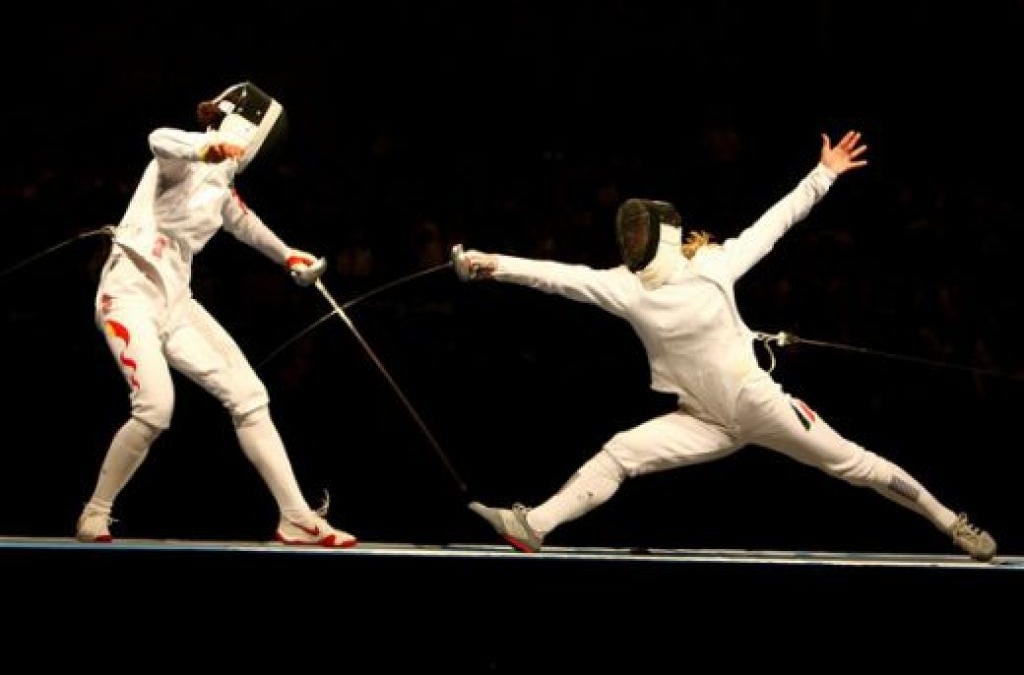
Category: Sports
Share
Archive
Like
The image you hold in your mind of a movement greatly influences its structure, and the sensations you focus on during performance are crucial in determining the movement's actual form. If you change your area of focus through what is known as the 'ideo-motor set-up', you will change the structure of the movement and modify the technique.
Ideo-motor set-up, as defined by Aladar Kogler, PhD., 'is a psychological factor that relates to movement and perfecting it.' It's one of the main elements in determining the form and structure of a movement. In his book,Yogafor Every Athlete, Kogler, a five-time Olympic fencing coach and Director of the Columbia University Sports Psychology Research Laboratory, describes an Eastern European study conducted with fencers that I think any martial artist seeking to improvewould find interesting. The following excerpt from his book describes the test:
In a study, Tishler looked at the amount of time that fencers require to complete a 'direct attack.' Fencers were timed from the beginning of their movement until the completed execution of a head cut with fleche and lunge.
Fencers were given the test of trying a number of different mental set-ups as they executed their fencing moves. At first, the fencers were all required to complete a direct attack without using any mental set-up. Next, each fencer was asked to execute the attack using one of four different mental set-ups. With each mental set-up, the action was repeated three times. The four mental set-ups included:
Focusing on the start of the movement of the fencer's front leg, making an explosive movement with the front leg.
Focusing on the start of an explosive take-off with the back leg.
Focusing on the 'synchrony' of movements of both legs.
Focusing on the speed of the movement of the arm (with weapon) - to hit the target as quickly as possible without attempting to control the movements of the legs.
The lower-level and middle-level fencers performed the fastest attacks with mental set-ups which focused on leg movement. That is, they did best with the first three mental set-ups. The technical level of these fencers required them to focus on the take-off and the factors related to the take-off. When these fencers focused on the speed of their arm movement, the take-offs were late, and errors occurred in hand-foot coordination.
The opposite was true for top-level fencers. Focusing on the take-off from the front or back leg actually decreased the effectiveness of their attacks. When these fencers focused on coordinating their leg movements, they had the same results as when they had no mental set-up at all. However, when the top-level fencers focused on the speed of their arm movements they increased the overall effectiveness and speed of their attacks. For these fencers, focusing on arm speed improved all aspects of the take-off, and increased the overall speed of the attack.
Thus, demonstrating that the advanced fencers increased their speed and effectiveness of their attacks using a different mental set-up than lower-level fencers. Presumably, this difference was due to the fact that top-level fencers had so mastered their leg movement that there was no need to think about or concentrate on the legs, just on the speed of the arm holding the weapon.
Source:Yoga For Every AthletebyAladar Kogler, PhD.
Llewellyn Publications (1995)
How does the above material relate to you as a martial artist? It boils down to this: the quality of your performance depends on the quality of your attention and intention. What you focus on when performing an action, movement, or technique can greatly affect the results. So, depending on your level of skill and experience, you may achieve better results in training by focusing your attention on a particular area of action, such as (a) footwork, (b) arm movement (strike), or (c) leg movement (kick). Try experimenting with this principle in your own training and note the results.
In a pivotal scene in the first episode of the television showLongstreet, Li Tsung, the character played by Bruce Lee, learns that Longstreet, the man he's been teaching how to fight and defend himself, is scheduled to face off against the bully who beat him up at the beginning of the show. Knowing that Longstreet is not ready, Li attempts to instill in him the proper mental attitude he will need for the fight, telling him,'To learn to die is to be liberated from it…You must free your ambitious mind and learn the art of dying.'
A lot of people tend to become perturbed when talk of death and dying comes up. While Bruce's statement may sound very negative to some, it really isn't, because the fact that it's not about death or learning how to die in the physical sense. Nor is it about having any desire to die. It's about cultivating a mindset that lets a person detach from the fear of losing their grasp on life.
When a samurai is engaged in combat, emptying their mind of thoughts of survival allows them to free themselves of the fear of death and personal injury, and thus to react naturally and spontaneously with all their capacities. By letting the self-preservation instinct go by the wayside, they're free to adapt to whatever unfolds in front of them instead of worrying about the fear of being killed perhaps or seriously hurt. If they don't, they're going to be gripped with some form of paralysis, and as a result will become a little bit apprehensive, a little too self-conscious, and a little hesitant, which can cost them their life.
'The art of dying' Lee is referring to is dying to the illusion of the ego, which is a false image of self that we've created, and something that can be a martial artist's worst enemy, as it seeks to preserve itself at all costs.
Freeing your ambitious mind relates to mentally releasing the ego. An 'ambitious mind' creates anxiety, rigidity, and overthinking. People want to learn how to win but fear losing—they want to succeed but fear failure. Releasing the ego means letting go of the fear of failure and ego so you can be completely free and present in your actions.
When a martial artist finds themselves in a combative situation, like the samurai, they must give it their all without thinking about the possibility of failure or defeat. If they're fearful or apprehensive of the possible results, they either won't take the required action or won't put everything into what they're doing. When they stop worrying about what happens if they fail, their mind clears up, and they can give it everything they've got with complete focus and determination.
How does a person go about learning the art of dying? To be perfectly honest, I couldn't tell you, because it's very individual, and what works for one person may not work for another. However, I recently read a comment in a surfing magazine by Layne Beachley, a seven-time world champion female surfer, which I think describes the attitude and approach perfectly –
'You've got to be fearless of death, but you've also got to be willing to work to lessen that risk – That means physical, mental, and emotional training – You've got to put yourself in situations that defy logic and stress you out, and then you've got to learn to relax in those situations – You can only get that through preparation and work.'
In your daily living, whether you're attempting to attain a particular goal you want, find yourself facing a tough problem or challenge, or in a difficult situation, if you allow yourself to become possessed by such things as worry, anxiety, or self-doubt, you'll lack the ability to react naturally and spontaneously with all your capacities. By detaching yourself from all results, letting go of your ego, fear, and rigid expectations -- by learning 'the art of dying,' you will be able to focus all your energies fully on the task at hand.
A note on cookies
Newshunt uses essential cookies to keep you signed in and to remember your language and country, so the site works the way you expect. With your permission, we'd also like to use analytics cookies to understand how people use Newshunt and improve it over time.
Accepting only affects analytics. To learn more, view our Privacy Policy or Terms & Conditions.
(0)Comments