


Reform councils face pressure from the top
Category: Politics
Share
Archive
Like
Senior party figures believe the performance of Reform councils will help decide whether the party enters government nationally, writes acting editor Martin George.
Reform UK councillors are feeling the pressure, but it is not just coming from where you might expect.
They will have expected robust scrutiny from opposition parties, the media and voters, but they are also feeling the heat from the very top of their own party.
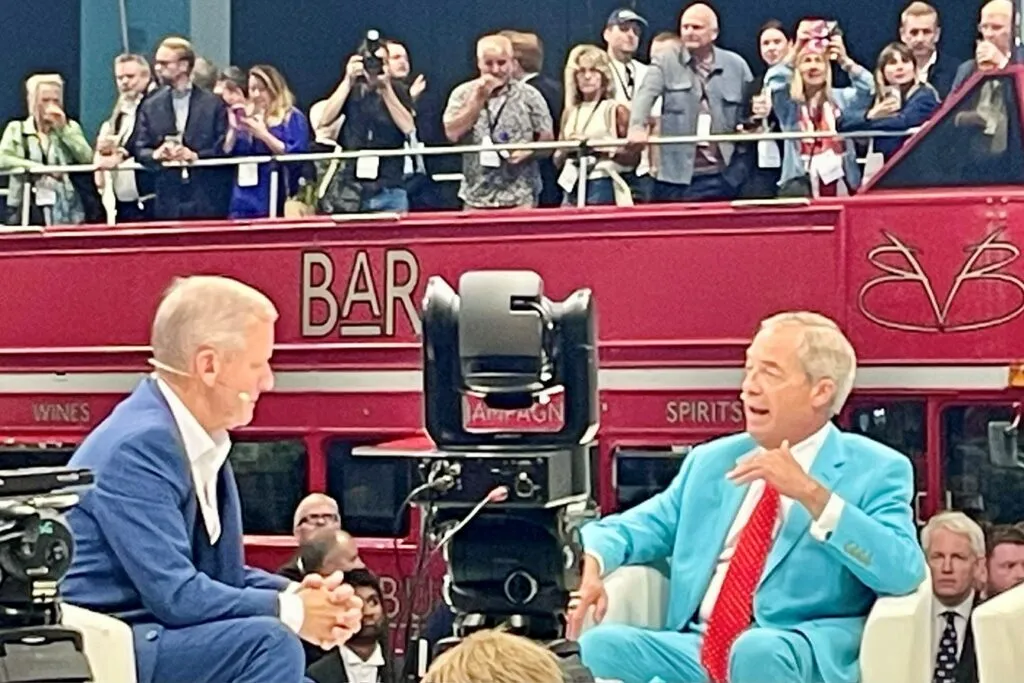
If there was a thread that ran through the local government elements of the party's annual conference in Birmingham last week, it was that the performance of Reform councils could be decisive in deciding whether Nigel Farage enters Downing Street.
They might be running local services, but the fate of a nation may rest in their hands.
Party leader Nigel Farage told his councillors they 'will shape whether we're able to genuinely change the political destiny of this country,' joking: 'If you let me down like a cheap pair of braces, we're in trouble.'
But it is not just delivery he demands, but probity too. He told them to 'do the right thing' if they find 'wrongdoing' in their groups.
For most party leaders, this would be taken for granted. It is hard to imagine Andy Burnham, Kemi Badenoch or Sir Ed Davey feeling the need to tell his council groups what to do with dodgy councillors.
The fact Mr Farage not only felt the need to say it out loud, but stress that it 'really, really, really, really, really matters,' shows just how much damage he thinks local government scandals could do to their national prospects.
The importance of local government was echoed by Sophie Stowers, research manager at polling company More in Common. She said a big barrier for many voters who are open to voting for Reform is 'concerns about professionalism and ability to govern'.
For her, 'proving yourself at a local level is going to be really crucial for voters like that'.
There is clearly close contact between Reform's local and national leadership.
The party is building what its head of local government Ben Bradley described as a 'mechanism' to link the two. Reform council leaders hold a regular Monday morning meeting, which is often attended by deputy leader Richard Tice, who talks about AI, modernisation, technology and 'pensions all the time'.
According to Kent CC leader Linden Kemkaran, the aim is to support each other in what can be a 'quite lonely' role, share information, and warn HQ 'if there's some great big horrible truck coming down the road aiming at us'.
Local government is seen as having an important role for Reform nationally in another way: teaching future ministers how to deal with the civil service.
Sean Matthews, leader of Lincolnshire CC, noted it would be 'extraordinarily hard' for a Reform government. It might only have five experienced MPs, and need another 90 to run a government. For him, the party's experience running councils will be 'absolutely vital'.
'I watch television sometimes, and I see the nonsense going on in Westminster about effectively being run by civil servants,' he told a fringe meeting. 'I look at my experience, which is they don't run me. They certainly don't run Linden. It is completely the other way round, and that's what we need to do.
'We've got the experience now. It was difficult at first. At first people were saying, 'welcome to your office. We'll leave you to sit there and enjoy life. We're going to carry on running the council the way we have done'.
'Oh no, that's not happening anymore. So that's experience of taking over control of the civil servants that we've got.'
So what are those Reform councils actually doing? For Gawain Towler, Reform UK's director of communications at the 2024 general election, they have shown a 'very pragmatic approach to governance'.
And listening to various Reform council leaders at the conference, it was striking how much of what they said was a function of the authority they run, rather than the party they represent.
Their comments about local government reorganisation, under-funded services, using AI to generate savings, and reducing pension contributions, would not have been out of place at a Labour, Tory or Lib Dem party conference.
Indeed, apart from often disputed savings attributed to decisions on net zero or diversity, it is hard to differentiate uniquely Reform savings from the type that are being implemented by administrations of all persuasions.
The concerns of local councillors and activists would also feel familiar at other party conferences: phone calls to party HQ going unanswered, leaflets pre-populated with national attack lines that don't leave space to promote local achievements, new activists being ordered to canvass voters before they are ready.
However, the biggest question for local government was what a Reform government would mean for the sector. It did not get clear answers.
The conference slogan – 'The first 100 days' – was plastered all over the venue, but the document outlining its initial pledges makes no reference to local government, devolution or councils. Privately, senior backroom figures acknowledge there are huge areas where Reform simply does not yet have any policies.
On devolution, Danny Kruger, who is leading the party's preparation for government, supported the idea of localising power, but said Andy Burnham's approach risked '1970s dysfunction on a regional scale'.
Some council leaders supported devolution as a way of 'mitigating' the fragmentation of LGR; some said devolution was centralising power away from their councils; others wanted their residents to decide whether to have a mayor.
Nigel Farage himself did not ooze positivity about the Burnham approach in his conference speech. Delegates booed when he mentioned Number 10 North, which he said 'means bigger government, more taxes, and of course, more failure'.
And it is worth noting that the mayors of Greater Lincolnshire and Hull & East Riding CAs did not have keynote speeches at the event.
Reform hopes its record in local government will help it win power in national government, but perhaps that is to overstate how much councils cut through in the public consciousness.
As Peter Walker, the Guardian's senior political correspondent, said: 'I get that point about councils working well, but my non-scientific view is that most people only notice their councils when the bins don't get collected properly.'
Perhaps being competent – even excellent – will simply not be recognised, but being associated with sleaze will.
Maybe the best thing Reform councils can do to help their party win power nationally is to take Mr Farage's advice and 'do the right thing' when they find wrongdoing.
A note on cookies
Newshunt uses essential cookies to keep you signed in and to remember your language and country, so the site works the way you expect. With your permission, we'd also like to use analytics cookies to understand how people use Newshunt and improve it over time.
Accepting only affects analytics. To learn more, view our Privacy Policy or Terms & Conditions.
(0)Comments