


Farmers urged to avoid stubble burning
Category: Financial
Share
Archive
Like
FAISALABAD:
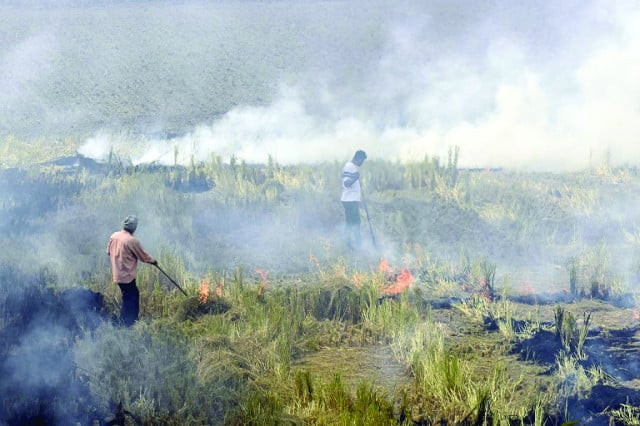
Rice growers have been urged to avoid burning crop residues after harvesting, as the practice contributes to smog and air pollution while reducing soil fertility and agricultural productivity.
A spokesman for the Agriculture (Extension) Department said on Sunday that farmers should follow official guidelines for the safe and environment-friendly disposal of rice stubble to help prevent smog.
He said burning crop residue destroyed organic matter in the upper soil layer, reducing fertility and affecting long-term agricultural productivity.
Under the Chief Minister Punjab's Smog Control Programme, the provincial government has provided 10,000 super seeders to farmers this year at a 60 per cent subsidy, involving an expenditure of Rs5.5 billion, he added.
The initiative aims to promote modern agricultural machinery to convert crop residues into useful material instead of burning them in fields.
The spokesman advised farmers to incorporate post-harvest stubble into the soil to improve its fertility. Farmers harvesting crops manually could use rotavators, while those using harvesting machinery could employ disc harrows to mix leftover residues into the land.
He further recommended deep ploughing, broadcasting half a bag of urea per acre and irrigating fields to accelerate the decomposition of crop residues and improve soil productivity.
He urged rice growers to prioritise super seeders for wheat cultivation after the rice harvest, saying the machinery offered an effective solution for managing crop residues while preparing fields for the next crop.
He warned that burning rice stubble and straw was a punishable offence with legal action, including fines and arrests, being taken against violators.
The spokesman urged farmers to adopt environment-friendly residue management practices and cooperate with the government in curbing smog, protecting soil health and promoting sustainable agriculture.
A note on cookies
Newshunt uses essential cookies to keep you signed in and to remember your language and country, so the site works the way you expect. With your permission, we'd also like to use analytics cookies to understand how people use Newshunt and improve it over time.
Accepting only affects analytics. To learn more, view our Privacy Policy or Terms & Conditions.
(0)Comments